Shaun K. Thomas
Deputy Director (Retd), Department of Agriculture
E-mail: mathaigk@gmail.com
The widespread decrease seen this year in pepper vines is closely linked to the summer heat. As the summer heat intensifies, pepper vines require special care.
For pepper vines growing on support trees, the partial shade provided by these trees is a great blessing. Without the shade of support trees, the pepper vines are directly exposed to the sun.
This causes the leaves to turn yellow and fall, the shoots to dry up, and eventually, the vine itself dies. As the summer progresses, this problem becomes more severe. The yield from such vines will be significantly lower.
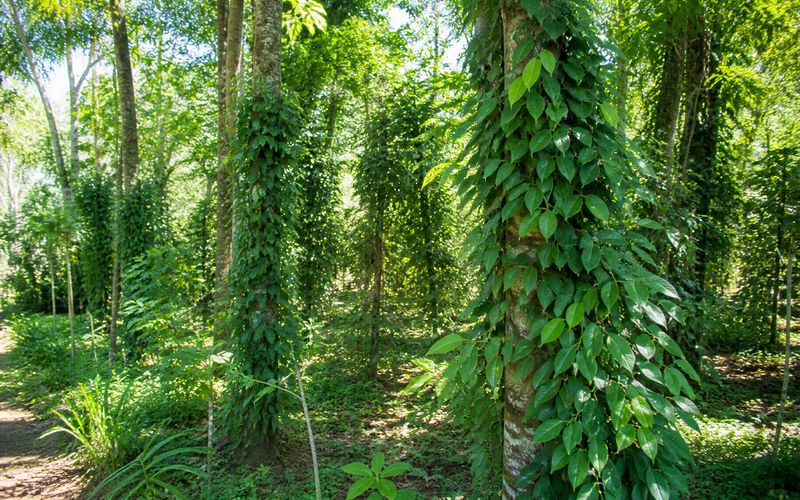
Partial shade from support trees can reduce direct summer sun exposure on black pepper vines.
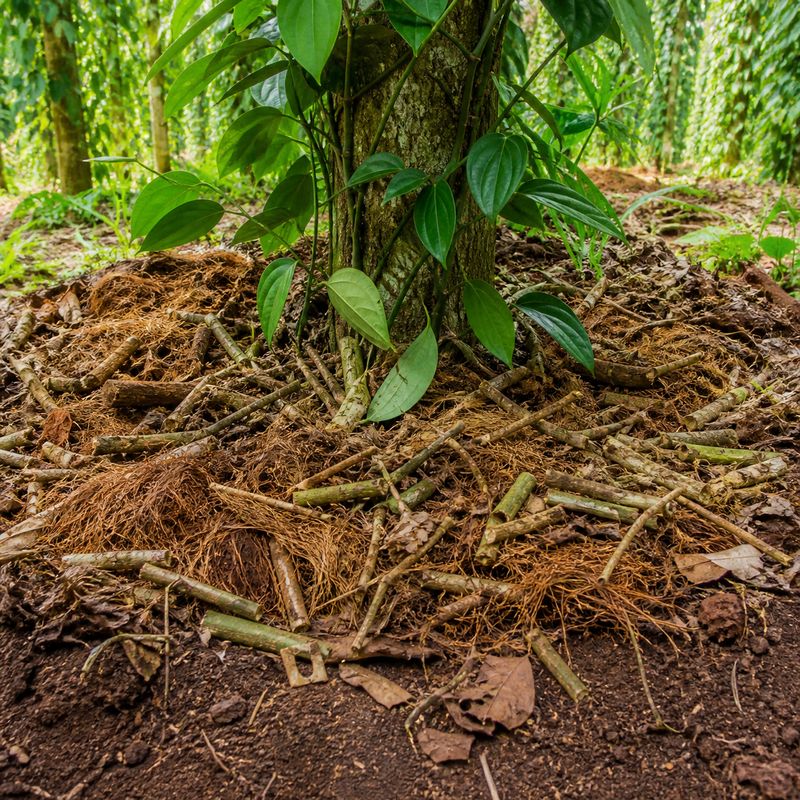
For this, the branches of the support trees, such as Murikku (Erythrina), should be pruned 14 days before the onset of the southwest monsoon (Edavappathi).
The pruned leaves and small branches should be used to mulch the base of the pepper vines. This will help retain moisture in the soil. There are about 20 different types of support trees.
Farming tip: Mulching with leaves, coir pith, and small branches is especially useful during hot months because it helps keep moisture around the root zone.
Rambutan, Pulasan
These fruit trees are excellent support trees for pepper vines. They provide good shade. Pruning the branches should be done carefully. Provide them with sufficient moisture.
To prevent the leaves from falling, apply a mixture of coir pith compost and cow dung at the base. Mix 3 kg of coir pith compost and cow dung in one liter of water and apply it at the base.
Also, spray 4 grams of Sulphate of Potash (SOP) per liter of water on the leaves. Additionally, spraying 2 grams of pseudomonas per liter of water is beneficial. These mixtures can also be applied at the base.
Mangosteen
Mangosteen is a good support tree. Pruning is not required for it. Applying cow dung slurry at the base is beneficial.
To prevent the leaves from falling, spray 4 grams of pseudomonas in one liter of water every 3-4 days. Also, apply 2-3 grams of VAM mixed with cow dung. Mulching the base of the plant to a thickness of 20 cm is good.
Taro
By cultivating taro, it will provide shade. It will prevent direct sunlight from hitting the ground.
Nutmeg
To prevent the nutmeg from drying out due to intense sunlight, spray 5 grams of SOP per liter of water on the leaves every 10 days.
Also, to prevent sun scorching on the trunk, apply a mixture of 1 part lime and 3 parts water to the base of the tree.
Orchid/Anthurium
From December 11th to May 3rd, these can be grown on the support trees. Ensure sufficient moisture.
To make the leaves flourish, spray 3 grams of pseudomonas per liter of water. Vermicompost is also beneficial. They can be grown by placing them in pots hung on the branches of the support trees.
Coconut
Provide sufficient moisture. To retain moisture, dig small trenches 30 cm away from the trunk.
To control red palm weevils, mix 2 grams of EPN (Entomopathogenic nematodes) in one liter of water and drench the crown. Applying 250 grams of neem cake at the base is also good. Also, placing neem leaves in the crown for 4 weeks will help.
To protect from the summer heat, mulching is essential for all crops. Leaves, coir pith, etc., can be used for mulching.
It is better to avoid chemical fertilizers during this period. PGPR mixes and organic fertilizers can be used. There are many such products available in the market.
When spraying on the leaves, add a Non-Ionic adjuvant. 4 ml of it can be mixed in one liter of water. It is good for foliar spraying.
To control pests, especially mealybugs, spray 5 ml of Verticillium lecanii per liter of water. It is better to spray this in the evening.
Spraying a mixture of 4 ml of fish amino acid and jaggery solution is beneficial for all crops.
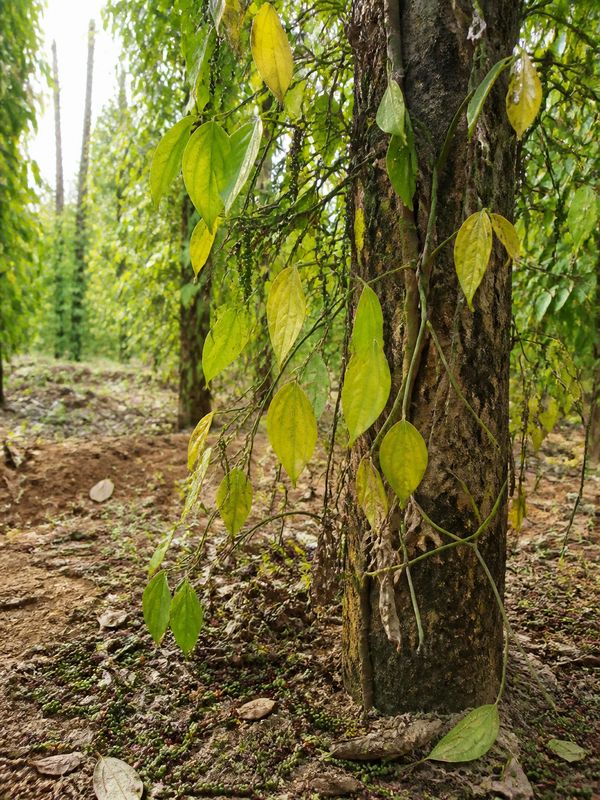
Pepper berries, known as karimkodi, that have fallen due to sun heat. Processing these will yield low-quality white pepper.
Pepper vines are highly susceptible to damage from summer heat. Young vines in their first and second years are particularly vulnerable. Sun scorching, yellowing and shedding of leaves, and wilting are the main symptoms.
- ✅ To protect young vines, provide artificial shade using coconut fronds, areca nut fronds, or other leaves.
- ✅ Mulching the base is essential. Coir pith compost, well-decomposed cow dung, and leaves can be used for this.
- ✅ Irrigate once every 3-4 days.
- ✅ Root rot, also known as quick wilt (Dhruthavaattam), is a major disease. It is caused by the fungus Phytophthora. This fungus can remain in the soil.
Trichoderma-enriched cow dung and pseudomonas can be used for control. Applying neem cake is also beneficial. For established vines, apply a mixture of Trichoderma and neem cake at the base. It is best to plant pepper vines on support trees that are at least 3 years old.
For planting pepper, dig pits and fill them with a mixture of topsoil, cow dung, and neem cake. Plant 4-6 rooted cuttings around each support tree.
At the onset of the monsoon, the support trees should be pruned.
For better growth of the vines, foliar spray a mixture of 20-30 grams of 19:19:19 and 10-15 ml of a micronutrient mix in 10 liters of water every 30 days. Also, spray 2 grams of pseudomonas per liter on the leaves.
To control scale insects and mealybugs, spray 5 ml of Verticillium lecanii per liter of water. Mealybugs are more commonly found on support trees like Murikku (Erythrina) and Seemakonna (Gliricidia).
Spraying a mixture of neem oil, garlic, and soap emulsion (2 ml per liter) is also effective.
For better growth, spray a mixture of 4 ml of fish amino acid and jaggery. Applying lime, dolomite, or ash to the soil is also beneficial.
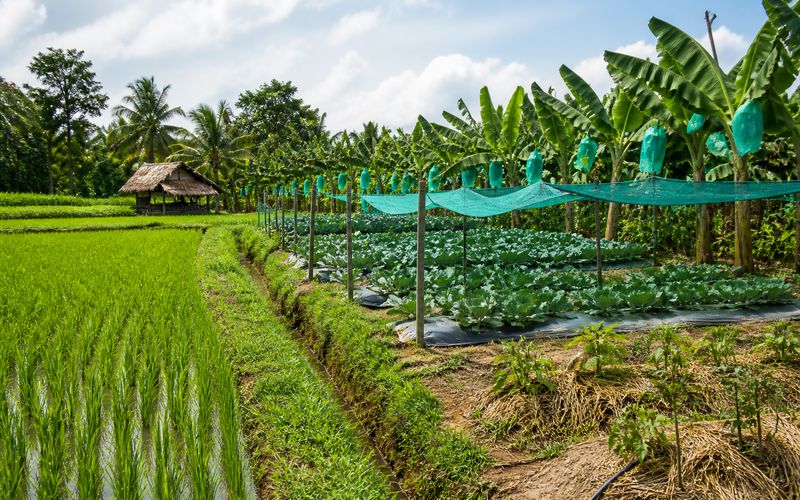
Paddy
Paddy fields are getting damaged by drying up. The leaves turn yellow and wither. Maintain the soil pH. For this, apply lime or dolomite. Ensure a thin layer of water is maintained.
Control stem borer insects. To do this, apply 20 grams of cartap hydrochloride granules mixed with sand in the field. Also, spray 1 ml of flubendiamide per liter of water. In summer, leaf folder insects are common. To control them, cut the tips of the leaves and destroy them.
Vegetables
Mulching is good for vegetables. Planting cowpea is also a solution. Cowpea provides shade and also fixes nitrogen. Covering vegetables with nets to protect them from sunlight is also practiced.
Banana
The leaves will dry up. The dried banana leaves themselves can be used for mulching the base. The bunches should be covered to protect them from sun heat.
For growth, spray 2 grams of a multi-nutrient mix (sampoorna) per liter of water. To control the banana weevil, apply 50 grams of neem cake at the base. Also, inject a solution prepared by mixing 2 ml of imidacloprid in 40 ml of water into the stem in the 5th month of growth. This should not be applied to the Nendran variety.
Why are black pepper vines turning yellow and drying in summer?
Black pepper vines can turn yellow, shed leaves, dry at the shoots, and wilt when exposed directly to intense summer sun. Vines without adequate support tree shade are especially affected. As heat increases, moisture stress becomes more severe, reducing vine health and eventually lowering yield.
Which support trees are good for pepper vines during hot weather?
Rambutan, Pulasan, Mangosteen, Murikku (Erythrina), and other support trees can help pepper vines by providing partial shade. The article notes that there are about 20 different types of support trees. Good support trees reduce direct sunlight, conserve moisture, and protect the vine canopy.
When should support trees for black pepper be pruned?
Support trees such as Murikku should be pruned 14 days before the onset of the southwest monsoon, known as Edavappathi. The pruned leaves and small branches should not be wasted; they can be placed around the pepper vine base as mulch to help retain soil moisture.
How often should young pepper vines be irrigated in summer?
Young black pepper vines, especially those in the first and second years, are highly vulnerable to summer heat. Irrigation once every 3-4 days is recommended in the article, along with artificial shade using coconut fronds, areca nut fronds, or other leaves and proper mulching at the base.
How can quick wilt or root rot in pepper be managed?
Quick wilt, also called Dhruthavaattam, is caused by the fungus Phytophthora, which can remain in the soil. The article recommends Trichoderma-enriched cow dung and pseudomonas for control. Neem cake is also beneficial, and established vines can receive a mixture of Trichoderma and neem cake at the base.
What can be sprayed for mealybugs on pepper and support trees?
For pest control, especially mealybugs, the article recommends spraying 5 ml of Verticillium lecanii per liter of water, preferably in the evening. A neem oil, garlic, and soap emulsion at 2 ml per liter is also noted as effective, especially where mealybugs occur on Murikku and Seemakonna support trees.
Why is mulching important for all crops in summer?
Mulching protects crops from summer heat by conserving moisture around the root zone and reducing direct sun impact on the soil. Leaves, coir pith, pruned branches, dried banana leaves, and other organic materials can be used. The article stresses that mulching is essential for all crops during hot months.









You may also like