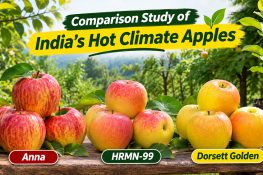
For decades, Indian apples meant cold Himalayan orchards in Jammu & Kashmir, Himachal Pradesh and Uttarakhand. Today, growers in the plains, lower hills and even South India are asking a practical question: which apple tree for hot climate conditions will actually flower, set fruit and deliver acceptable quality? Three names dominate that conversation: HRMN-99, Anna and Dorsett Golden. This guide compares these hot climate apple varieties in India using published evaluation data, so you can match a variety to your site rather than to marketing claims.
Apples are temperate trees. In winter they go dormant and need a period of cold, counted as chilling hours (generally hours below about 7°C), before buds break evenly. Most conventional commercial cultivars need roughly 1,000 to 1,500 chilling hours, which is why traditional orchards sit at about 5,000 to 8,500 feet above sea level. Without enough chill, flowering becomes irregular, fruit set declines and quality suffers.
A low chilling apple variety completes this cycle with far less cold. Internationally developed cultivars such as Anna, Dorsett Golden, Tropic Sweet and Ein Shemer were bred for mild winters, and many were introduced into India for evaluation from the early 1990s by institutions such as Dr YS Parmar University of Horticulture and Forestry.
Large parts of India never accumulate meaningful winter chill, while rising temperatures and shifting snowlines are pushing traditional orchards higher. An apple variety for hot climate conditions therefore serves farmers in non-traditional regions seeking diversification, and home gardeners wanting a summer apple plant they can genuinely harvest. Early-season fruit can also reach markets when hill apples are scarce.
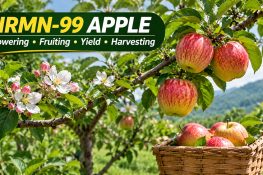
Between 2014 and 2019, National Innovation Foundation (NIF) multi-location trials placed over 20,000 HRMN-99 saplings across about 30 states, with fruit set reported from 23 states and Union Territories, including Kerala, Karnataka, Telangana, Andhra Pradesh and Puducherry.
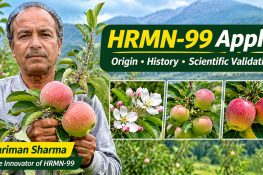
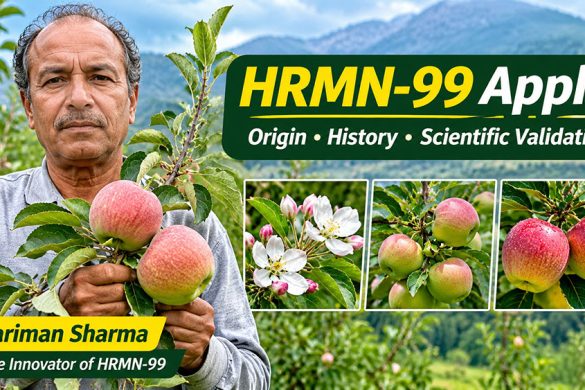
The HRMN 99 apple variety began as a chance seedling noticed in 1999 in Paniala, Bilaspur (Himachal Pradesh), a village around 1,800 feet above sea level where summers reach 40 to 45°C. Padma Shri awardee Dr Hariman Sharma multiplied it through grafting, and NIF later supported its evaluation and registration under the PPV&FR Act.
Minimal chilling
The TAAS publication states HRMN-99 needs very little or almost no chilling, while Anna and Dorsett Golden need about 100 hours.
Self-pollinating
A single tree can set fruit without a pollinator cultivar, ideal for small plots.
Market appeal
Striped red-over-yellow skin, soft juicy pulp and TSS of about 11.5 to 15.5°Brix in IARI and ICAR-NEH tests.
Early harvest
Matures in early to mid-June, ahead of most hill apples.
Limitations to weigh: shelf life is short (about 8 to 12 days at room temperature), fruiting usually starts around the third year, yields in 3 to 8-year-old trees ranged widely from about 5 to 100 kg per plant, and results depend heavily on soil management, pruning and irrigation.
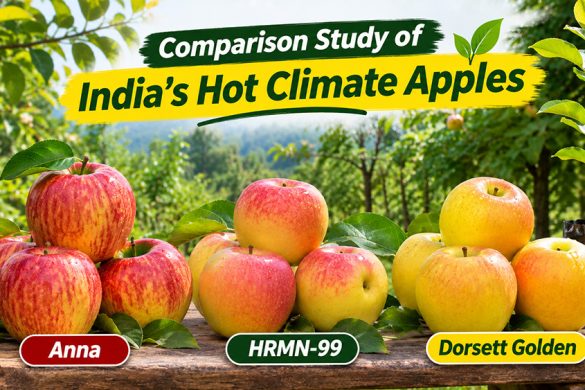
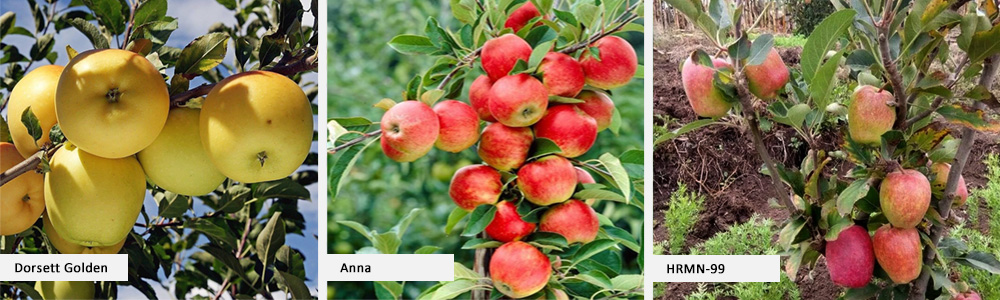
The Anna apple variety is one of the best-known low-chill cultivars worldwide. Its yellow skin carries a red blush, and the flesh is crisp, juicy and sweet-tart. In the NIF morphological study, Anna recorded the highest average fruit weight (136 g), slightly above HRMN-99 (129.4 g). SSR DNA fingerprinting placed Anna and HRMN-99 in the same cluster, showing a genetic relationship while confirming HRMN-99 remains distinct.
Anna also has an important orchard role: it is the recommended pollinator for Dorsett Golden, making it valuable in mixed plantings.
The Dorsett Golden apple has yellow skin with a slight red tinge and a sweet-sour to tart flavour. Its fruits were comparatively small in the NIF study (about 67.6 g, width 5.06 cm). According to TAAS, it requires cross-pollination, with Anna as the pollinator. On the positive side, it produced the most fruits per plant and showed stronger tree morphology in the North-western plains trial. Genetically, it formed a separate cluster from HRMN-99 and Anna.
| Trait | HRMN-99 | Anna | Dorsett Golden |
|---|---|---|---|
| Chilling need | Very little or almost none (TAAS) | About 100 hours | About 100 hours |
| Pollination | Self-pollinating | Used as pollinator for Dorsett Golden | Needs Anna for cross-pollination |
| Fruit colour | Striped red over yellow | Yellow with red blush | Yellow with slight red |
| Taste / texture | Soft, sweet, juicy | Crisp, juicy, sweet-tart | Sweet-sour to tart |
| Size (NIF study) | 129.4 g; larger than Dorsett Golden | 136 g | 67.6 g; smallest |
| Maturity | Early to mid-June | Early season; varies by site | Early season; varies by site |
| Suitability | Single-tree gardens, warm plains and lower hills | Crisp-fruit preference, mixed orchards | Productive orchards paired with Anna |
| Notes | Short shelf life; buy genuine grafts | Genetically close to HRMN-99 | Highest fruit count in Kumar et al. 2023 |
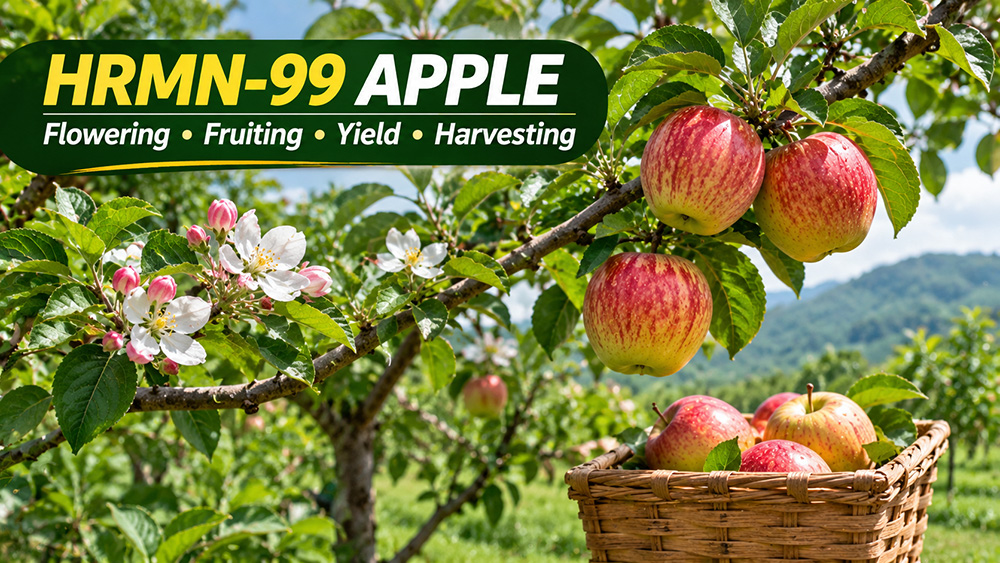
Kumar et al. (2023) compared the three cultivars in the North-western plains of Uttar Pradesh across 2019-20 and 2020-21. Flowering began in mid-February, with full bloom in late February to early March, and the overlapping windows support mixed planting.
Fruits per plant (pooled)
Dorsett Golden 190.25, Anna 176.62, HRMN-99 120.75.
Fruit weight (pooled)
72.37 to 76.62 g across all three; differences were non-significant.
Branches per plant
HRMN-99 28.5, versus about 11.5 for the other two.
Study conclusion
Dorsett Golden was more productive; Anna and HRMN-99 had better marketable fruit traits.
Fruit weights here were lower than in other HRMN-99 evaluations (150 to 178 g at IARI Shimla and ICAR-NEH Manipur), showing how strongly tree age, location and management influence outcomes. Claims of HRMN-99 superiority from NIF and GSBTM studies relate mainly to distinctiveness and fruit quality, not to every productivity measure.
Balanced view: The best variety depends on local climate, management and planting goal. No single low-chill apple wins on every trait, so treat published results as guidance and trial on your own site.
One tree, small space
HRMN-99, because it is self-pollinating and low-chill.
Crisp eating apples
Anna, for its crisp sweet-tart bite.
Maximum fruit numbers
Dorsett Golden planted alongside Anna.
Mixed orchard
All three together; TAAS notes this can enhance pollination and fruit numbers.
Gardeners in Kerala and other southern states often start with an all weather apple plant such as HRMN-99, then add Anna once the first tree establishes. Choose a sunny, well-drained site and consult your nearest Krishi Vigyan Kendra.
Apple seeds do not reproduce the parent variety, so the qualities of HRMN-99 survive only through grafting, traditionally on crab apple seedling rootstock. The TAAS publication warns that fake HRMN-99 plants are being sold, and recommends buying from accountable sellers with a proper bill.
- ✅ Grafted plants fruit earlier and stay true to type.
- ✅ A mature graft union handles transit and transplanting better.
- ✅ Authentic stock protects your time, space and investment.
Greens of Kerala supplies grafted HRMN-99 plants around six months post-grafting, shipped in sturdy wooden boxes for safer delivery.
HRMN-99, Anna and Dorsett Golden each earn a place among hot climate apple varieties in India. HRMN-99 stands out for minimal chilling and self-pollination, Anna for crisp fruit and pollination support, and Dorsett Golden for fruit numbers when paired correctly. If the HRMN 99 apple plant hot climate variety suits your goals.
Which apple variety is best for hot climate in India?
There is no single winner. HRMN-99 is popular because TAAS data describe it as needing very little or almost no chilling and being self-pollinating, which simplifies planting. Anna offers crisp, sweet-tart fruit, while Dorsett Golden recorded the highest fruit numbers in a North-western plains trial. Your local climate, soil, irrigation and care routine ultimately decide which performs best.
Is HRMN-99 better than Anna Apple?
It depends on your goal. HRMN-99 is reported to need less chilling than Anna and sets fruit without a pollinator. Anna produces crisper, sweet-tart fruit and, in one morphological study, slightly heavier apples (136 g versus 129.4 g). In the Kumar et al. 2023 trial, both showed better marketable fruit traits than Dorsett Golden, so neither is universally superior.
Does HRMN-99 Apple need a pollinator?
No. Evaluation data summarised by TAAS and NIF describe HRMN-99 as self-pollinating, meaning a single tree can set fruit without a partner variety. This makes it convenient for terraces, home gardens and small plots. However, research notes that growing low-chill varieties together may improve pollination and fruit numbers, so adding Anna can still be worthwhile in larger plantings.
Can Anna and Dorsett Golden be planted with HRMN-99?
Yes. The TAAS publication notes that HRMN-99, Anna and Dorsett Golden perform in low-chill areas and can be cultivated together for better pollination and higher fruit numbers. Dorsett Golden specifically needs Anna for cross-pollination, so include Anna whenever you plant it. Their flowering overlapped in February and March in the North-western plains trial, supporting mixed planting.
Which low-chill apple variety is suitable for South India?
HRMN-99 has reported fruit set in Kerala, Karnataka, Telangana, Andhra Pradesh and Puducherry during NIF multi-location trials, making it a common starting choice for South Indian growers. Results still vary with altitude, rainfall, soil drainage and pruning. Choose a sunny, well-drained site, use genuine grafted plants and seek advice from your local Krishi Vigyan Kendra before planting widely.
Can I grow hot climate apple varieties from seeds?
Seeds are not recommended. Apple seedlings do not reproduce the parent variety, usually take five to six years or longer to fruit, and may need far more chilling. HRMN-99 itself began as a rare chance seedling, but its qualities are preserved only through grafting. For predictable fruiting and true-to-type apples, buy grafted plants from a reliable nursery.
Where can I buy HRMN-99 Apple Plant online in India?
You can order a grafted HRMN-99 Apple Plant from Greens of Kerala through the HRMN-99 product page. Plants are supplied about six months after grafting and packed in sturdy wooden boxes for safer transit across India. For availability or bulk orders, call +91 9746999125 and review the shipping policy before ordering.
Does Greens of Kerala sell grafted HRMN-99 Apple Plant?
Yes. Greens of Kerala sells grafted HRMN-99 Apple Plants that are around six months post-grafting, giving a stronger graft union before dispatch. Each order ships in a protective wooden box to reduce transit damage. Visit the product page for pricing, call +91 9746999125 for guidance, and read the shipping policy for delivery details.