✍️ Staff Reporter
Many people start farming to reduce tension. What if farming itself becomes a source of tension? “No need to be tense, modern technologies that make farming effortless are available today,” says Harikrishnan, the founder of Yuvabiya, a startup based in Kozhikode.
Harikrishnan, who got his B.Tech from IHRD Engineering College, Chengannur, founded the startup company Yuvabiya in Pathanamthitta. Yuvabiya operates with the support of the Startup Mission and financial assistance from the Central Government.
This young agricultural entrepreneur, who participated in the Agri Hackathon organized by the Agriculture Department for farmers and agricultural entrepreneurs, is in the process of releasing what he saw there in a manner suitable for our conditions. There are many commercial farms in Israel that are controlled by IoT (Internet of Things), which combines modern technologies including artificial intelligence, says Harikrishnan.
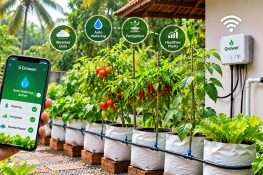
Farming has also advanced. Pictured are the Ramadevi-Satheesh Kumar couple at home. Ramani from Kakodi is seen near the Grower system that helps with the new farming method.
At the house of Ramadevi, a retired Joint Director of the Agriculture Department, ancillary facilities like rainwater harvesting and well recharging have also been arranged.
In the state, there are predominantly two types of farmers. The first are those who have the time and circumstances to produce vegetables and fruits only for household needs. The second are small-scale farmers with only one or one and a half acres of farmland.
Those who have the time and circumstances to produce vegetables and fruits only for household needs.
Small-scale farmers with only one or one and a half acres of farmland.
Harikrishnan says that the aim of his startup is to make farming easier for both these groups with the help of technology. The main problem faced by kitchen gardeners who wish to grow poison-free vegetables for their household needs is consistent watering.
Although watering is possible by setting a timer, it will not be according to the weather or the needs of the crop. The Grower, an IoT system developed by Harikrishnan, is a solution to this problem.
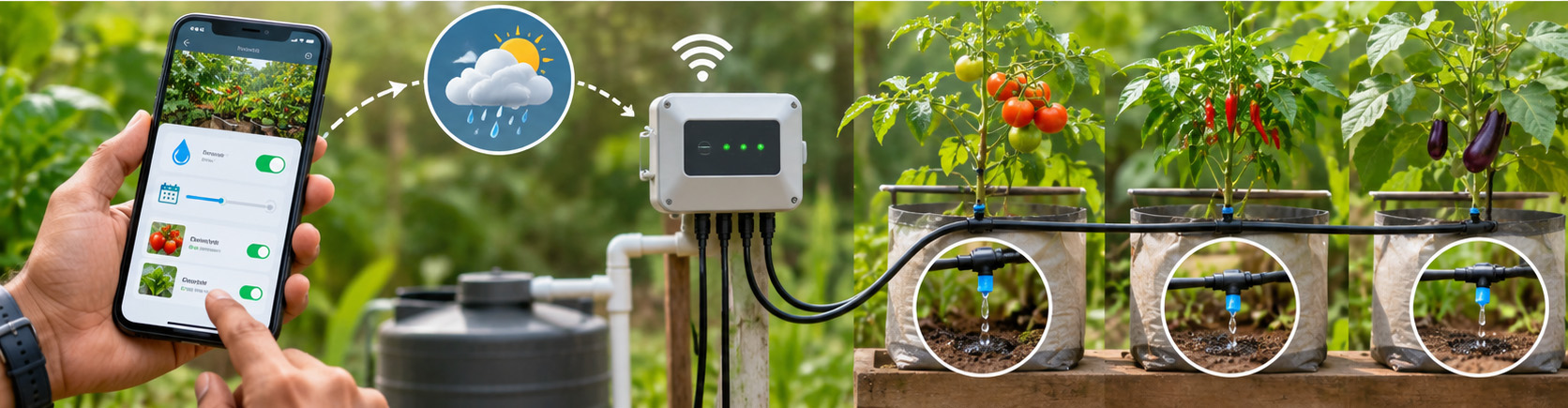
The Grower works by connecting to a mobile application via Wi-Fi. The plants in the kitchen garden, which is farmed under the control of the Grower, will be watered according to the weather report provided by Google.
✅ That is, if the heat is less on a particular day, the Grower will automatically readjust the amount of water.
✅ The Grower can determine the watering in this manner every day.
The amount of water required for each plant will be different. Harikrishnan says the Grower is capable of making autonomous decisions in this way for each plant in the kitchen garden.
The fertigation method, which provides fertilizer along with water, can also be included in this system. But in a kitchen garden, only the watering needs to be self-controlled, in Hari’s opinion.
The concern for most people is that plants will die from lack of watering on days they are away from home. Harikrishnan says that many who started kitchen gardens with enthusiasm later backed out because of interruptions in watering.
When kitchen garden farming gained huge popularity in the state, the Niravu Residents’ Association in Vengeri, Kozhikode, was presented as an excellent model for it.
Harikrishnan’s family is one that farms excellently as part of this collective. Niravu later grew into a farmer’s company.
As part of a project sanctioned for Niravu by NABARD, Grower units were installed and kitchen gardens were created in 15 houses in Vengeri. Currently, these houses have been provided with watering systems that are linked to a mobile application and function according to the weather.
15 houses in Vengeri received Grower units and kitchen gardens.
Watering systems are linked to a mobile application and function according to the weather.
The cost for one house under the Vengeri project was ₹22,500.
After deducting the subsidy provided by NABARD, homeowners only had to spend ₹5,000.
Harikrishnan says that by updating this Grower, the entire maintenance, including the application of fertilizer, can be brought under self-control. But it will be expensive.
The cost for one house under the Vengeri project, including 15 pots, plants, potting mix, watering system, control unit, and service, was ₹22,500. However, after deducting the subsidy provided by NABARD, the homeowners only had to spend ₹5,000.
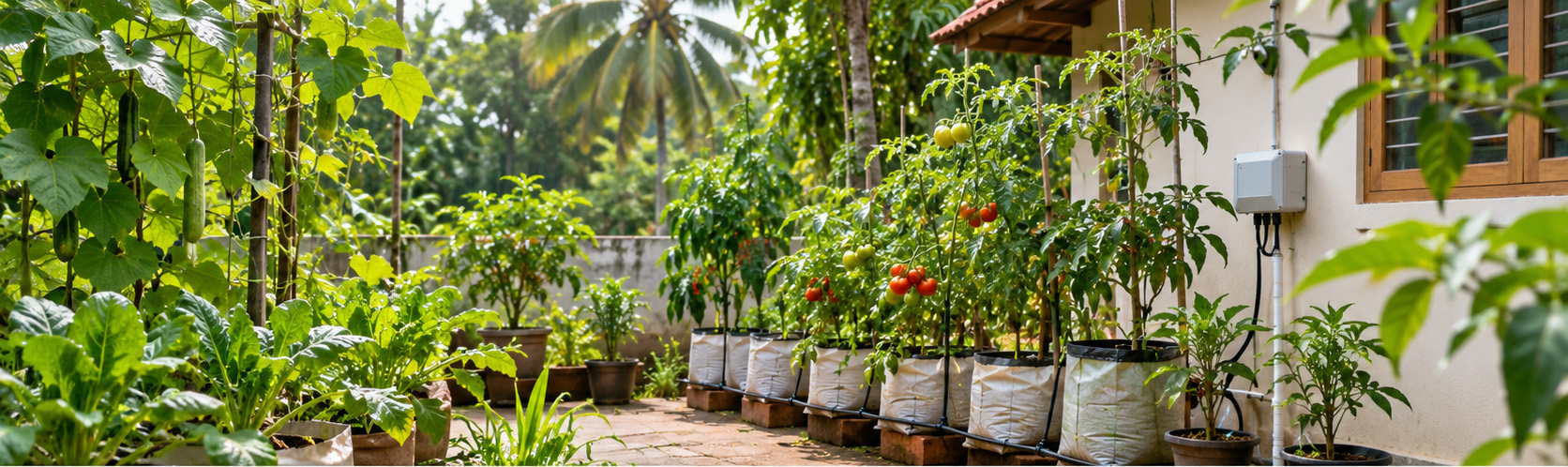
Kitchen gardens in Vengeri where watering is done using the Grower system.
- 1. Parakkunnummal Shaukkath and his wife.
- 2. Thazheppadath Suseela.
📞 8075363182