Research article: “Effect of different substrates on growth performance of King oyster mushroom (Pleurotus eryngii)” by Bhosale SS, Karande RA, Deshmukh DP, Waghmare SJ, Lajurkar MR and Sathe SN.
The study, published in the International Journal of Advanced Biochemistry Research in 2025, tested how seven common agricultural wastes perform as growing substrates for King oyster mushroom, also known as Kabul Dhingri, King Trumpet Mushroom, French Horn Mushroom, King Brown Mushroom and Trumpet Royale.
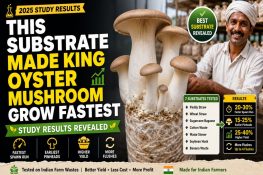
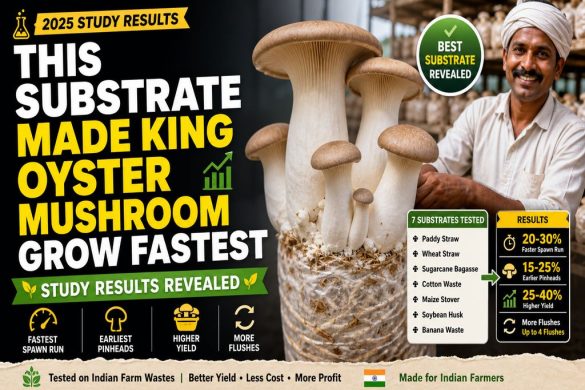
In simple farming terms, the researchers found that paddy straw was the best performer. It gave the shortest spawn run duration at 18.33 days, fastest pinhead formation at 27.67 days and earliest first harvest at 32.67 days. Groundnut shells were the slowest, taking 25.33 days for spawn run, 37.67 days for pinhead formation and 48.33 days for first harvest.
Mushrooms are macro fungi with distinct fruiting bodies that are large enough to be seen by the naked eye and picked by hand, as described by Chang and Miles in 1992. They grow on organic substrates and produce fleshy, spore-bearing structures.
Edible mushrooms are important as human food because of their nutritional and medicinal properties. They are nutrient-dense, with protein, essential minerals such as zinc, calcium, iron, magnesium, manganese and phosphorus, and vitamins including B, C and D. They also contain bioactive compounds such as phenolic compounds while remaining relatively low in fat.
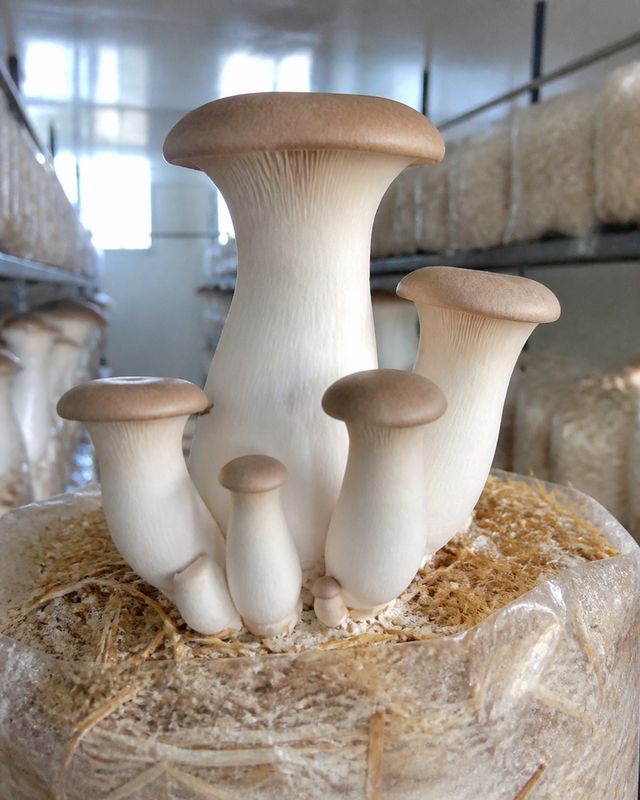
Pleurotus eryngii, the King oyster mushroom, is an edible, basidiomycetous and saprophytic fungus in the oyster mushroom family. It is native to Mediterranean regions of Europe, the Middle East and North Africa, with natural distribution from the Atlantic Ocean through the Mediterranean Basin and Central Europe to Western Asia and India. It is valued for its firm cap and stem, culinary quality and longer shelf life compared with other oyster mushroom species.
For India, the study is especially practical because agriculture produces large volumes of crop residues after harvest. Converting paddy straw, wheat straw, soybean straw and similar farm waste into mushroom crops is a green way to recycle residues while producing protein-rich food.
Journal:
IJABR 2025; 9(1): 178-181
Institution:
Plant Pathology Section, RCSM College of Agriculture, Kolhapur, Maharashtra, India
Timeline:
Received 08-10-2024; Accepted 13-11-2024
✅ Core objective: The investigation was undertaken to find out the effect of different cultivation substrates on the growth performance of King oyster mushroom.
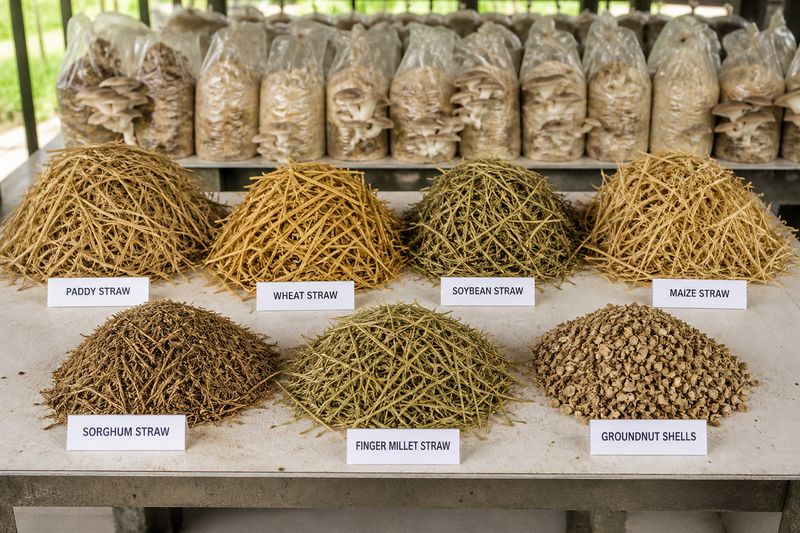
The researchers tested readily available agricultural residues that can support mushroom production and reduce crop-waste pollution.
- 🌾 Paddy straw
- 🌾 Wheat straw
- 🌱 Soybean straw
- 🌿 Finger millet straw
- 🥜 Groundnut shells
- 🌾 Sorghum straw
- 🌽 Maize straw
Pure culture: The pure culture of Pleurotus eryngii was obtained from the Directorate of Mushroom Research, Chambaghat, Solan, and maintained on malt extract agar medium.
Spawn preparation: Wheat grains were cooked so starch did not come out. Then 4% calcium carbonate and 2% gypsum, based on boiled grain weight, were mixed. The grains were packed in polypropylene bags and sterilized at 121 °C for 30 minutes.
Incubation: After inoculation with pure mycelial culture, bags were incubated at 28±2 °C for 7-10 days until the mycelium fully covered the wheat grains.
Substrate preparation: Crop straws were chopped into 3-5 cm pieces, soaked in fresh water for 12-18 hours, drained, and autoclaved for 1 hour at 15 lbs pressure.
Polyethylene bags of 14×18 inches and 100 gauge thickness were sterilized by dipping in 2% formalin. Spawning was done by multilayering at 2 percent of wet weight basis of substrate. Each bag was filled up to 90 percent capacity, and about 20-25 minute holes were made all around the filled bags using a sterilized needle.
Each agro-waste bag contained 3 kg material for individual treatment. After spawning, the bags were incubated in the dark at 28 °C. After spawn run, casing was done using coco pit, vermicompost and soil in suitable proportion. During fruiting, cropping room temperature was maintained between 16 to 18 °C, and humidity was maintained at 85 to 90 percent by frequent water sprays on walls and floor. Beds were maintained up to the third flush.
📐 Flush interval formula used: Period between flushes = days taken from first harvest to last harvest ÷ total number of flushes.
Paddy straw was the superior substrate. It had the fastest spawn run, fastest pinhead formation, earliest first harvest and shortest average interval between flushes.
Groundnut shells were the slowest substrate. They needed the maximum days for spawn run, pinhead formation and first, second and third harvests.
The table below shows how quickly Pleurotus eryngii colonized each substrate and formed pinheads. Values are the mean of three replications.
| Treatment | Substrate | Days Required for Spawn Run | Days Required for Pinhead Formation |
|---|---|---|---|
| T1 | Paddy straw | 18.33 | 27.67 |
| T2 | Wheat straw | 19.33 | 30.67 |
| T3 | Soybean straw | 18.67 | 29.33 |
| T4 | Finger millet straw | 22.33 | 33.67 |
| T5 | Groundnut shells | 25.33 | 37.67 |
| T6 | Sorghum straw | 21.67 | 33.33 |
| T7 | Maize straw | 21.33 | 32.67 |
| SE± | 0.45 | 0.54 | |
| CD (0.05) | 1.38 | 1.67 | |
Akyuz and Yildiz reported that mycelium development in Pleurotus eryngii can vary from 15-27 days depending on substrate. The present result fits that range. Sawant et al. also reported 17-19 days spawn running for Pleurotus sajor-caju on soybean straw and observed the longest spawn running period on groundnut straw, supporting this study’s trend.
Paddy straw again performed best, reaching first harvest in 32.67 days. Groundnut shells took the longest time, with first harvest at 48.33 days.
| Treatment | Substrate | First Harvest | Second Harvest | Third Harvest |
|---|---|---|---|---|
| T1 | Paddy straw | 32.67 | 45.33 | 59.67 |
| T2 | Wheat straw | 38.33 | 51.67 | 66.33 |
| T3 | Soybean straw | 35.67 | 48.67 | 63.33 |
| T4 | Finger millet straw | 43.67 | 58.33 | 73.67 |
| T5 | Groundnut shells | 48.33 | 64.67 | 81.33 |
| T6 | Sorghum straw | 41.67 | 55.33 | 70.67 |
| T7 | Maize straw | 40.67 | 54.33 | 69.33 |
| SE± | 0.33 | 0.50 | 0.45 | |
| CD (0.05) | 1.01 | 1.53 | 1.38 | |
Earlier studies on Pleurotus spp. reported total harvest periods ranging from 50-55 days, 56-59 days, and 30-72 days, with one cited harvest period of 70 days. The current findings sit well within those research observations.
The period between flushes was shortest in paddy straw and longest in groundnut shells. This matters because shorter intervals can help farmers complete production cycles faster.
| Treatment | Substrate | Period Between Flushes |
|---|---|---|
| T1 | Paddy straw | 9.00 |
| T2 | Wheat straw | 9.33 |
| T3 | Soybean straw | 9.77 |
| T4 | Finger millet straw | 10.00 |
| T5 | Groundnut shells | 11.00 |
| T6 | Sorghum straw | 9.66 |
| T7 | Maize straw | 9.55 |
| SE± | 0.18 | |
| CD (0.05) | 0.57 | |
Iqbal et al. reported an interflush interval range of 4.7 to 8 days in King oyster mushroom, while Bhatti et al. observed flush intervals from 6.33 to 16.72 days, which supports the variability seen in this study.
For a farmer choosing a substrate for King oyster mushroom cultivation, this study points clearly toward paddy straw as the first choice when it is clean, available and properly prepared.
- ✅ Fastest option: Paddy straw gave the earliest growth and harvest across all evaluated parameters.
- ✅ Good alternatives: Soybean straw and wheat straw followed closely for spawn run and pinhead formation.
- ⚠️ Slower option: Groundnut shells delayed growth, pinhead initiation and harvest compared with the other substrates.
- 💡 Practical note: Substrate preparation, sterilization, humidity and temperature control remain critical even when using the best substrate.
The results clearly indicate that paddy straw was the most superior substrate for King oyster mushroom cultivation. It showed the shortest spawn run duration of 18.33 days, fastest pinhead formation at 27.67 days and earliest fruiting at 32.67 days. It consistently outperformed the other substrates in all evaluated parameters.
The authors acknowledged the I/C Professor, committee members and staff of the Plant Pathology Section, RCSM College of Agriculture, Kolhapur, Maharashtra, India, for resources required for the study.
Read the full research paper here: Effect of different substrates on growth performance of King oyster mushroom (Pleurotus eryngii)