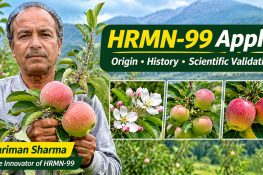
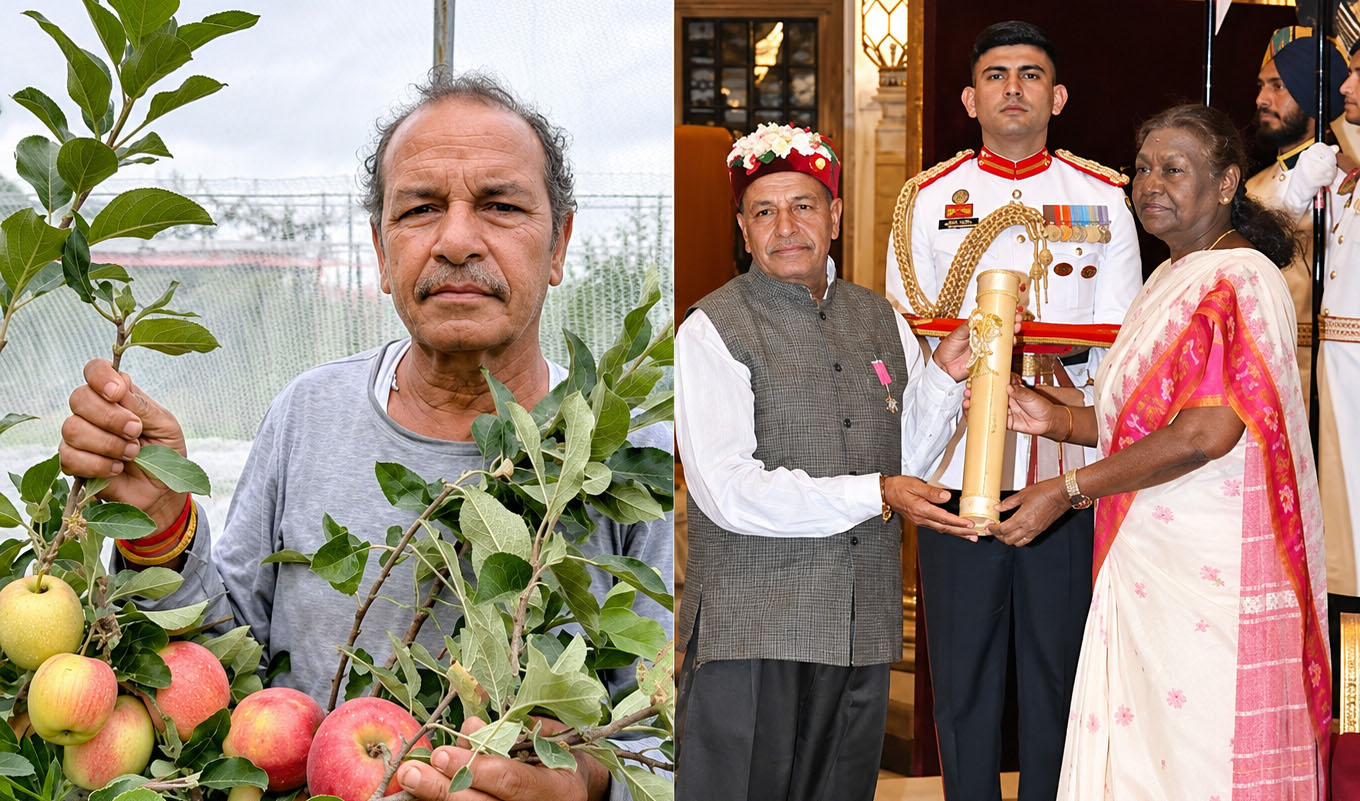
For generations, Indians have linked apples with snow-capped Himalayan slopes. The HRMN 99 apple variety, also known as the Hariman 99 apple, challenged that belief. It is a low chilling apple variety that began as a chance seedling in a farmer’s backyard in Bilaspur, Himachal Pradesh, and has since been documented flowering and fruiting in regions where summer temperatures reach 40–45°C.
This article explains where HRMN-99 came from, who developed it, how national institutions tested it, and why it is treated as a genuine hot climate apple variety rather than a marketing claim. The focus is history and evidence, not detailed care or buying advice.
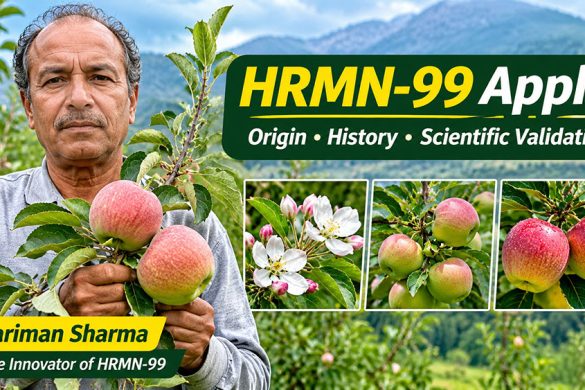
In 1998, Hariman Sharma, a progressive farmer from Paniala village in Ghumarwin tehsil of Bilaspur district, bought some apples for his family. After eating them, the seeds were tossed into the backyard. Paniala lies in the lower Shivalik hills at roughly 1,800 feet above mean sea level, a subtropical belt better known for mango, guava, citrus and pomegranate than apples.
In 1999, one seed germinated, survived the heat and grew vigorously. By 2001 it had flowered and borne fruit. This was surprising on two counts: seedling apples usually take five to six years or longer to fruit, and apples were not expected to fruit at all at such a low, warm elevation.
Hariman Sharma, later called the ‘Apple Man of Bilaspur’ by a local newspaper, recognised that a fruiting apple tree in his village was extraordinary. Instead of treating it as a curiosity, he protected the mother plant and observed it season after season.
1998
Seeds from market apples discarded in the backyard
1999
A seedling germinates and survives the heat
2001
First flowering and fruiting observed
2002
First successful grafts made on a plum tree
Most commercial apple varieties need prolonged winter chilling, typically about 1,000 to 1,500 hours below 7°C, to break dormancy and flower uniformly. That is why India’s apple orchards have stayed concentrated at roughly 5,000–8,500 feet in Jammu & Kashmir, Himachal Pradesh and Uttarakhand. Without enough cold, flowering becomes erratic, fruit set declines and quality suffers.
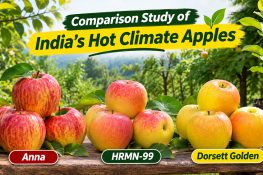
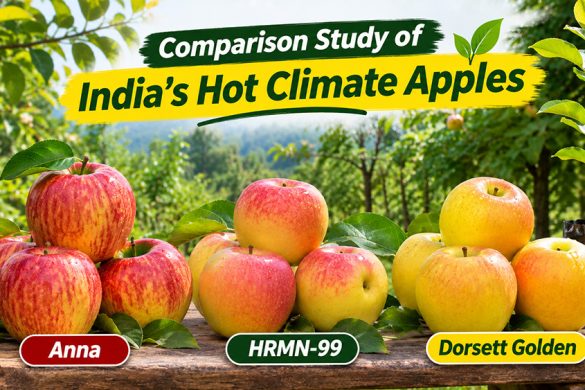
Low-chill cultivars such as Anna and Dorsett Golden were introduced and evaluated in India from the early 1990s, but adoption remained limited. HRMN-99 stood apart. NIF documentation describes it as needing very little or almost no deep chilling, while Anna and Dorsett Golden require about 100 chilling hours. This trait explains why HRMN-99 is discussed as an apple for low hills, plains, tropical and subtropical areas.
Did You Know? On 7 July 2007, Hariman Sharma met the then Himachal Pradesh Chief Minister in Shimla carrying HRMN-99 apples and mangoes harvested from the same orchard. Growing apple alongside mango in one field remains one of the most striking features of his farming system.
A single remarkable tree means little unless its traits can be reproduced. In 2002, with no apple rootstock available locally, Hariman Sharma grafted branches of the mother tree onto a plum tree. The graft succeeded and fruit quality was good. During 2003–05 he brought crab apple seedlings from Shimla, used them as rootstock and built a mini orchard around the original tree, alongside mango, plum, peach, apricot, pomegranate and kiwi. Today he sources crab apple seedlings from Kashmir every year for grafting.
The grafted trees reproduced the parent’s growth habit, colour and taste, showing that the traits were stable through vegetative propagation. The name HRMN-99 combines ‘HRMN’ from Hariman and ‘99’ for 1999, the year the seedling emerged. This farmer-led innovation came from observation and patience, not a laboratory breeding programme.
The turning point came when Dr P.L. Gautam, then Chairperson of the Protection of Plant Varieties and Farmers’ Rights Authority (PPV&FRA), connected Hariman Sharma with the National Innovation Foundation (NIF), an autonomous institute of the Department of Science and Technology. From there, HRMN-99 moved into structured scientific scrutiny.
NIF Support
Financial and technical backing from 2014 for nursery development, documentation and multi-location trials.
Morphological Study
Compared with Anna and Dorsett Golden; distinct leaf, flower and conical fruit traits with medium anthocyanin colour.
SSR DNA Fingerprinting
By NIF and GSBTM, Gandhinagar: HRMN-99 clustered near Anna but showed its own distinct genetic profile.
Fruit Quality Reports
ICAR-IARI Regional Station Shimla and ICAR-NEH Manipur recorded TSS of 11.5–15.5°Brix and total sugar up to 12.5%.
Multi-location trials: Between 2014 and 2019, NIF facilitated planting of over 20,000 saplings at farmers’ fields and 25 organisations, including Rashtrapati Bhavan. Fruit set was reported from 23 states and Union Territories, including Bihar, Manipur, Gujarat, Karnataka, Telangana, Kerala and Delhi. Commercial cultivation began in Manipur in 2015.
Legal protection: NIF filed the application on Hariman Sharma’s behalf under the PPV&FR Act, 2001, a process requiring evidence of distinctness, uniformity and stability. The TAAS success story ‘HRMN-99: Transforming India’s Apple Landscape’ reports that the variety has since received registration and protection.
Recognition: He received the 9th National Biennial Grassroots Innovation and Outstanding Traditional Knowledge Award 2017 (National Second, Plant Variety) from President Pranab Mukherjee, the IARI Fellow Award 2017, and the Padma Shri on 28 April 2025.
| Trait | Documented Profile |
|---|---|
| Climate adaptation | Low hills and plains with summers up to 40–45°C; very little or almost no deep chilling |
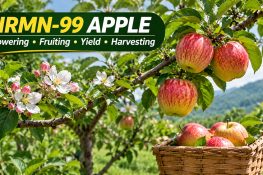
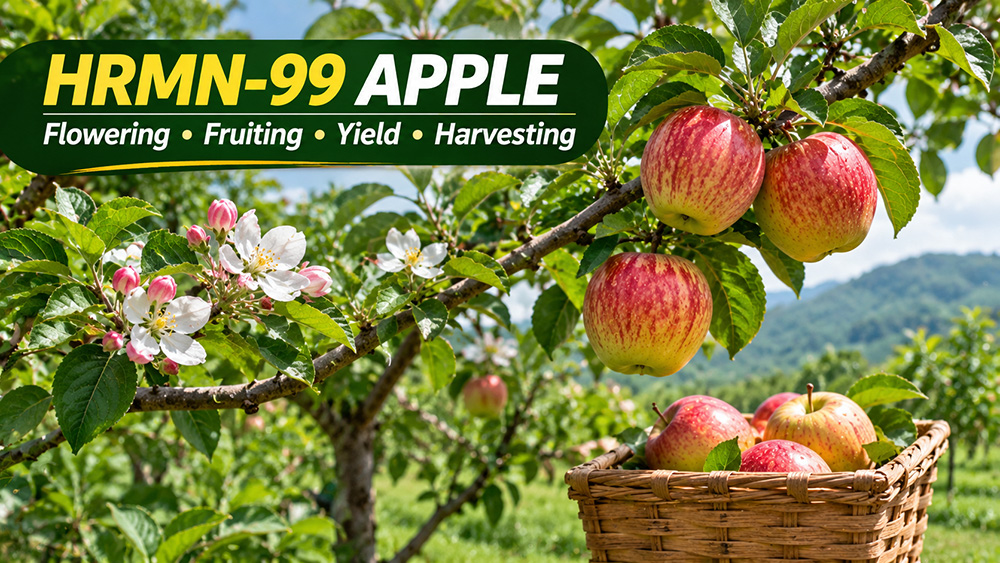
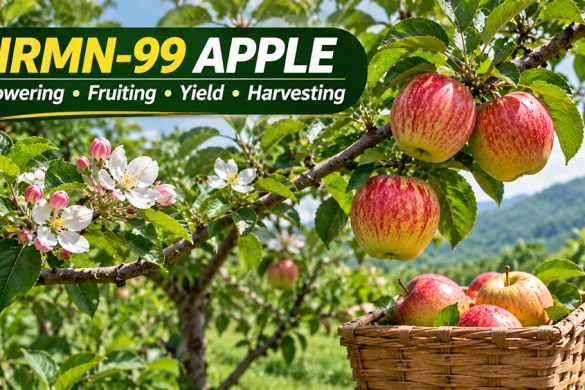
| Flowering and harvest | Flowering from early January at Bilaspur (February in north-western plains); harvest around June |
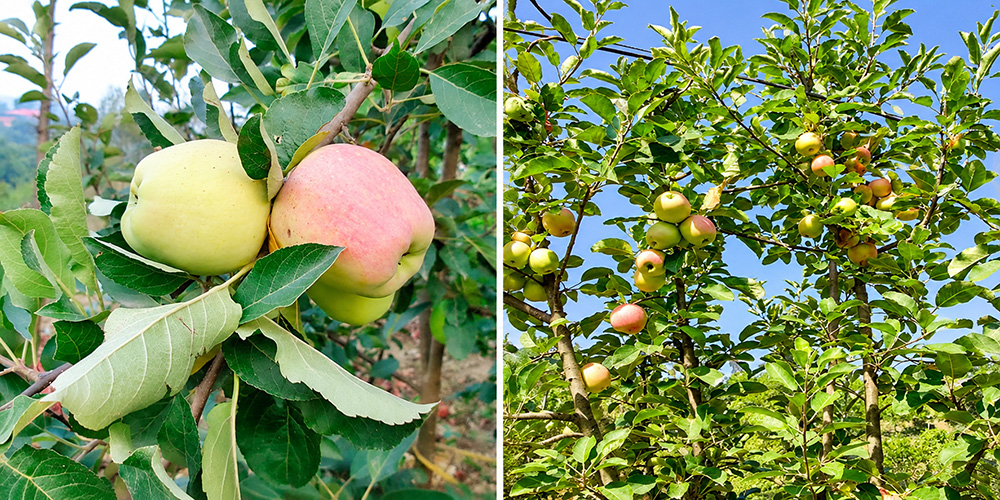
| Fruit colour | Yellow-red, described as striped red over yellow at maturity |
| Taste and texture | Sweet to sweet-sour; soft, juicy pulp |
| Plant height | Up to 12–15 feet |
| Fruiting age | Typically from the third year after planting |
| Shelf life | About 8–12 days at room temperature |
| Yield in mature trees | About 1 quintal per plant at 10–12 years under good management |
| Disease tolerance | Described as scab tolerant in NIF documentation |
Climate Resilience
A low-chill option as rising temperatures reduce winter chilling in traditional belts.
Diversification
Fits alongside mango and other fruits without replacing existing crops.
New Apple Regions
Opens apple growing to lower hills and plains once considered unsuitable.
Farmer Innovation
Proof that farmers can create varieties worthy of national validation.
Its June harvest also arrives before most hill apples reach markets, a timing advantage highlighted in TAAS and NIF reports.
HRMN-99 is adaptable, but results depend on the plant you start with and how you manage it. Scientific reports note that apple remains a climate-sensitive crop and that HRMN-99 performs better with appropriate soil management and agronomic practices.
- ✅Start with genuine grafted plants, since seedlings will not carry the same traits.
- ✅Expect seasonal pruning, steady irrigation and balanced nutrition.
- ✅Performance varies with soil, local climate and care, so treat yields as potential, not guarantees.
- ✅Plan to eat or share fruit soon after harvest because of its short shelf life.
The TAAS publication warns that some vendors sell fake HRMN-99 plants. Buy from a traceable source and keep your purchase record.
HRMN-99 shows how one farmer’s careful observation, backed by NIF, ICAR institutions, GSBTM and the PPV&FR framework, can expand the map of apple growing in India. Its story is rooted in documented evidence: a fruiting seedling in 2001, stable grafts, DNA fingerprinting, fruit quality reports and multi-state trials.
If you would like to grow this piece of horticultural history in your own garden, you can explore genuine grafted plants on the Greens of Kerala HRMN-99 hot climate apple plant page.
Is HRMN-99 Apple a real apple variety?
Yes. HRMN-99 is a documented farmer-developed apple variety from Paniala, Bilaspur, Himachal Pradesh. Its distinctness was studied through morphological characterisation and SSR DNA fingerprinting by NIF and GSBTM, its fruit quality was analysed by ICAR-IARI Regional Station Shimla and ICAR-NEH Manipur, and NIF filed for its protection under the PPV&FR Act, 2001.
Who developed HRMN-99 Apple?
HRMN-99 was developed by Hariman Sharma, a progressive farmer from Paniala village in Bilaspur district, Himachal Pradesh, often called the Apple Man of Bilaspur. He noticed a chance seedling fruiting in 2001, propagated it through grafting and named it after himself and the year 1999. He received the Padma Shri in 2025 for this work.
Does HRMN-99 Apple need chilling hours?
NIF documentation describes HRMN-99 as requiring very little or almost no deep chilling for flowering and fruit set, unlike conventional apples that need roughly 1,000–1,500 hours below 7°C. This is why it fruits in low hills and plains. Even so, flowering time and yield can still vary with local climate and orchard management.
Is HRMN-99 Apple self-pollinating?
Yes. NIF and TAAS sources describe HRMN-99 as self-pollinating, meaning a single tree can set fruit without a separate pollinator cultivar. Dorsett Golden, by comparison, needs Anna for cross-pollination. Scientific reports also note that growing HRMN-99, Anna and Dorsett Golden together may enhance pollination and fruit numbers in tropical and subtropical areas.
How is HRMN-99 different from Anna and Dorsett Golden?
All three are low-chill apples, but SSR DNA fingerprinting showed HRMN-99 has a distinct genetic profile. HRMN-99 needs very little chilling, while Anna and Dorsett Golden need about 100 hours. HRMN-99 bears striped red-over-yellow fruit with soft, juicy pulp; Anna has crisper pulp, and Dorsett Golden gives smaller, sweet-sour fruit and needs a pollinator.
Where can I buy HRMN-99 Apple Plant online in India?
You can explore genuine grafted HRMN-99 plants on the Greens of Kerala product page at https://www.greensofkerala.com/p/hrmn-99-hot-climate-apple-fruit-plant/. The page shares plant details and delivery information. For current availability, plant size or regional suitability questions, contact the Greens of Kerala team on +91 9746999125 before placing an order.
How can I order HRMN-99 Apple Plant from Greens of Kerala?
Visit https://www.greensofkerala.com/p/hrmn-99-hot-climate-apple-fruit-plant/, review the plant details, choose your quantity and complete checkout online. If you prefer guidance, call +91 9746999125 to confirm availability, delivery to your location and basic establishment advice. Keep your order confirmation so you can trace the source of your grafted plant.