Field reference: Nisha Teacher amidst the Massangeanas, with Captain Mani in Karimpuzha ornamental foliage cultivation.
Theme: Heart-filling Massangeana — cut-foliage cultivation as an intercrop.
There is a nostalgia that gently reminds of the bygone era. After celebrations and crowds, in the loneliness of isolation, what provides comfort and care as a companion are the ornamental plants within the walls of the home.
Similarly, with the unique characteristic of no two being the same, each leaf is different. The ornamental foliage plant called Massangeana, with its stripes blending dark and light green, has many takers. Leaves are very important in bouquets and flower arrangements. Bouquets are also arranged using only foliage. This is what led them to the cultivation of Massangeana in a polyhouse.
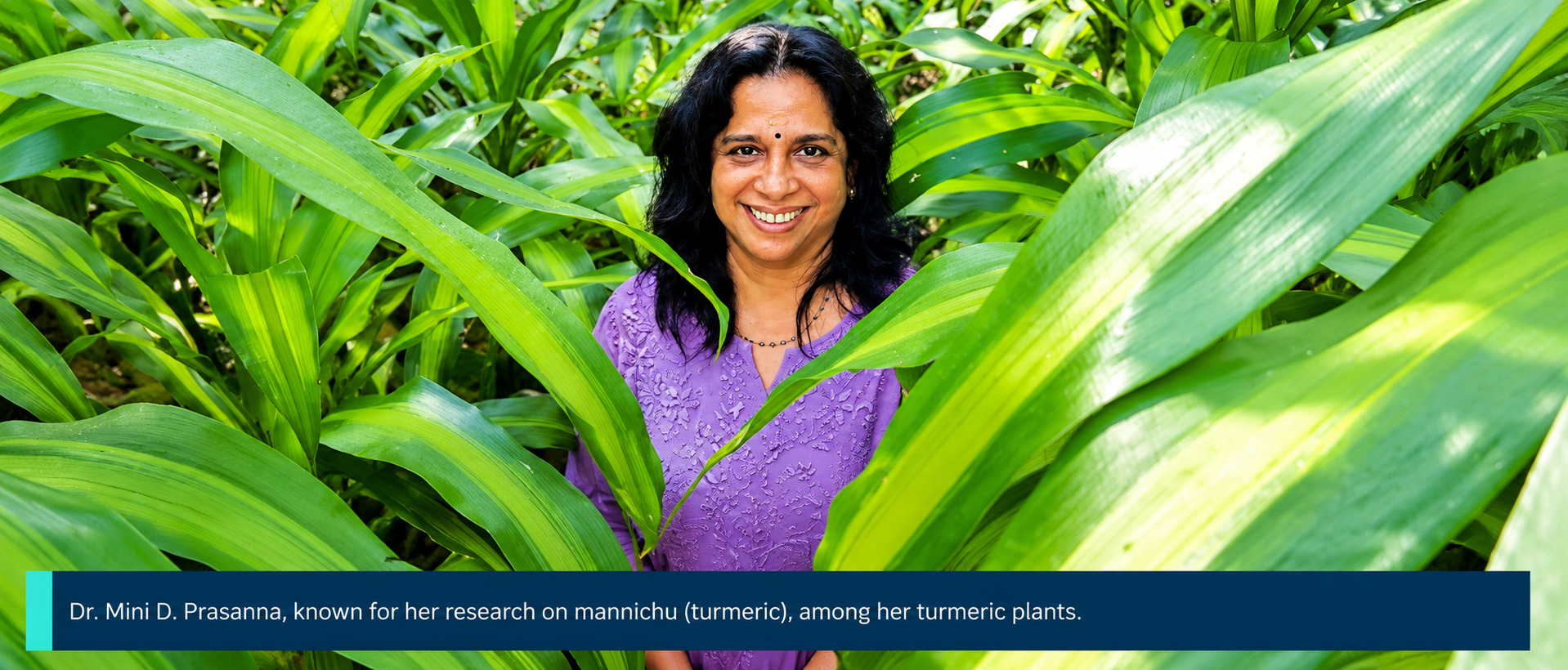
The cultivation of ornamental foliage plants is something that provides a good income in the heat of city life. The presence of ornamental foliage is not just in houses and flats in cities, but also in government and private institutions, parks, and even airports. Their position as indoor plants is at the forefront.
Ornamental foliage, which previously came only from Gulf countries, started reaching the domestic market 10 years ago. While flowers wilt quickly, the reason for the demand in the market is that leaves can retain their freshness for up to a week.
Amidst the Massangeana leaves that are a mix of dark green, light green, yellow, and white, flowers of any color will look more beautiful. Its ability to absorb gases and purify the atmosphere is also one of its special features.
With the aim of ensuring the quality of the leaves, cultivation is done in a greenhouse by controlling light and heat. Harvesting can be done in 7-8 months. Subsequently, harvesting can be done every two months.
Leaves ranging from one to three feet in length are popular in the market. One bundle will have 20 leaves. 2000 bundles are harvested from one acre in a single go. Since it is greenhouse cultivation, it can be done throughout the year. Leaf lengths of 50-70 cm can be achieved.
First harvest
Harvesting can be done in 7-8 months.
Repeat harvest
Subsequently, harvesting can be done every two months.
Market length
Leaves ranging from one to three feet are popular.
Bundle count
One bundle will have 20 leaves.
The cultivation is completely organic. Soil that is stony, mixed with laterite, and loamy is suitable. Cow dung powder is the main fertilizer. Coir pith compost and vermicompost can also be used.
To prevent small pests from appearing on the leaves and changing their color, a neem oil mixture can be sprayed for protection. Damaged leaves should also be cut and removed. It is also possible to make changes in the cultivation method based on information received from the market.
🛡️ Practical crop-care note: Quality is protected by controlled greenhouse conditions, organic nutrition, neem oil mixture for small pests, and timely removal of damaged leaves.
Captain Mani. With the support of Nisha Teacher, when entering the field of work directly, Mani was interested in choosing a field in which he had no prior experience. Heeding the advice of his brother, the ornamental plant cultivation started 3 years ago on two and a half acres in Karimpuzha has now become an enterprise in Nisha’s name. This land has been owned by the family for years.
The main varieties cultivated are high-quality Massangeana, Golden Milky, Song of India, Song of Jamaica, Silver Stem, and Golden Bamboo, a type of bamboo stem, brought from Bengaluru. They are getting ready to export nearly ten thousand bundles per month. They are also trying to prepare other foliage plants that are in demand.
📦 Market activity: Bundling Song of Jamaica stems for the market is part of the enterprise’s regular foliage movement.
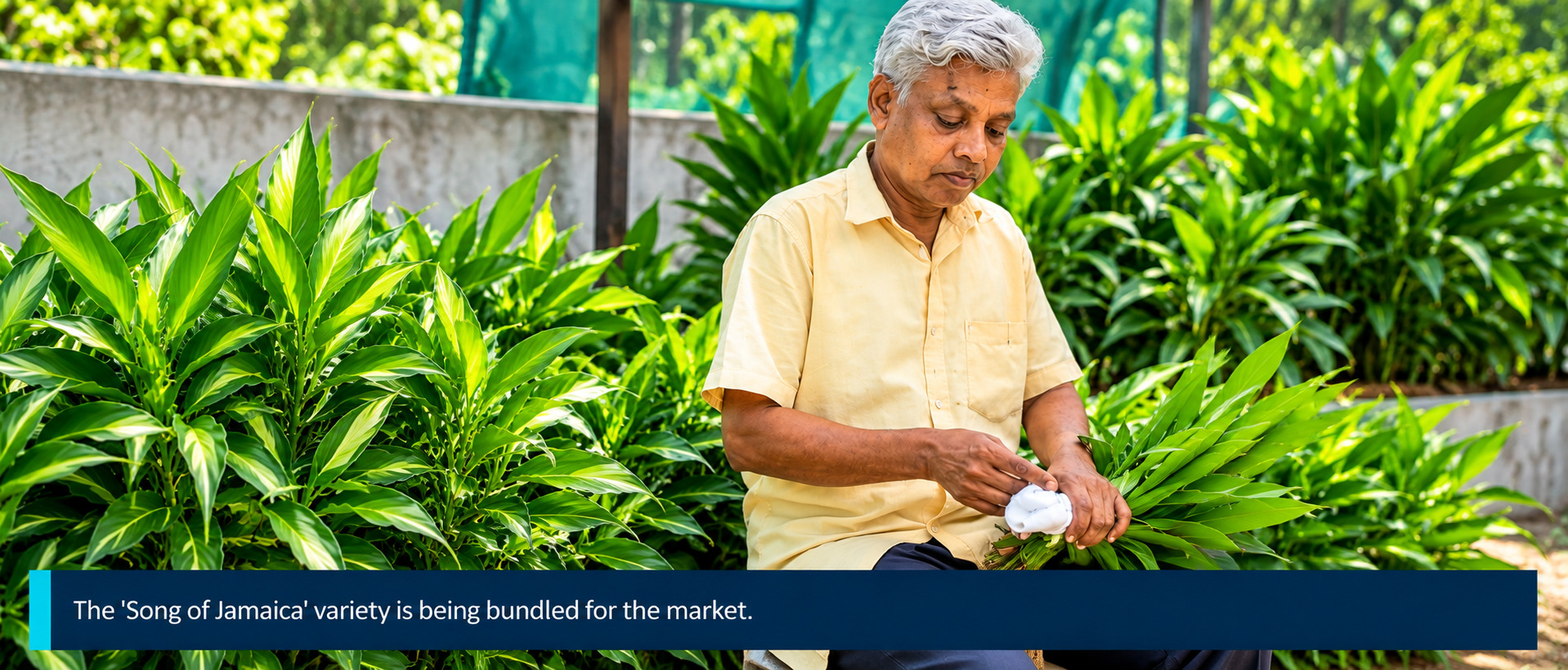
Mainly the stems of Song of India and Song of Jamaica are brought to the market. They reach the market in bundles weighing 5 kilos each. Since the quality is top-notch, there are many buyers for the leaves from here. The stems of the foliage plants are also marketed.
Compared to other plants, Massangeana leaves have double the price. The stems have more than double the price. Exports are to Dubai, Saudi Arabia, and Qatar. Within 3 years, they were able to earn more than double the investment. A stem costs between 3.5 to 4 rupees.
Good quality foliage plants are more expensive than flowering plants. There are also exports to cities like Bengaluru and Pune. Currently, they only deal with people from our state. Although there were concerns at the beginning, the market is now very extensive. Nisha Teacher has created her workplace right around her.
Export destinations
Dubai, Saudi Arabia, and Qatar.
Indian city demand
Bengaluru and Pune are also markets.
Stem rate
A stem costs between 3.5 to 4 rupees.
Investment return
Within 3 years, more than double the investment was earned.
When he realized that traditional farming was a loss, Mani’s brother, who has been in the agricultural sector for over 30 years, was ready to give up farming altogether. 8000 coconut trees were cut down then. Subsequently, he is now also the owner of a rubber processing factory with a capacity of 20,000 tons.
Following his brother’s path to success, Mani also left his painting job and came into agriculture. Although it started as an enterprise in his wife’s name, now Mani has also become a full-time farmer. They became notable in the market by utilizing the possibilities of business and marketing.
Contact: 9746293156