Field reference: A.T. Thomas of Oonnukallel house, a native of Parakkadavu in Angamaly East, has planted 600 sandalwood saplings on two acres of land.
Sandalwood, No Sandalwood. Price will become extreme, an obituary. Sandalwood grows everywhere on earth. It is the embodiment of fragrance. Sandalwood is more unique than gold. Nothing is superior to its heartwood.
Sandalwood cultivation, which was once the monopoly of forest officials, can now be done by anyone. There is no need to fear that thieves will steal it like in the old days.
If sandalwood is grown in the house compound or on one’s land, it becomes an asset to the government. The government provides assistance to ensure the protection of these trees. The Social Forestry wing of the Forest Department provides this assistance.
📌 Through a law amendment in September 2012, sandalwood trees on private land were made legal. As there are no plantations in the state, sandalwood is sourced from Tamil Nadu and Karnataka.
Assistance will be provided to those who plant and grow sandalwood in their house compounds and on their land. A special fund is allocated for this.
Plant one sapling and assistance will be received within 15 days.
An application must be submitted for this. Officials will conduct a site inspection.
For each sapling, assistance will be provided at the rate of 75 rupees with a 50 percent subsidy.
The Forest Department gives permission to cut the trees. 50 percent of the value of the felled wood will be given to the farmer.
✅ The plantation owners must find the planting materials. The project is implemented through Social Forestry.
Sandalwood that grows in places with extreme heat and severe drought has more heartwood and fragrance.
Although there will be growth in places with more rain, the heartwood will be less.
A.T. Thomas of Oonnukallel house, a native of Parakkadavu in Angamaly East, has planted 600 sandalwood saplings on two acres of land. Protection has been provided by fencing the area. Nearby, in another plot, there is also a eucalyptus plantation.
The sandalwood cultivation was prepared on barren land by digging trenches using an excavator. The saplings have been planted in trenches two feet deep and wide. The sandalwood trees planted in the plantation 2 years ago are now standing at a 12×12 feet distance.
Saplings one foot tall were bought from Tirunelveli at a rate of 75 rupees each. Only cow dung powder, bone meal, and vermicompost are given as fertilizer. Assistance for the saplings has been received from Social Forestry.
📷 A.T. Thomas on sandalwood cultivation.
The weeds in the plantation are cleared using a machine. In 2001, sandalwood saplings were also planted on an experimental basis along with gooseberry and mahogany. The saplings planted at a 12×12 feet distance have good growth.
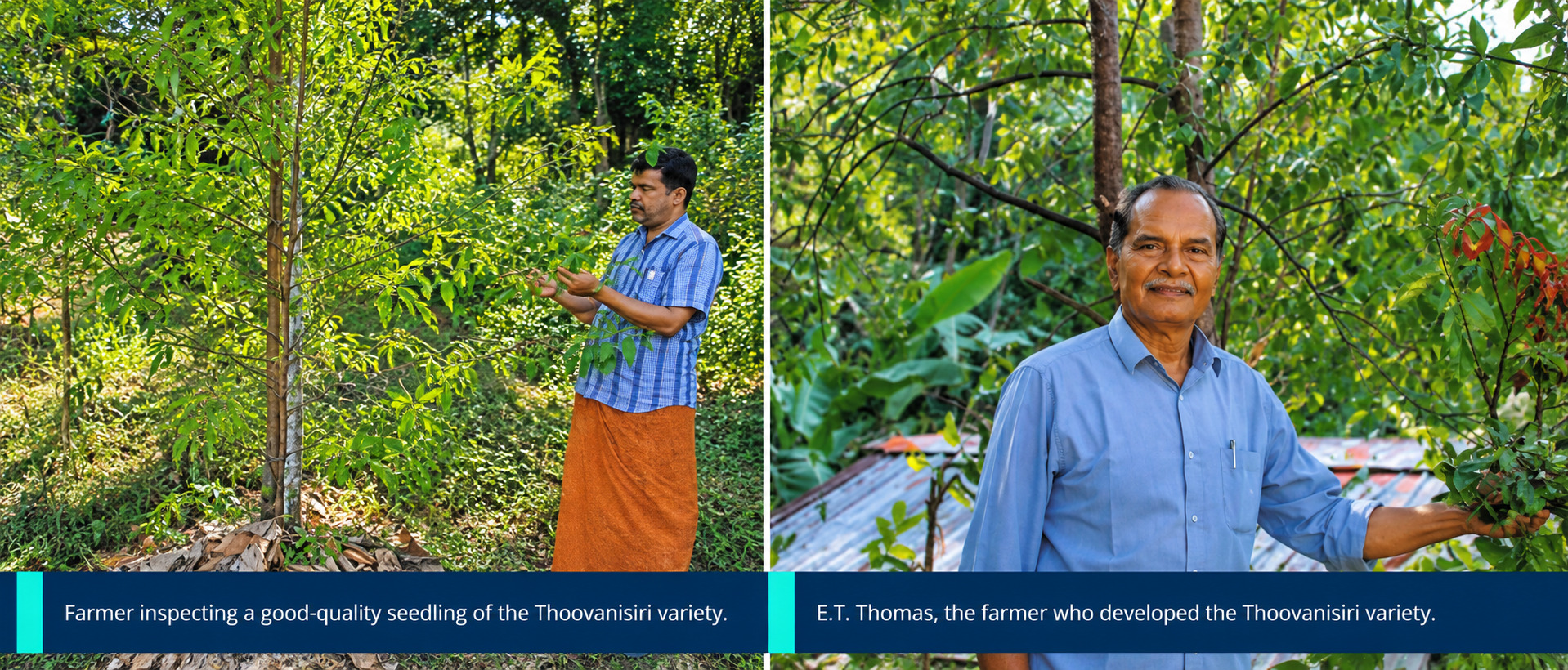
Sandalwood is a crop that requires good sunlight. It is watered two or three times in the summer. The plantation must be kept free of weeds.
Bamboo sticks have been planted to support the plants. Care must also be taken to prevent fires in the summer.
The saplings should be planted in pits one meter long, wide, and deep. Cow dung powder, neem cake, and bone meal can be given as a basal fertilizer.
In 4-5 years, the trees will grow to a good height. The leaves can be used as cattle feed.
⚠️ Waterlogged areas are not suitable for cultivation. If waterlogging occurs, the plants will be destroyed.
Thomas, who was an LP school teacher, started sandalwood cultivation for future generations. Thomas’s family has an agricultural background. His father Ouseph raised his children by cultivating the land he inherited.
It was his interest in agriculture that made Thomas turn to sandalwood cultivation. His wife Chinnamma and sons Eldhose and Basil are with him in support. The cultivation was expanded with government assistance. He has visited many places for agricultural study and training.
💬 Sandalwood cultivation is something that ordinary farmers do not know much about. Moreover, many are reluctant to enter this field due to the restrictions of the Forest Department. However, Thomas says that contrary to all this, sandalwood is a cultivation that can be done profitably.
“If I plant now, my children or grandchildren will get the benefit of it. How valuable would it be if sandalwood could be used to make things like cots and chairs.”
The price of teak wood, which was 200 rupees, gradually increased to 8000-10000 rupees. Thomas also says that sandalwood is more valuable than gold.
After 10 years, the sandalwood tree will start to form heartwood.
When it is 20 years old, the tree will be ready for felling.
A better harvest can be obtained in 25-30 years.
Loans and other facilities can be availed from banks based on the value of the trees.
📏 The tree will form heartwood by the time it reaches 20 inches in girth. Trees in areas with 50 cm girth trees have value. Banks provide loans to those who plant trees like sandalwood, teak, and rosewood.
Sandalwood oil can be extracted from the wood. Sandalwood is used in cosmetics and medicines.
Sandalwood seeds also have a good price.
Thomas says that it is better to make planks with sandalwood than with any other wood.
The trees can also be planted in front of the house. It is believed that sandalwood brings prosperity to the house.
🪵 A plank 10 feet long and one foot wide is priced at 20,000 rupees. It is believed that sandalwood brings prosperity to the house.
Thomas is ready to answer questions about the cultivation. During the 84-85 period, he had planted and grown about 200 different types of trees. Cashew and anjili were planted then. Thomas had also planted acacia and mangium.
☎️ 9496496025 (Chief), 9447212091 (Thomas)
Is sandalwood cultivation legal on private land?
Yes. Through a law amendment in September 2012, sandalwood trees on private land were made legal. The article notes that sandalwood cultivation, once the monopoly of forest officials, can now be done by anyone, with Social Forestry support and Forest Department permission required for cutting the trees.
How much subsidy is available for sandalwood saplings?
For each sandalwood sapling, assistance is provided at the rate of 75 rupees with a 50 percent subsidy. An application must be submitted, and officials will conduct a site inspection to determine the number of saplings. The assistance is implemented through the Social Forestry wing of the Forest Department.
What spacing is used for sandalwood planting?
In A.T. Thomas’s plantation, sandalwood saplings were planted at a 12×12 feet distance, and the article says the saplings planted at this spacing have good growth. The saplings were planted in trenches two feet deep and wide, while general pit preparation is one meter long, wide, and deep.
When does sandalwood start forming heartwood?
The sandalwood tree starts forming heartwood after about 10 years. When it is 20 years old, the tree will be ready for felling. A better harvest can be obtained in 25-30 years, and heartwood forms by the time the tree reaches 20 inches in girth.
Which climate gives better sandalwood fragrance?
The article says sandalwood grown in places with extreme heat and severe drought has more heartwood and fragrance. Although sandalwood will also grow in areas with more rain, the heartwood will be less. Waterlogged areas are not suitable because waterlogging can destroy the plants.
Can farmers get bank loans for sandalwood trees?
Yes. In the meantime, loans and other facilities can be availed from banks based on the value of the trees. The article also states that banks provide loans to those who plant valuable trees like sandalwood, teak, and rosewood.
What fertilizers are used for sandalwood saplings?
A.T. Thomas uses only cow dung powder, bone meal, and vermicompost as fertilizer. The article also says cow dung powder, neem cake, and bone meal can be given as a basal fertilizer when planting sandalwood saplings in prepared pits.