By Vividha Snehamayi
Let’s see the model farm of this youth center located near the Kolingal paddy field in Coimbatore.
Good agriculture with Sadhguru is presented here through soil care, traditional paddy, vegetable gardening, organic fertilizers, drip irrigation and youth-led farming.
The Isha Yoga Center in Coimbatore, founded by Sadhguru, the holistic form of Indian culture, is an encouragement not only for the ashram residents but also for those who consider agriculture sacred. While the venture is new, an infinite element to be dedicated to Sadhguru’s soil is the love for agriculture and the environment.
It is not that farmers are without struggles, including those from the changing climate. He has been engaged in agricultural projects such as ‘Save Soil’ aimed at increasing the ‘soil’s organic content’ to counter continuous natural calamities affecting the environment.
The ashram is located on 24 acres on a hilltop. There, he suggested forming a village like ‘Edayarpalayam Gramam’ on a farmer’s hill. ‘Farming that lasts forever, farming that provides income forever’ is the message Isha propagates.
With this intention, the protection of 4 acres of fallow agricultural land was also undertaken. This itself has become a part of the project formulated for farmers in districts including Tiruppur, with Coimbatore as its base.
24 acres
on a hilltop
4 acres
of fallow agricultural land protected
Save Soil
focus on soil organic content
Coimbatore base
with districts including Tiruppur
Out of the 37 acres of fallow land adjacent to the Isha Yoga Center, about 20 acres were set aside for paddy cultivation. The instruction for the farmers in the farmland was to cultivate 100 superior varieties of paddy.
On the 37 acres of farmland, which has a tradition of being cultivated in India, farming was started organically for the first time. Bhavani, Saramathi, Vazhavella, Vadakkendasan Sanna, and other traditional paddy varieties were cultivated.
Along with paddy, crops like sesame, black gram, green gram, and cowpea were also cultivated. Currently, the ashram is preparing for cultivation. Good farming is initiated by utilizing agricultural techniques that have been popular since ancient times, aiming for higher production.
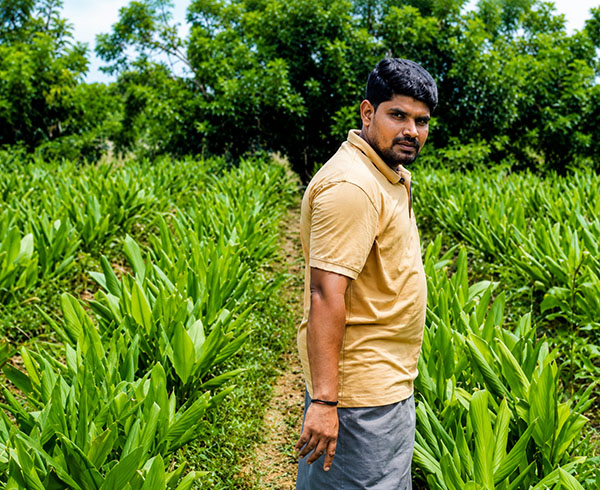 Caption: Farm in-charge Mr. Karuppuswamy
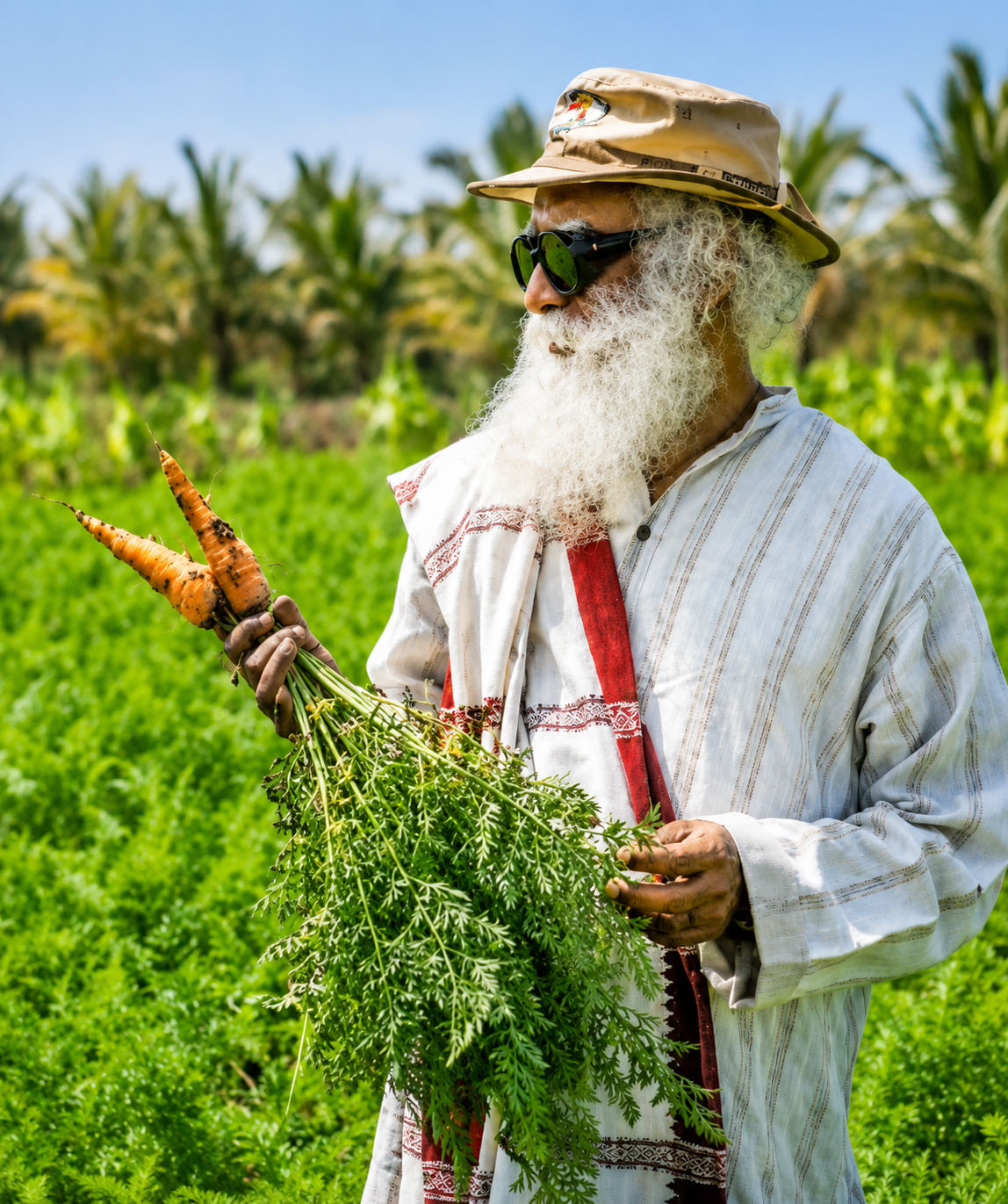
Sadhguru also showed interest in getting into the paddy field to do farm work. He ploughed the land driving a tractor and sowed the seeds. He got into the muddy field and engaged in farming activities. Along with Sadhguru, his followers also took part in the farm work.
Sadhguru became an inspiration to get down into the soil and farm as a part of living in harmony with nature. He worked alongside the farmers and tried to understand their problems. He tried to experience for himself the challenges that a farmer faces.
He spoke with the farmers about their methods of cultivation. He educated them about new farming techniques. He gave instructions to promote organic farming. Sadhguru reminded them that farming is a way of life, and through it, one can get closer to nature.
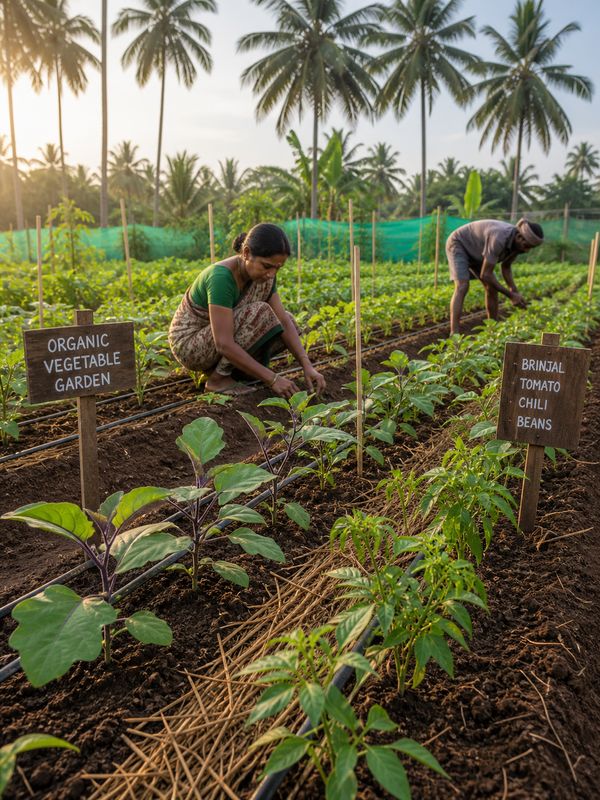
The Isha Foundation has also started a vegetable garden in the adjacent area. Brinjal, tomato, chili, ladies’ finger, beans, spinach, bottle gourd, snake gourd, bitter gourd, and cucumber are cultivated here.
It is a completely organic farm. Drip irrigation is the method used for watering. It is managed by a group of youths. The soil is enriched with organic matter. Jeevamrutham and Panchagavyam are used as fertilizers.
The specialty here is that the harvested vegetables are sold fresh to consumers on the same day. Vegetables are harvested every 15 days. The farm operates as a model for organic farming.
Vegetable farming was the next step. About 20 cents of land was set aside for it. A good harvest was obtained from it. Vegetables like ladies’ finger, brinjal, tomato, and beans were cultivated.
A group of youths who are followers of Sadhguru lead the farming. They are completely dedicated to agriculture. They believe that providing poison-free food to people is a great service.
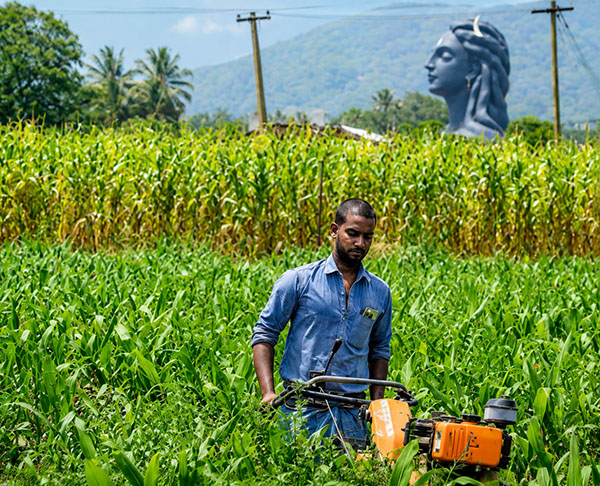 Caption: Helper in Sadhuguru Farm
Although nature was not always benevolent, the harvest was not bad. Scant rainfall affected the crops. They also had to face pest attacks. But these problems were overcome using organic farming methods.
Only organic fertilizers were used in vegetable cultivation. This helped to increase the soil’s fertility and enhance the quality of the crops. Chemical fertilizers and pesticides were completely avoided. This ensured healthy food. It also helped in protecting nature. Farmers were given training on organic farming methods.
Jeevamrutham
was sprayed to enrich the soil.
Panchagavyam
was used as an organic fertilizer.
Drip irrigation
was the method used for watering.
Mulching
helped retain moisture and prevent weed growth.
The land for the vegetable garden was prepared by the farmers themselves. It was ploughed, weeds were removed, and the soil was conditioned. Jeevamrutham was sprayed to enrich the soil. After planting the vegetable saplings, mulching was done to retain moisture. This also helped to prevent weed growth.
The harvest started within 60 days. In the first phase, 200 kg of vegetables were obtained. The harvested vegetables were marketed with the help of volunteers. Volunteers were actively involved in all stages of the farming process.
Caption: Sprouted vegetable saplings planted by Sadhguru.
The unique needs of each vegetable were taken into consideration. For example, some vegetables require more sunlight, while others grow well in the shade. The planting was done by taking such factors into account.
A systematic method of cultivation was adopted. Regular care and attention were given to the plants. As a result, a good harvest was obtained. This farming model proves that even a small piece of land can be used effectively for cultivation. This is an inspiration for all those who are interested in agriculture.
Contact number shared in the report: 9443057562
What is special about Sadhguru’s organic model farm in Coimbatore?
The farm near the Isha Yoga Center is presented as a model for organic farming, soil care and youth-led agriculture. It includes traditional paddy cultivation, vegetable gardening, drip irrigation, Jeevamrutham, Panchagavyam, mulching and direct fresh vegetable sales. The article highlights it as an inspiration for farmers and people interested in poison-free food.
How much land was used for paddy cultivation near Isha Yoga Center?
Out of the 37 acres of fallow land adjacent to the Isha Yoga Center, about 20 acres were set aside for paddy cultivation. Farmers were instructed to cultivate 100 superior paddy varieties, including traditional varieties such as Bhavani, Saramathi, Vazhavella and Vadakkendasan Sanna.
Which organic fertilizers were used in the vegetable garden?
The vegetable garden used organic inputs such as Jeevamrutham and Panchagavyam. Jeevamrutham was sprayed to enrich the soil, while Panchagavyam was used as an organic fertilizer. Chemical fertilizers and pesticides were completely avoided, helping improve soil fertility, crop quality and healthy food production.
What vegetables were cultivated in the Isha Foundation garden?
The garden cultivated brinjal, tomato, chili, ladies’ finger, beans, spinach, bottle gourd, snake gourd, bitter gourd and cucumber. In the next step of vegetable farming, about 20 cents of land was set aside, and crops such as ladies’ finger, brinjal, tomato and beans gave a good harvest.
How did the farm handle low rainfall and pest attacks organically?
The article notes that scant rainfall and pest attacks affected the crops, but the problems were overcome using organic farming methods. The farm relied on organic fertilizers, soil enrichment, mulching and regular care instead of chemical fertilizers and pesticides, which helped protect nature and maintain crop quality.
How quickly did the vegetable garden begin harvesting?
The harvest started within 60 days after the vegetable saplings were planted. In the first phase, 200 kg of vegetables were obtained. Vegetables were harvested every 15 days, and the harvested produce was sold fresh to consumers on the same day with the help of volunteers.
Why is this farming model useful for small farmers?
This model shows that even a small piece of land can be used effectively for cultivation. With systematic planting, drip irrigation, organic fertilizers, mulching, regular attention and careful consideration of each vegetable’s needs, the farm achieved a good harvest and became an inspiration for people interested in agriculture.