✍️ By R. Jnanadevan
Whether you grow a local or hybrid variety, rock salt is an excellent fertilizer for coconut trees. Composed of 60 percent chlorine and 40 percent sodium, applying rock salt increases yield, enhances disease resistance, and improves the growth of coconut fronds. In soils that are 90 percent chlorine-deficient, rock salt application has been found to significantly increase yield. It is essential for absorbing other nutrients and also helps in water absorption. With its application, the number of coconuts, the amount of copra, the quantity of oil, and the size of the nuts all increase — and this has been proven through experiments.
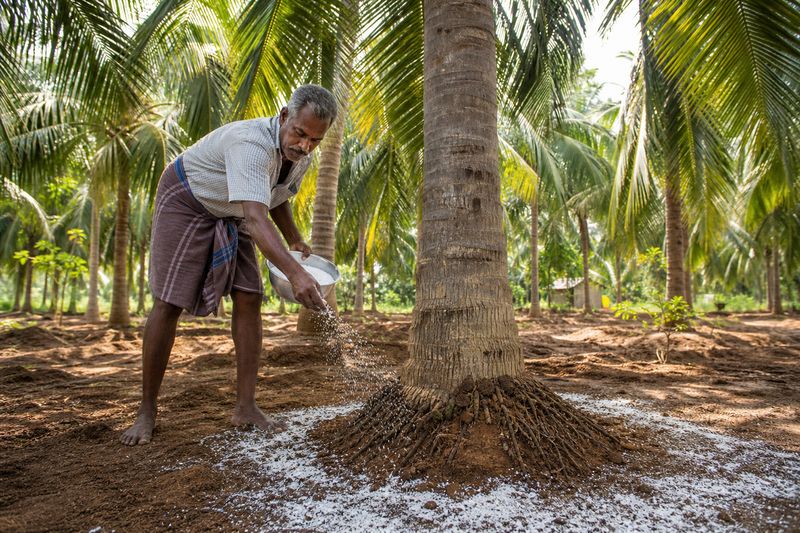
🧂 Why Rock Salt Works for Coconut Trees
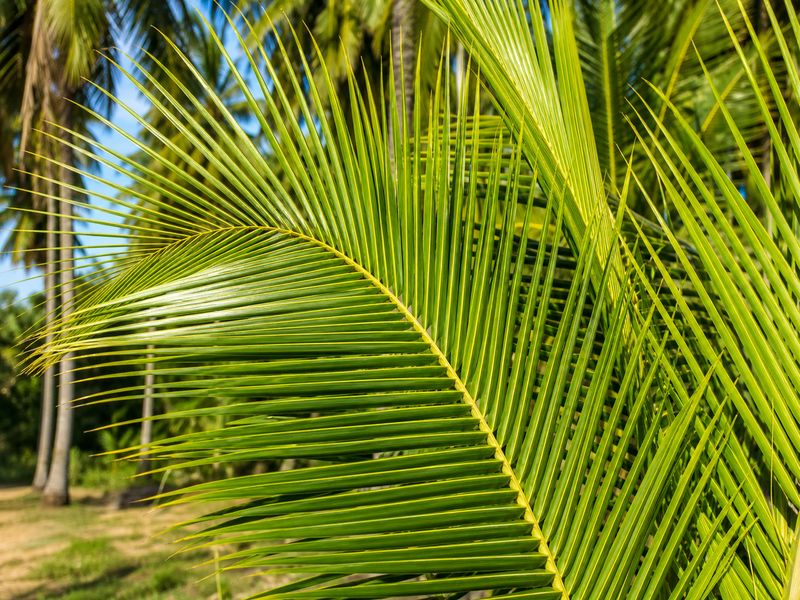
Rock salt delivers a range of measurable benefits when applied correctly to coconut trees:
- ✅Coconut fronds become greener and healthier in appearance.
- ✅The number of tender coconuts increases noticeably.
- ✅It ensures 90 percent pollination of female flowers.
- ✅The strength of the frond’s petiole increases, making it harder for the rhinoceros beetle to bore through.
- ✅Attacks from the red palm weevil also decrease.
- ✅Rock salt acts as a remedy for stem bleeding disease.
- ✅It is also a solution for the yellowing of fronds.
- ✅The water from tender coconuts becomes very sweet after rock salt application.
- ✅For coastal trees where saline water intrudes, rock salt makes them more resistant.
🌿 Traditional Wisdom: Applying rock salt to coconut trees is a practice that our ancestors followed for generations. However, today’s farmers are hesitant to continue this. Even if the price of coconuts falls, the increased yield from applying rock salt makes coconut cultivation profitable.
🌱 Fertilizer Mix for Farmers Who Need Quick Yield
For those who need to utilize the yield quickly, mix the following in 5 kilograms of cow dung and apply twice a year:
100g
Urea
150g
Rock Phosphate
500g
Muriate of Potash
750g
Magnesium Sulfate
1100–1300g
Dolomite
6–8g
Borax (optional)
Local varieties of coconut trees require 60–70 liters of water. To retain moisture in the basin, place coconut husks, leaves, and coir pith. Even in soils with low acidity, applying rock salt is beneficial, and applying it twice a year is sufficient.
🪜 How to Apply Rock Salt to Coconut Trees
Follow these steps for effective rock salt application:
-
1
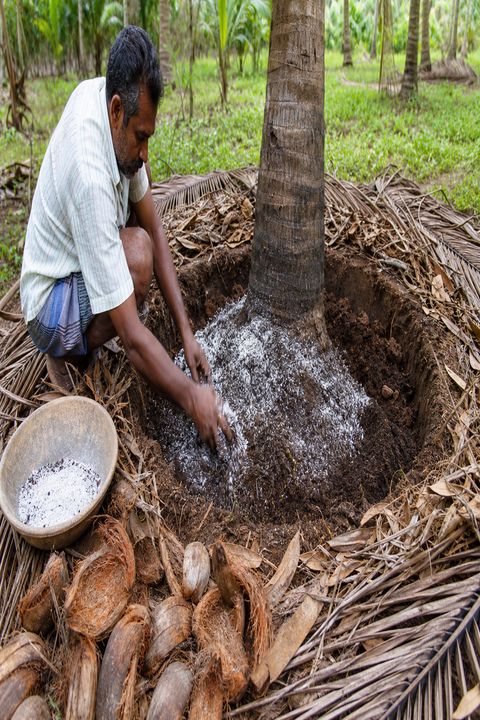
Make a basin around the coconut tree by digging to a depth of 2 feet. The basin should be two meters wide. -
2
For a healthy tree, apply 100 grams of rock salt. For a tree with yellowing fronds, apply 2 kilograms of rock salt. -
3
Along with the rock salt, apply 2 kilograms of dolomite. Mix both with the soil. -
4
Cover the basin with organic matter to retain moisture and support nutrient absorption. -
5
After a month, apply a fertilizer mixture containing NPK to further support tree growth. -
6
For trees showing stunted growth due to lack of nutrient absorption, apply 20 kilograms of cow dung or goat manure. -
7
For coastal trees: apply 2 kilos of rock salt once a year and mix it with the soil — this is sufficient for saline-affected areas.
🐛 Pest and Disease Control Tips
In addition to applying rock salt, the following pest and disease control measures are recommended:
Rhinoceros Beetle: Fill the crevices of the fronds with a mixture of salt and ash for pest control.
Red Palm Weevil: Rock salt strengthens the petiole, naturally reducing weevil attacks.
Bud Rot: Apply Bordeaux mixture to prevent bud rot disease effectively.
General Pest Control: Mix 30 ml of neem oil in one liter of water and pour it into the crevices of fronds.
Key Takeaway: Applying rock salt helps in the absorption of all other fertilizers. Thus, a good yield can be expected from your coconut trees — even when market prices fall. Rock salt application is one of the most cost-effective inputs a coconut farmer can use.
📬 Expert Contact: W.D.S (Rtd.), Mogral, Vilasam Post. 📞 Phone: 9446054597
❓ FAQ
🧂 How much rock salt should I apply to a coconut tree?
For a healthy coconut tree, 100 grams of rock salt is sufficient. If the fronds are turning yellow, increase the application to 2 kilograms. Along with this, apply 2 kilograms of dolomite. For coastal trees affected by saline water intrusion, 2 kilos applied once a year and mixed with soil is adequate.
📅 How often should rock salt be applied to coconut trees?
Applying rock salt twice a year is generally sufficient for most coconut trees. For coastal trees or those in saline-prone zones, once a year is enough. Always mix it well with soil and cover with organic matter to maximize nutrient retention and effectiveness.
🌴 Does rock salt work for both local and hybrid coconut varieties?
Yes, rock salt is beneficial for both local and hybrid coconut varieties. It is composed of 60 percent chlorine and 40 percent sodium, which addresses chlorine deficiency in soils and helps improve yield, nut size, copra content, and oil quantity regardless of the coconut variety being grown.
🐛 Can rock salt help protect coconut trees from pests?
Yes. Rock salt strengthens the coconut frond’s petiole, making it harder for the rhinoceros beetle to bore through. It also reduces attacks from the red palm weevil. For additional protection, fill frond crevices with a salt and ash mixture and apply 30 ml of neem oil diluted in one liter of water.
💛 Why are my coconut fronds turning yellow and how does rock salt help?
Yellowing of coconut fronds is often a sign of chlorine or nutrient deficiency. Rock salt directly addresses chlorine deficiency and assists in the absorption of other nutrients. Applying 2 kilograms of rock salt along with 2 kilograms of dolomite has been shown to restore frond color and improve overall tree health.
🌊 Is rock salt safe to use for coconut trees in coastal saline soil areas?
Absolutely. For coconut trees in coastal areas where saline water intrudes, adding rock salt actually makes the trees more resistant. Applying 2 kilos of rock salt once a year, mixed into the soil around the basin, is sufficient to strengthen the tree’s tolerance to saline conditions.
🥥 Does applying rock salt improve the quality of coconut water?
Yes! One of the notable benefits of rock salt application is that the water from tender coconuts becomes very sweet. This is because rock salt supports better nutrient absorption and overall tree health, which in turn improves the flavor and quality of the coconut water produced by the tree.
💰 Is rock salt application economically viable for coconut farmers?
Yes, rock salt is a highly cost-effective input for coconut farming. Even when market prices for coconuts fall, the increased yield in terms of nut count, copra quantity, oil content, and nut size makes cultivation profitable. It also reduces dependency on expensive synthetic fertilizers by improving the absorption of all other nutrients applied.