✍️ By Rahul Raj M & Suchitra B
A new and alarming fungal disease is quietly spreading across the major ginger-growing regions of Kerala, leaving farmers in serious distress as their crops fail to reach fruition. Known locally among farmers as Koodali disease, the infection begins with yellowing of tender leaves, followed by the appearance of small green spots — symptoms that can easily be mistaken for other common leaf diseases.
If left undetected, entire clumps of plants turn yellow and dry up within days. Understanding this disease early is the first step toward saving your ginger crop.
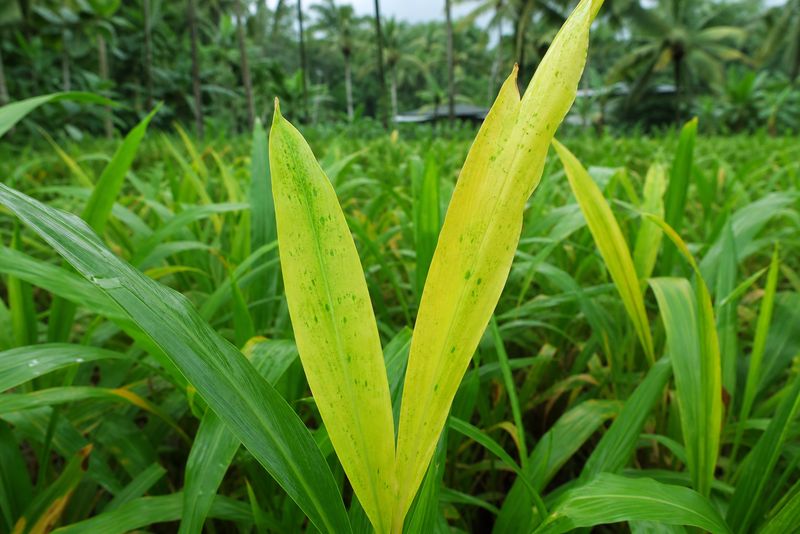
Early yellowing symptom of Koodali disease on ginger leaves. Photo: K. S. Godwin, Kozhikode
Initial symptom visible on infected ginger plant. Photo: K. S. Godwin, Kozhikode
Koodali disease is caused by a group of fungi similar to Phytophthora — the same pathogen responsible for rhizome rot. These pathogens attach to soil, roots, and stems to produce the next generation, entering the plant primarily through the roots.
- 🌱 Initial Stage: Appears as a leaf-limited disease with yellowing starting from tender leaves and small green spots forming on the surface.
- ⚠️ Progression: Plants turn yellow in clumps and dry up within days as the disease advances rapidly.
- 💨 Wind-Borne Spread: Since the pathogens spread through the wind, their spores travel long distances, making containment difficult.
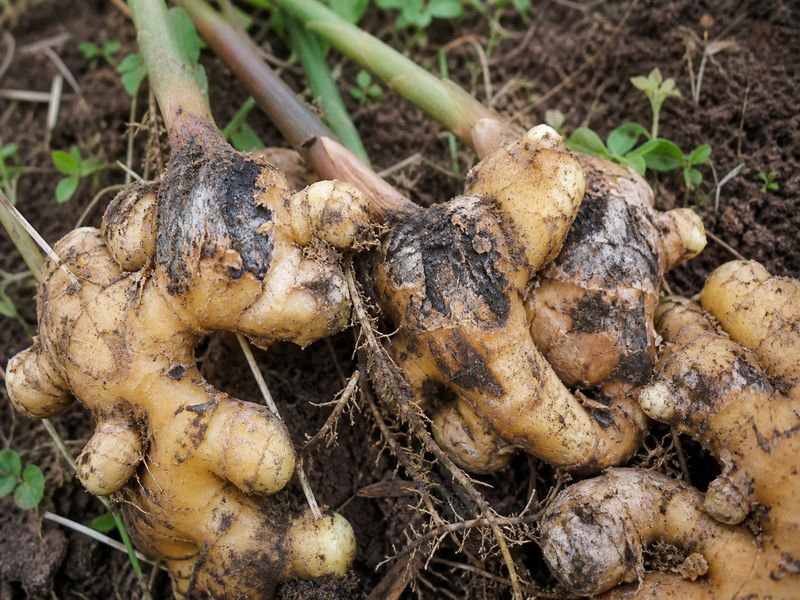
- 🌾 Seed-Borne Spread: When ginger seeds are collected from infected fields, pathogens infect the rhizomes and intensify during seed storage.
- 🔍 Visual Confusion: The symptoms seen on the leaves are similar to leaf blight disease, making early diagnosis challenging.
⚠️ Important: This disease is easy to control if detected early. Infected plants should be uprooted and destroyed immediately to prevent further spread to neighbouring farmlands.
Timely action and proper seed management are the most effective tools against Koodali disease. Follow these recommended practices to protect your crop:
Ensure that seeds to be planted are disease-free. Avoid collecting seeds from affected areas.
Soak seeds in Bordeaux mixture (1%) or Mancozeb (3%) for 30 minutes, then dry in the shade before planting.
Use biological fungicide Pseudomonas — mix 20 g (talc) or 10 ml (liquid) per litre of water. Soak rhizomes for 30 minutes, shade-dry, then plant.
Apply organic fertilizer with Trichoderma (neem cake) to help prevent the disease from taking hold in the soil.
🌿 If Symptoms Appear: Spray the leaves with a solution of 20 grams of Pseudomonas per litre of water.
🔴 If the Disease Becomes Severe: Use fungicides like Bordeaux mixture (1%) or Copper oxychloride (0.2%). All infected plants must be destroyed immediately. Seek expert advice.
- ✅ Inspect tender leaves regularly for early yellowing or small green spots
- ✅ Use only disease-free seeds; never collect from infected fields
- ✅ Treat seeds with Bordeaux mixture (1%) or Mancozeb (3%) before planting
- ✅ Apply Pseudomonas biological fungicide as seed treatment and foliar spray
- ✅ Incorporate Trichoderma-enriched organic fertilizer (neem cake) into the soil
- ✅ Uproot and destroy all infected plants immediately
- ✅ Contact a Krishi Vigyan Kendra expert if the disease worsens
📞 Expert Contact Information
Dr. P. S. Manoj — Krishi Vigyan Kendra, Kakkanad
📱 Phone: 9947231642
📷 Photo Credit: K. S. Godwin, Kozhikode — 📱 8848696434
What is Koodali disease in ginger?
Koodali disease is a fungal infection affecting ginger crops, caused by a group of fungi similar to Phytophthora — the same pathogen responsible for rhizome rot. It starts with yellowing of tender leaves and small green spots, progressing to rapid wilting and drying of entire clumps of plants. It is now a growing threat in major ginger cultivation areas of Kerala.
How does Koodali fungal disease spread in ginger farms?
The disease spreads in two primary ways. First, the fungal spores travel long distances through the wind, infecting neighbouring farms. Second, when seeds are collected from infected fields, the pathogens infect the rhizomes and intensify during seed storage, spreading the disease to new planting areas the following season.
What are the early symptoms of the new fungal disease in ginger?
The first visible sign is yellowing starting from the tender leaves, followed by small green spots on the leaf surface. In the early stage, it appears as a leaf-limited disease. As it advances, plants turn yellow in clumps and dry up within days. The symptoms closely resemble leaf blight disease, which can make early identification challenging.
How can I treat ginger seeds to prevent Koodali disease?
Before planting, soak ginger rhizomes in either Bordeaux mixture (1%) or Mancozeb (3%) for 30 minutes, then dry in the shade. Alternatively, use biological fungicide Pseudomonas — mix 20 grams (talc form) or 10 ml (liquid form) per litre of water, soak rhizomes for 30 minutes, shade-dry, and then plant. Always avoid using seeds collected from diseased fields.
What fungicide should I spray if Koodali disease symptoms appear on leaves?
If symptoms appear on leaves, spray with a solution of 20 grams of Pseudomonas per litre of water. If the disease becomes severe, apply chemical fungicides such as Bordeaux mixture (1%) or Copper oxychloride (0.2%). Destroy all infected plants and consult an agricultural expert like those at Krishi Vigyan Kendra, Kakkanad, for further guidance.
Can Trichoderma help prevent fungal disease in ginger cultivation?
Yes. The application of organic fertilizer enriched with Trichoderma — such as neem cake — can help prevent Koodali disease. Trichoderma is a beneficial soil fungus that suppresses harmful pathogens in the root zone, offering a biological defence against the fungal infections that cause this disease in ginger plants.
Is Koodali disease the same as Phytophthora rhizome rot in ginger?
They are caused by closely related pathogens. Koodali disease is caused by a group of fungi similar to Phytophthora, the same organism behind rhizome rot. While rhizome rot primarily affects the underground parts of the plant, Koodali disease begins visibly on the leaves and then progresses downward, eventually destroying entire plants if not treated early.