Dr. P.A. Vikas
Subject Matter Specialist, Fisheries, Krishi Vigyan Kendra, Kollam.
E-mail: kvkkamakulam@yahoo.co.in
What is pen culture in fish farming? How is it done? Information about open pen aquaculture is also provided here. To know the details, let’s look at the main points.
Pen culture is one of the methods of fish farming in large water bodies like vast swamps, backwaters with water flow, lakes, and rivers. In the pen culture method, a small part of the water body is partitioned with nets, fish are stocked there and reared by feeding them.
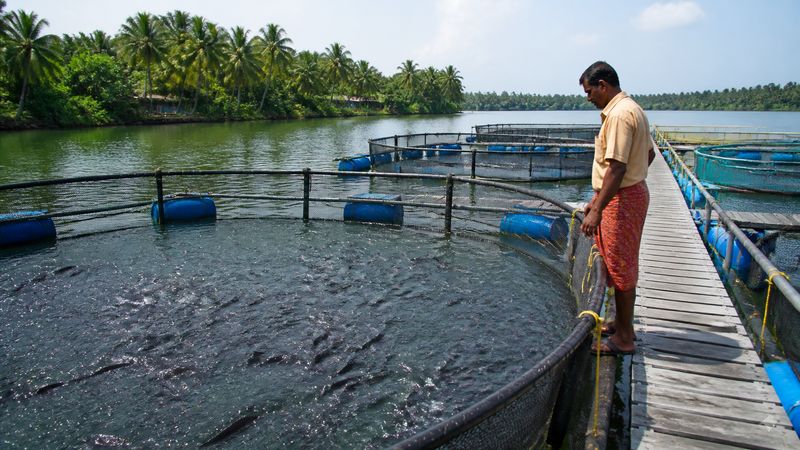
For this, places with less current, fewer waves, and a depth of more than 4 feet should be selected. Pen culture can be done in areas adjacent to backwaters and in the middle of lakes.
✅ The best locations are calm sections of backwaters, lakes, rivers, and vast swamps where the pen can remain secure and fish can be managed easily.
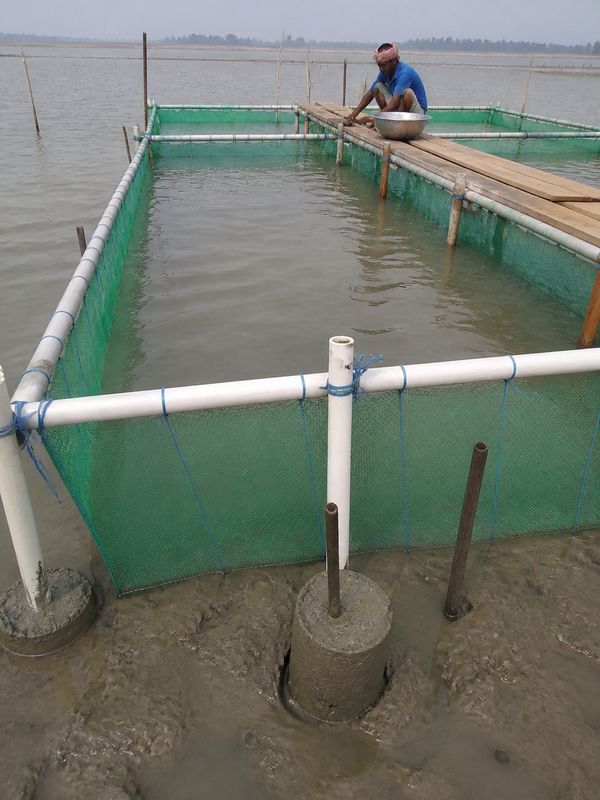
For this, the net can be secured using HDPE nets with a thickness of 2.5 mm and a mesh size of 40 mm, fastened to 90 mm diameter PVC pipes filled with concrete. The bottom part of the net should be buried in the mud.
The net can be tied and stretched onto iron pegs that are driven firmly. The iron pegs can be 20 mm thick. The pegs can be fixed two meters apart, and the HDPE nets can be tied to them.
A wooden plank or something similar can be fixed to walk over the net for feeding and other purposes. For this, 60 mm thick HDPE pipes can be tied.
🧵
HDPE net:
2.5 mm thickness and 40 mm mesh size.
🧱
PVC pipe:
90 mm diameter pipes filled with concrete.
📏
Iron pegs:
20 mm thick and fixed two meters apart.
🚶
Walkway:
Wooden plank or similar support for feeding.
Fingerling-sized fish should be stocked. Species that fetch a higher price in the market and grow fast can be selected. Karimeen (pearl spot), tilapia, poomeen (milkfish), and also rohu and catla, which can be farmed in freshwater, can be selected.
Mixed fish farming, where more than one species of fish is reared at the same time, is more profitable.
⚠️ Predatory fish should be avoided or removed from the pen area. This is because they will attack and destroy the fingerlings.
🐠 Brackishwater choices:
Karimeen, tilapia, and poomeen can be considered where suitable.
💧 Freshwater choices:
Rohu and catla can be farmed in freshwater conditions.
Scientifically prepared pellet-form feed can be given. In addition, feed made by mixing rice bran and oil cake can also be given. Finely ground meat waste and fish like sardines can also be given as feed.
Feeding trays can be used to prevent feed wastage. The feeding time should be strictly followed. Initially, feed up to 10% of the fish’s body weight can be given. As they grow, the amount of feed should be reduced to 3-5%.
- ✅ Pellet-form feed can support scientific feeding.
- ✅ Rice bran and oil cake mixture can also be used.
- ✅ Feeding trays help reduce feed wastage.
- ✅ Feeding time should be strictly followed.
- ✔ Select large water bodies with less current and fewer waves.
- ✔ Maintain water depth of more than 4 feet.
- ✔ Use HDPE nets, PVC pipes filled with concrete, and firmly driven iron pegs.
- ✔ Bury the bottom part of the net in the mud.
- ✔ Stock fingerling-sized fish and protect them from predators.
- ✔ Follow regular feeding time and adjust feed from 10% body weight to 3-5% as fish grow.
What is pen culture in fish farming?
Pen culture is a fish farming method used in large water bodies such as vast swamps, backwaters, lakes, and rivers. A small part of the water body is partitioned with nets, fingerling-sized fish are stocked inside, and the fish are reared by giving feed regularly.
Where can open pen aquaculture be done?
Open pen aquaculture can be done in areas adjacent to backwaters and in the middle of lakes. The selected site should have less current, fewer waves, and a depth of more than 4 feet so that the pen remains stable and fish can be managed properly.
Which materials are used to build a fish farming pen?
The article recommends HDPE nets with 2.5 mm thickness and 40 mm mesh size. These can be fastened to 90 mm diameter PVC pipes filled with concrete. Iron pegs of 20 mm thickness can be fixed two meters apart, and the bottom of the net should be buried in mud.
Which fish species are suitable for pen culture?
Fingerling-sized fish should be stocked. Species that grow fast and fetch a higher market price are preferred. Karimeen, tilapia, poomeen, rohu, and catla can be selected depending on whether the system is in brackishwater or freshwater conditions.
Is mixed fish farming profitable in pen culture?
Yes. Mixed fish farming, where more than one species of fish is reared at the same time, is more profitable. Farmers can choose compatible species based on the water body, market price, growth rate, and freshwater or brackishwater suitability.
How much feed should be given in pen culture fish farming?
Initially, feed up to 10% of the fish’s body weight can be given. As the fish grow, the amount of feed should be reduced to 3-5%. Feeding time should be strictly followed, and feeding trays can be used to prevent feed wastage.