Featured farmer: V.A. Radhakrishnan, a senior library assistant from the Government Press in Thrissur.
Place: Maliekal house in Ollukkara, Thrissur. Contact: 📞 7907531071
Many people raise goats to sell their milk. However, there are some who cherish and raise goats differently. Radhakrishnan of Maliekal house in Ollukkara, Thrissur, is one of them.
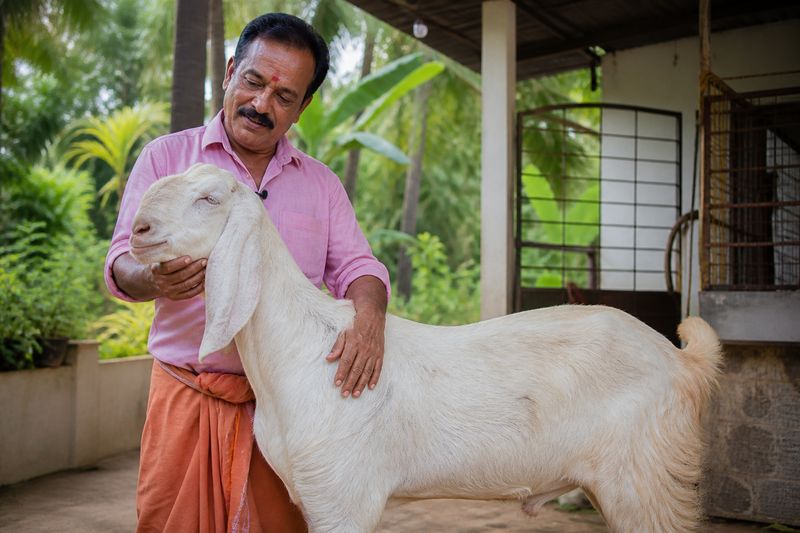
"Many raise goats as a means of livelihood. But for me, it is a passion. I have long-term experience in goat farming and an understanding of the market," says Radhakrishnan, affectionately holding and caressing his Jamnapari goat.
💡 His view: "They are bigger and heavier than breeds like Thaam and Anglo-Nubian. But getting more good quality kids increases the price of the goat."
It’s the same way… I too have a job. So, I raise goats in my spare time. It also becomes a source of income. Radhakrishnan ventured into goat farming on his own. He does not agree with raising goats for a livelihood. He has no desire to start a large-scale farm. Therefore, he only raises breeds that he is interested in.
V.A. Radhakrishnan, a senior library assistant from the Government Press in Thrissur, has been at his home for a year where one can see an original Jamnapari. He also has Richu, Mintu, Sirohi, and Hyderabadi Bheema.
Why start with these when they are commonly raised locally? "Those who get into goat farming with the hope of making it a livelihood should not jump into it hastily, that is the very reason," is Radhakrishnan’s reply. Although he had been farming goats for a long time, Radhakrishnan was raising medium-sized breeds in Balanthilal. Moreover, since he has a job, he does not see goat farming as a means of livelihood, but as an additional source of income.
The very reason for choosing premium breeds is the high demand for their milk and meat. After their childhood, breeds like Jamnapari and Hyderabadi will cost between 25,000-30,000 rupees. A good mother goat can fetch more than 20,000 rupees if sold within a short period. "There is no ready stock right now," says his wife Shobana.
Jamnapari
Original Jamnapari can be seen at his home.
Richu and Mintu
Premium goats raised out of interest.
Sirohi
Among the breeds he keeps at home.
Hyderabadi Bheema
One of the high-value premium breeds.
Heavy breeds
He raises breeds that weigh 100 kg at 2 years of age.
₹25,000-₹30,000
Jamnapari and Hyderabadi after childhood.
Over ₹20,000
A good mother goat can fetch this if sold within a short period.
Over ₹20,000
Billy goats at one and a half years old.
From ₹10,000
Many people approach him to raise billy goats starting from this price.
A major mistake beginners often make in goat farming is in selecting the animals, says Radhakrishnan. When choosing for livelihood, it must be profitable. One should not buy just by looking at breeds that yield more kids. One must select breeds that take good care of their young and give more milk.
- ✅ Each goat becomes weak after two or three deliveries. It is better to sell them at this time.
- ✅ Or they should be able to produce 3 liters of milk. This is why people often incur losses.
- ✅ Additionally, one can understand the age and health of a goat by looking at its teeth.
⚠️ Important for costly goats: For expensive goats like Jamnapari, ensuring insurance coverage is also important.
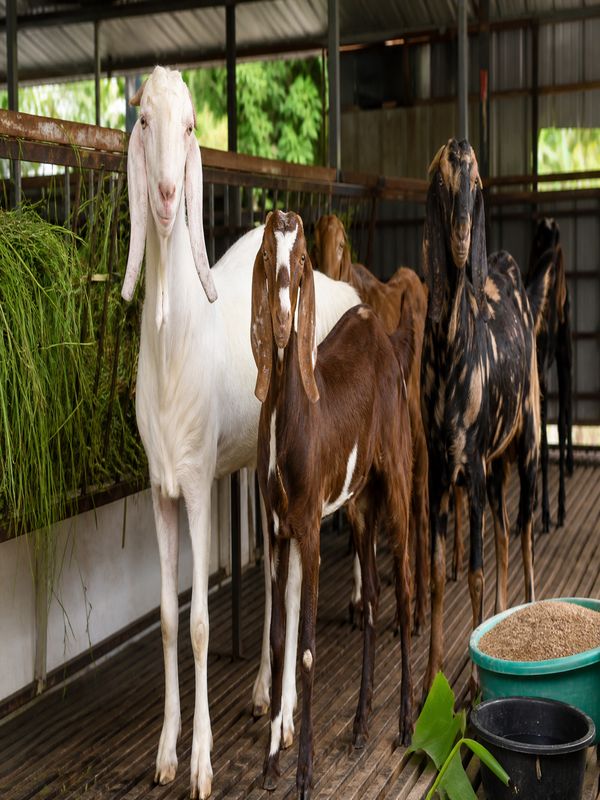
When he returns home from work, Radhakrishnan finds time to spend with the goats. He raises breeds that weigh 100 kg at 2 years of age. However, due to lack of space, he has built a kennel-style shed.
In addition to cattle feed, he also provides grass and green leaves. He also gives balanced feed for nutrition. Radhakrishnan himself administers medicine for diseases like jaundice.
He does not sell goats for slaughter. Since they are premium breeds, people come from far-off places seeking the billy goats. At one and a half years old, they fetch a price of over 20,000 rupees.
V.A. Radhakrishnan: 7907531071