Expert Opinion
V.K. Harish
Agriculture Assistant Director, Kunnamkulam

Keniroye is being cultivated on an industrial scale for ethanol, cattle feed, starch, and related cassava-based uses.
Cassava is a leading crop among tuber crops. It plays a major role in ensuring food security in Kerala. Cassava is cultivated in about 60,000 hectares of land in the state. The production is 23.7 lakh tons.
By adopting scientific cultivation methods, 150 to 200 quintals of cassava can be produced per acre. Through this, an income of up to 50,000 rupees can be ensured from 50 cents.
🌱 Keniroye has recently gained much popularity among farmers because it is able to withstand adverse weather and provide high yields. Farmers like it because it gives about twice the yield of local varieties.
Open spaces that receive good sunlight are suitable for cassava cultivation. It can also be intercropped in coconut groves in farmlands. Soil that does not retain water is most suitable for cultivation.
The land should be tilled well, weeds removed, and clods broken. In places where water is likely to stagnate during the rainy season, it can be cultivated by making mounds or ridges.
In sloping areas, it is good for soil and water conservation to cultivate by constructing contour bunds. Cultivating legumes as a preceding crop will improve soil health.
Varieties that are free from diseases and pests and give higher yields should be selected for cultivation. Sree Jaya, Sree Vijaya, H-165, H-226, M-4, etc., released by the Central Tuber Crops Research Institute, and Vellayani Hraswa, Nidhi, Kalpaka, etc., released by the Agricultural University, are popular varieties.
An item that has recently gained much popularity among farmers is Keniroye. This variety is being cultivated on an industrial scale for the production of ethanol, cattle feed, starch, etc. Keniroye is able to withstand adverse weather and provide high yields.
📌 This is a Tamil Nadu variety. This variety, which has all the qualities of cassava, is also called Malaysian Blue by farmers.
Farmers also use the main varieties H 97, 16.
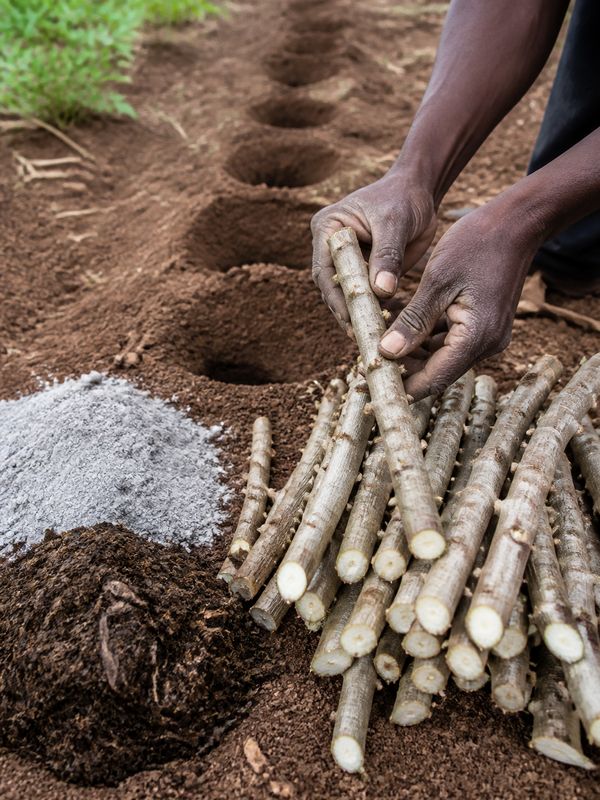
Well-matured cassava stems cut to 15 centimeters with 3-4 nodes are preferred for planting.
Well-matured stems should be selected for planting. The top and bottom parts of the stem can be discarded and the middle part used for planting. Stems cut to a length of 15 centimeters should have 3-4 nodes.
Soaking the cut stems in a pseudomonas solution at the rate of 20 grams in one liter of water for 15 minutes before planting will help in disease prevention.
There are varieties with maturities of 4 and 10 months. If planted in April-May, they can be harvested by December. There are varieties with a 7-month maturity. They can also be planted in October and November.
Keniroye is a 7-month maturity variety. It can be harvested in 6-7 months.
The selected stem for planting can be cut and planted in pits taken at a distance of 75 centimeters.
It can also be planted by making ridges 90-100 cm apart.
For pit cultivation, up to 8,000 pits can be made per acre.
When cultivated this way, the tubers will form at a greater depth and a better yield will be obtained.
Weeding should be done 4-5 weeks after planting the cassava. At the same time, among the sprouted stems, retain one or two strong ones and cut away the rest. During the growth phase, soil should be added and mounded up.
Mix farmyard manure with the soil at the rate of 10 tons per hectare. Fertilizer application is very important in cassava cultivation.
- ✅ As a basal fertilizer, Dolomitic lime can be given at the rate of 50 grams per pit.
- ✅ Two weeks after applying lime, one ton of cow dung, 50 kg of bone meal, and 100 kg of ash per acre can be given as basal fertilizer.
- ✅ After the basal fertilizer, chemical fertilizers can be applied.
⚠️ Fertilizer should not be applied after 90 days. Ash helps reduce soil acidity and bitterness. A fertilizer mix of ash and potash is good for cassava.
As an intercrop, 5 grams of cowpea and 3 grams of black gram can be planted per pit. Applying Rhizobium culture, which is given to leguminous crops, to the soil will greatly help in increasing the yield.
After harvesting cassava, legumes can be cultivated for the next crop. Tapioca chips are a large-chain industry. The peel and other residues from cassava processing can be used as cattle feed.
The reason for the bitterness contained in cassava is the 2.5 grams of hydrocyanic acid it contains. If it is up to 1.5 grams, the bitterness will be less. In some places, there is a practice of plucking the leaves to reduce the bitterness of boiled cassava.
Keniroye is a variety that has the ability to resist mosaic disease to a certain extent. It builds resistance to mosaic because the amount of Cyanogenic glucosides in the leaves is low.
- 🟨 Yellow traps can be set up to control the whiteflies that spread mosaic disease.
- 🍄 To get rid of mealybugs on cassava, the friendly fungus Verticillium lecanii can be used.
- 💧 Spraying rice water, also called Meleese, will help get rid of mealybugs.
- 🌿 To repel cassava’s leaf roller worm and scale insects, a neem oil mixture can be sprayed.
- 🔍 Mealybugs and scale insects should also be watched out for.
There is a saying among farmers that adding more chicken manure will increase the bitterness in cassava. This is not correct.
Harvesting can be done from the sixth month after planting. One kilo of tubers will be obtained from 2 plants. Prominent varieties can be planted. A sign for harvesting is when the dark green color of the leaves changes.
If there is not enough moisture in the soil, after irrigating, the tubers can be pulled out in a way that does not damage them.
Spraying a 5 to 10 percent Sulphate of Potash, SoP, solution on the leaves will help increase the starch content in the tubers. It will also help reduce moisture content and store them for a longer time without spoiling. It can be sprayed on the leaves at the rate of 5-10 grams per liter of water.
What is Keniroye cassava?
Keniroye is a Tamil Nadu cassava variety that has recently become popular among farmers. It is also called Malaysian Blue by farmers. The variety is valued because it withstands adverse weather, gives high yields, and is being cultivated on an industrial scale for ethanol, cattle feed, starch, and related purposes.
How much yield can scientific cassava cultivation give per acre?
By adopting scientific cultivation methods, 150 to 200 quintals of cassava can be produced per acre. The article notes that through this, an income of up to 50,000 rupees can be ensured from 50 cents, depending on crop performance and proper management.
When can Keniroye cassava be harvested?
Keniroye is a 7-month maturity variety and can be harvested in 6-7 months. Harvesting can begin from the sixth month after planting. One useful harvest sign is when the dark green color of the leaves changes, and tubers should be pulled out carefully to avoid damage.
What spacing is recommended for cassava pit cultivation?
The selected cassava stem can be cut and planted in pits taken at a distance of 75 centimeters. For pit cultivation, up to 8,000 pits can be made per acre. It can also be planted by making ridges 90-100 cm apart, especially where ridge planting is more suitable.
How should cassava stems be treated before planting?
Well-matured stems should be selected, while the top and bottom parts can be discarded. The middle stem portion should be cut to 15 centimeters with 3-4 nodes. Soaking the cut stems in pseudomonas solution, 20 grams in one liter of water, for 15 minutes helps in disease prevention.
How can mosaic disease and mealybugs be managed in cassava?
Yellow traps can be set up to control whiteflies that spread mosaic disease. Keniroye can resist mosaic disease to a certain extent. For mealybugs, the friendly fungus Verticillium lecanii can be used, and spraying rice water, called Meleese, may also help reduce mealybug problems.
Does chicken manure increase bitterness in cassava?
The article mentions a farmer belief that adding more chicken manure increases bitterness in cassava, but says this is not correct. Cassava bitterness is linked to hydrocyanic acid content. Ash helps reduce soil acidity and bitterness, and a fertilizer mix of ash and potash is good for cassava.