✍️ George K. Mathai — Deputy Director (Retd.), Department of Agriculture | mathaigk@gmail.com
There are many elements commonly seen as the main nutrients for paddy — and also many that are not recognized as effective. A major reason for disease conditions that cannot be controlled by potassium and magnesium is the lack of variation in the timing of plowing or planting across the entire paddy field.
There is no point in applying more chemical fertilizers for higher yield. What needs to be applied to the plant through various pathways is often contrary to or overshadows what is naturally available. That is, the chemical components to be absorbed appear to be out of order. It is not enough to simply buy and apply any mixture available in the market for paddy, rubber, banana, or coconut.
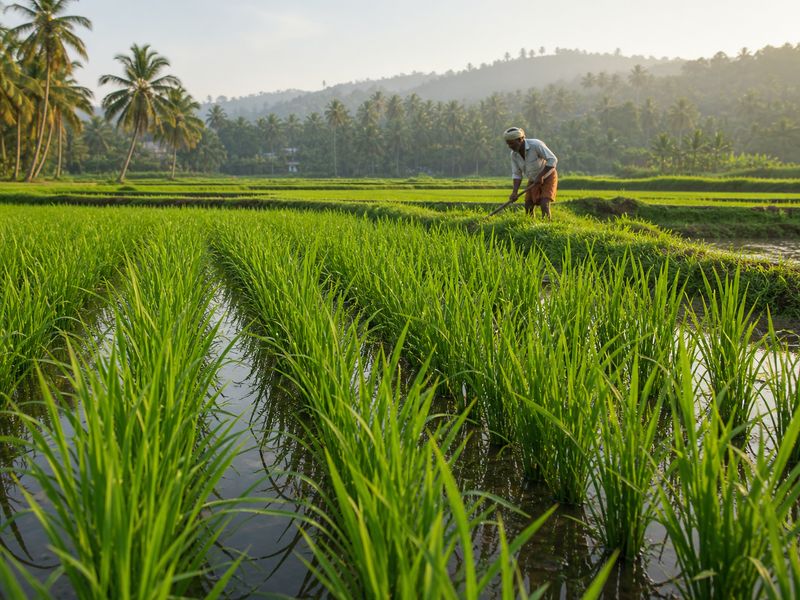
Instead of urea and phyto-hormones, applying 5 tons of organic manure is far more effective. Additionally, plants on the edges of the paddy field can be plucked, placed in the middle of the field, and stomped down to decompose within 15–20 days. Protecting nutrients this way without loss is more beneficial for the crop.
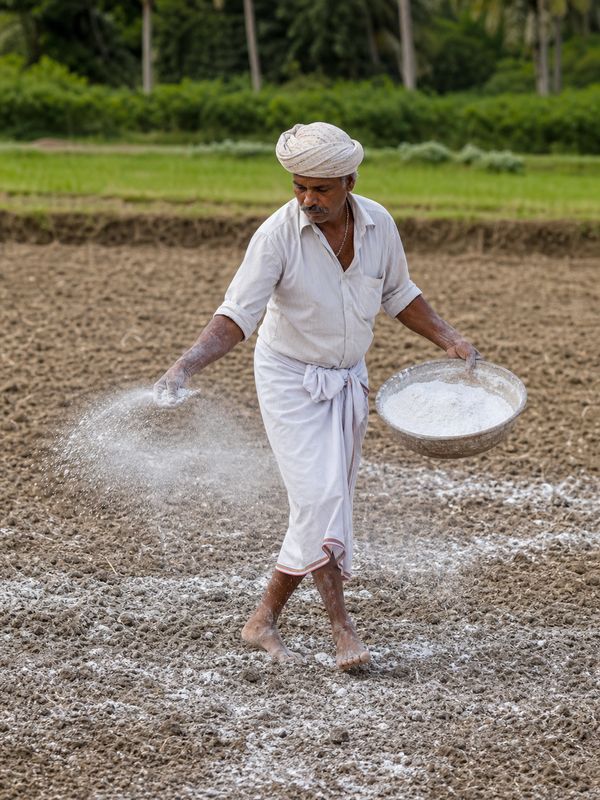
For paddy cultivation, 350 kg of lime or 400 kg of dolomite can be applied per hectare — which is more than the general recommendation. This helps correct soil pH and provides essential calcium and magnesium to support healthy crop growth.
Green cow dung mixed with water should not be applied in the morning when the mud is moist. For best results, it can be diluted by adding water and applied 2–3 times at this rate. Afterwards, filter the cow dung, and after application, the sprayer can be washed — the rinse water can then be poured into the field.
Through this process, the fermented liquid also reaches the field as manure, ensuring nothing is wasted and the field receives the full benefit of the organic input.
🌱 Recommended Seedling Age for Planting:
- ✅ First crop seedlings: 15–18 days old
- ✅ Older / traditional varieties: 20–25 days old
The fertilizer schedule below outlines the recommended quantities of each input based on the crop duration. Follow the basal dose timing and top-dressing schedule carefully for best results.
| Fertilizer | During Planting | Short Duration | Long Duration |
|---|---|---|---|
| Basal Dose | |||
| Rajphos | 66 | 85 | 115 |
| Muriate of Potash | 120 | 150 | 200 |
| Factamfos | 100 | 150 | 200 |
| Urea | 23 | 25 | 35 |
| Muriate of Potash (Top Dress) | 17 | 20 | 40 |
The table below details top-dressing quantities of Urea and Muriate of Potash by crop stage:
| Type / Stage | Urea (Kg/Ha) | Muriate of Potash (Kg/Ha) |
|---|---|---|
| I. During Planting | 22 | 17 |
| II. On the Twentieth Day | ||
| a) Short Duration | 35 | 30 |
| b) Long Duration | 45 | 38 |
💡 Pro Tip: A mixture of Urea and Rajphos can be broadcasted the day before applying fertilizer. The next day, Urea and Potash can be mixed together and kneaded into the mud for better absorption.
For plant growth, when spraying pesticides, it is sufficient to add the Non-ionic adjuvant required by the plant. This helps protect the leaves, roots, and stems from perishing.
⚠️ Important: If leaves do not get wet after applying Non-ionic adjuvant, various diseases such as rot can be prevented. However, if this dry condition persists for more than 4 days, disease can set in.
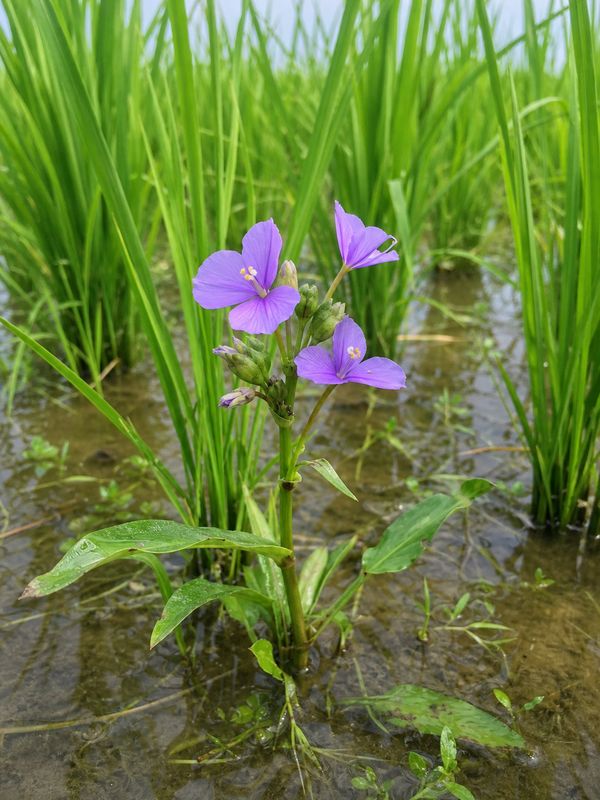
A common weed found in paddy fields has distinctive characteristics that every farmer should recognize early. Each of its petals, which are like a skirt folded in four, holds 4 liters of water. It usually withers even if it does not get water.
This weed transforms its tender leaves into characteristic leaves and thrives under clear sunlight and water with high salinity. Each plant contributes about 400,000 seeds. Once the violet-colored flowers bloom, it matures within a week — making early detection critical.
Its tender leaves, stems, flowers, and tubers can also be used as a vegetable, so the weed has dual-use potential. However, allowing it to spread uncontrolled can severely impact paddy yields.
Manual Removal
Having laborers pluck the weed out is the best and most effective method for controlling this weed in paddy fields.
Herbicide Spraying
It is best to spray herbicide in well-plowed fields. This approach is more effective when the field is properly prepared.
Water Drainage
This weed usually drains the water from the field, making timely control essential to prevent moisture loss.
Edible Use
Its tender leaves, stems, flowers, and tubers can all be used as a vegetable, offering a practical way to reduce waste.
Use 5 tons of organic manure instead of urea and phyto-hormones for healthier growth.
Apply 350 kg lime or 400 kg dolomite per hectare for optimal soil health.
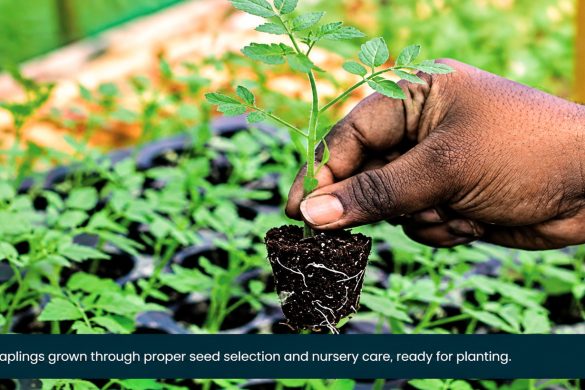
Plant seedlings at the right age — 15–18 days for first crop, 20–25 for older varieties.
Add Non-ionic adjuvant during pesticide spraying to protect leaves, roots, and stems.
Apply fermented cow dung liquid correctly — dilute properly and avoid morning moist-mud application.
Control violet-flowered weeds before they bloom — each plant produces ~400,000 seeds.