71
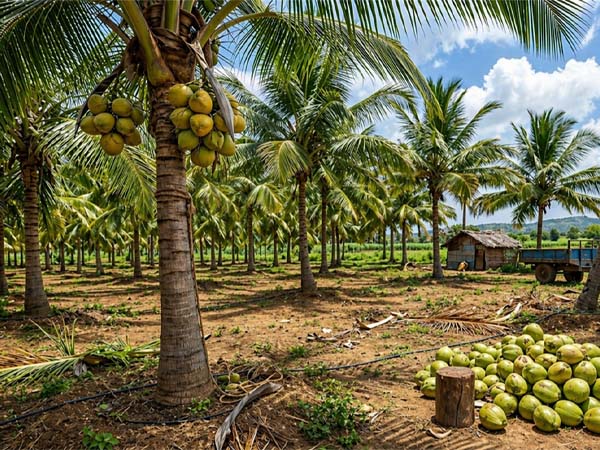

Coconut farming plays a major role in India’s agriculture, especially in coastal regions like Karnataka. However, many farmers face low productivity, mainly due to poor soil fertility. A recent study conducted in Dakshina Kannada and Udupi districts helps us understand:
- ✔ What nutrients are available in coconut soils
- ✔ Which nutrients are lacking
- ✔ How soil conditions affect yield
👉 This guide simplifies the research findings into practical insights for farmers.
The research focused on two major coconut-growing regions:
- Beltangadi (Dakshina Kannada) – High rainfall, hilly terrain
- Brahmavara (Udupi) – Coastal plains with humid climate
🌦️ Climate Highlights
- • Rainfall: 3200 mm to 4850 mm annually
- • Soil: Deep, well-drained, but nutrient-leached due to heavy rain
🌡️
Soil Reaction (pH)
- • Soil is acidic (pH 4.9 – 5.7)
- • Acidic soil reduces nutrient availability
👉 Acidic soils = Lower nutrient absorption = Reduced coconut yield
🌱
Organic Carbon
- • Surface soil: High organic matter
- • Subsoil: Low organic matter
👉 Plant residues and manure added only to topsoil
🧱
Soil Texture & Structure
- • Clay content: 28% – 42%
- • Moderate nutrient holding capacity (CEC)
Nitrogen (N) – Range: Low to Medium. Higher in topsoil, decreases with depth. 👉 Needed for: Leaf growth, overall plant vigor
Phosphorus (P) – Very Low across all soils. Gets locked in acidic soils (iron & aluminum fixation). ⚠️ Phosphorus deficiency is a major reason for low coconut yield.
Potassium (K) – Range: Low to Medium. Higher in surface soil. Important for: Nut formation, drought resistance.
Sulphur (S) – Mostly deficient. Essential for: Oil formation in coconuts.
Calcium (Ca) & Magnesium (Mg) – Low in both regions. Cause: Heavy rainfall washes these nutrients away.
Adequate Nutrients ✅ Iron (Fe), Manganese (Mn), Zinc (Zn), Copper (Cu)
❌ Deficient Nutrient: Boron (B)
Highly deficient in all soils. Important for: Flowering, Nut development.
⚠️ Boron deficiency directly affects coconut yield and nut quality.
📊 Key Observations
- • Nutrients highest in topsoil
- • Decrease with depth
- • Heavy rainfall: nutrient leaching & poor retention
⚠️ Major Soil Problems
- • Acidic soil conditions
- • Low phosphorus availability
- • Deficiency of S, Ca, Mg
- • Severe boron deficiency
- • Nutrient leaching
These soil issues result in:
- • Poor palm growth
- • Low nut yield
- • Reduced copra quality
👉 Conclusion: Improving soil fertility is critical for increasing coconut production.
🧪
1. Correct Soil Acidity
Apply lime or dolomite
🌾
2. Improve Organic Matter
FYM, Compost, Green manure
⚖️
3. Balanced Fertilization
NPK regularly, focus on P & K
🧬
4. Micronutrient Management
Apply boron & micronutrient mixtures
🌿
5. Prevent Nutrient Loss
Mulching, cover crops, drainage
📎 Full Research Paper (Case Study)