297

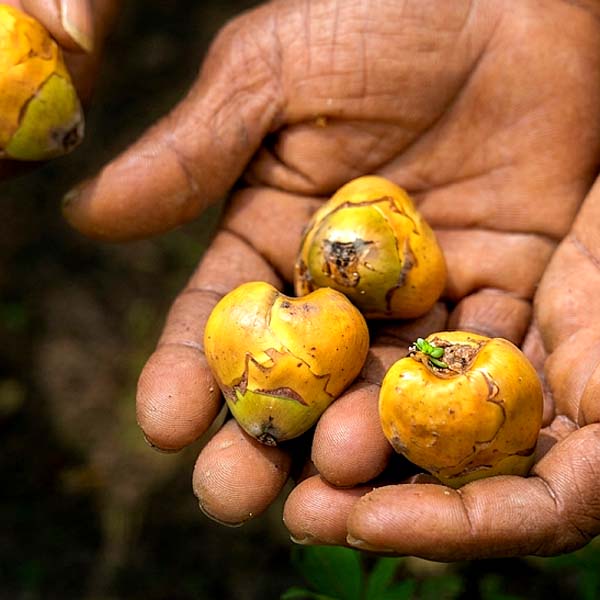
Kerala is known as the land of “Kalpavriksha” (the coconut tree). Although we are at the forefront in terms of coconut cultivation area, we are not equally ahead in productivity. One of the main reasons for this is the diseases that affect coconut yield. Many diseases impact coconut cultivation, leading to economic losses for farmers.
01
🪵 Stem Bleeding
✔ Symptoms
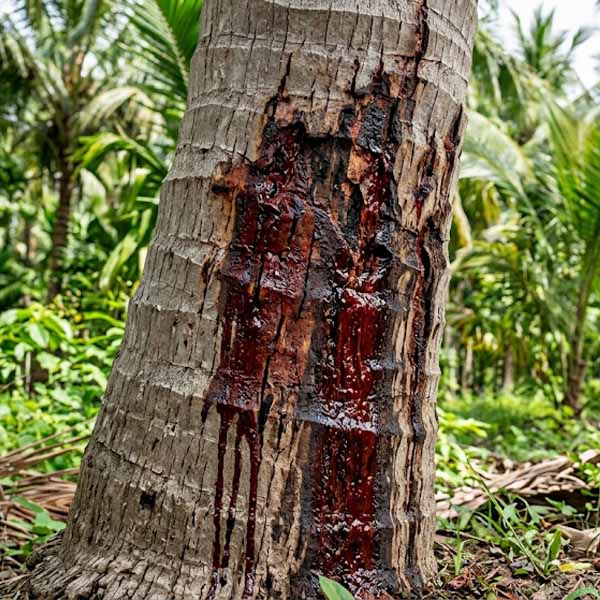
- This disease is characterized by the oozing of a reddish-brown liquid from the trunk of the coconut tree.
✔ Cause
- It is caused by the fungus Thielaviopsis paradoxa.
- Natural cracks in the trunk, environmental stress, and imbalanced fertilization can lead to this disease.
✔ Control Measures
- Apply 5 kg of neem cake mixed with Trichoderma around the base of the tree.
- Avoid burning waste materials close to the trunk.
- Ensure proper drainage and prevent water stagnation around the base, especially during the rainy season
01
🪵 Stem Bleeding
✔ Symptoms
- This disease is characterized by the oozing of a reddish-brown liquid from the trunk of the coconut tree.
✔ Cause
- It is caused by the fungus Thielaviopsis paradoxa.
- Natural cracks in the trunk, environmental stress, and imbalanced fertilization can lead to this disease.
✔ Control Measures
- Apply 5 kg of neem cake mixed with Trichoderma around the base of the tree.
- Avoid burning waste materials close to the trunk.
- Ensure proper drainage and prevent water stagnation around the base, especially during the rainy season
02
🌿 Thanjavur Wilt
✔ Symptoms
- Lower leaves initially lose color and wilt.
- Gradually, all leaves dry up, leading to complete destruction of the tree.
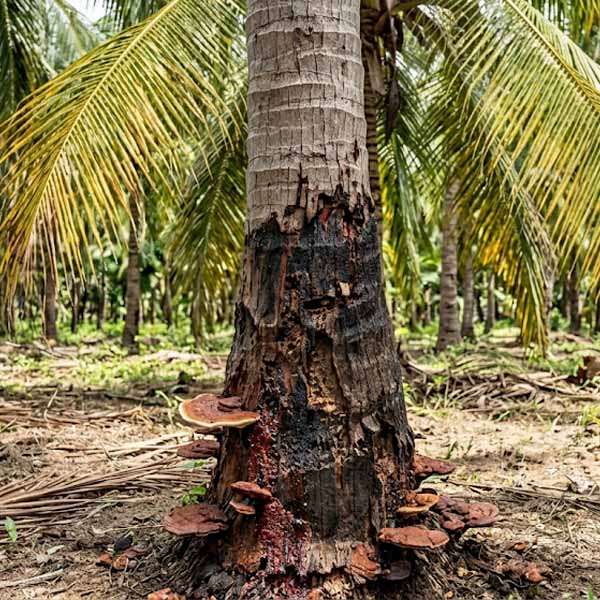
- Black exudation near the base and mushroom-like growths on the trunk are also symptoms.
✔ Cause
- This is a fungal disease.
✔ Control Measures
- Intercrop with banana, as root exudates of banana help suppress the fungus.
- Apply 40 liters of 1% Bordeaux mixture at the base of the affected tree.
02
🌿 Thanjavur Wilt
✔ Symptoms
- Lower leaves initially lose color and wilt.
- Gradually, all leaves dry up, leading to complete destruction of the tree.
- Black exudation near the base and mushroom-like growths on the trunk are also symptoms.
✔ Cause
- This is a fungal disease.
✔ Control Measures
- Intercrop with banana, as root exudates of banana help suppress the fungus.
- Apply 40 liters of 1% Bordeaux mixture at the base of the affected tree.
03
🌾 Crown Choke (Boron Deficiency)
✔ Symptoms
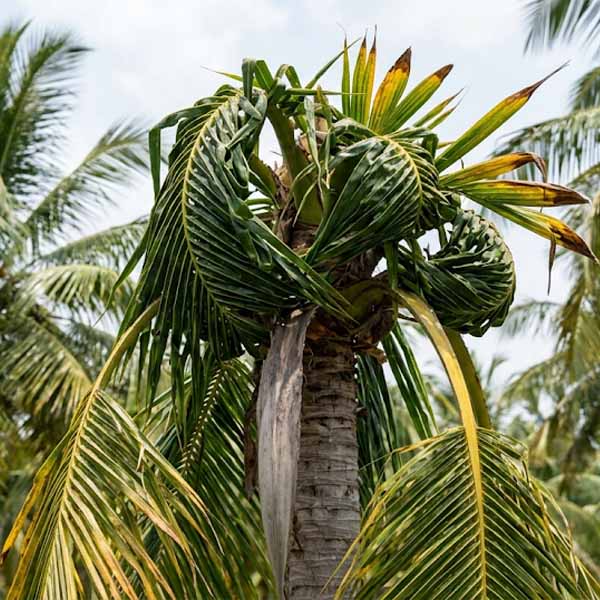
- Tips of leaves rot, shrink, and deform.
✔ Control Measures
- Apply 250 grams of borax along with organic manure, four times a year.
03
🌾 Crown Choke (Boron Deficiency)
✔ Symptoms
- Tips of leaves rot, shrink, and deform.
✔ Control Measures
- Apply 250 grams of borax along with organic manure, four times a year.
04
🍃 Leaf Rot
✔ Symptoms
- Appearance of large spots on young leaflets emerging from the crown.
- Spots enlarge, rot, and turn dark.
- Affects the edges and tips of the leaves.
✔ Control Measures
- Mix 50 grams of Pseudomonas fluorescens in 500 ml of water and apply.
- Repeat twice a year for effective control.
04
🍃 Leaf Rot
✔ Symptoms
- Appearance of large spots on young leaflets emerging from the crown.
- Spots enlarge, rot, and turn dark.
- Affects the edges and tips of the leaves.
✔ Control Measures
- Mix 50 grams of Pseudomonas fluorescens in 500 ml of water and apply.
- Repeat twice a year for effective control.
05
🥥 Button Shedding
✔ Symptoms
- Reduced nut size and thinner copra.
- Leaves may turn yellow.
- Edges may dry out.
✔ Control Measures
- Ensure proper fertilization and irrigation.
- Grow green manure crops like Sesbania around the base.
- Use disease-resistant varieties such as Kalpa Sree and Kalpa Raksha.
05
🥥 Button Shedding
✔ Symptoms
- Reduced nut size and thinner copra.
- Leaves may turn yellow.
- Edges may dry out.
✔ Control Measures
- Ensure proper fertilization and irrigation.
- Grow green manure crops like Sesbania around the base.
- Use disease-resistant varieties such as Kalpa Sree and Kalpa Raksha.
👉 Proper nutrient management, drainage, and disease control practices can significantly improve yield.
1. What are the most common coconut tree diseases in Kerala?
The most common coconut tree diseases in Kerala include Stem Bleeding, Thanjavur Wilt, Crown Choke (Boron Deficiency), Leaf Rot, and Button Shedding. These diseases significantly affect coconut yield and overall tree health.
2. What causes stem bleeding disease in coconut trees?
Stem bleeding disease in coconut trees is caused by the fungus Thielaviopsis paradoxa. It is often triggered by trunk injuries, environmental stress, poor drainage, and imbalanced fertilization.
3. How can stem bleeding in coconut trees be controlled?
Stem bleeding can be controlled by applying neem cake mixed with Trichoderma, avoiding burning near the trunk, and ensuring proper drainage to prevent water stagnation around the base.
4. What are the symptoms of Thanjavur wilt in coconut trees?
Thanjavur wilt symptoms include yellowing and wilting of lower leaves, gradual drying of all leaves, black exudation near the base, and mushroom-like growths on the trunk.
5. How do you treat Thanjavur wilt in coconut trees?
To control Thanjavur wilt, farmers can intercrop with banana and apply 1% Bordeaux mixture around the base of the affected coconut tree.
6. What is crown choke in coconut trees and how is it treated?
Crown choke is a condition caused by boron deficiency in coconut trees, leading to deformed and rotting leaf tips. It can be treated by applying 250 grams of borax along with organic manure regularly.
7. What causes leaf rot disease in coconut trees?
Leaf rot disease in coconut trees is caused by fungal infections that affect young leaves, resulting in dark spots, rotting, and drying of leaf edges and tips.
8. How can leaf rot in coconut trees be prevented?
Leaf rot can be prevented by applying Pseudomonas fluorescens solution and repeating the treatment twice a year for effective disease control
9. What is button shedding in coconut trees?
Button shedding is a common issue where immature coconuts fall prematurely, leading to reduced nut size, thinner copra, and lower yield.
10. How can coconut yield be improved by preventing diseases?
Coconut yield can be improved by adopting proper fertilization, irrigation, drainage management, using disease-resistant varieties like Kalpa Sree and Kalpa Raksha, and timely disease control measures.