
By Dr. C.K. Shaju, Peruva
Deputy Director (Retd.), Department of Animal Husbandry, Phone: 9447399303
Reader question: I would like to know about the milk replacers that are given to calves as an alternative to milk.
P.P. Sreedharan, Kanjirappally
The average body weight of crossbred calves at birth is 30 kilograms. When raising them scientifically, care must be taken to ensure there are no major problems.
For the first month, 3 liters of milk per day should be set aside just for the calf. Milk should be given until 3 months of age for the calves to have good growth. This requires more than 200 liters of milk.
Therefore, raising calves by giving them an excessive amount of the mother’s milk will be expensive. This is where the milk replacer, which is comparable to cow’s milk, becomes important.
30 kg
Average body weight of crossbred calves at birth
3 liters daily
Milk set aside for the calf during the first month
3 months
Milk feeding period for good calf growth
200+ liters
Milk needed when rearing calves with mother’s milk
💡 It contains 22% protein and 18% fat. Additionally, all the nutrients that a calf should get through milk are also present in the milk replacer powder.
Skimmed milk powder is the main component of milk replacer. Along with it, nutritional components such as plant- and animal-based fats, starches, glucose, grain powders including soybean, mineral salts, and vitamins including A, E, and B12 are also present in the milk replacer.
- ✅ Skimmed milk powder
- ✅ Plant- and animal-based fats
- ✅ Starches and glucose
- ✅ Grain powders including soybean
- ✅ Mineral salts
- ✅ Vitamins including A, E, and B12
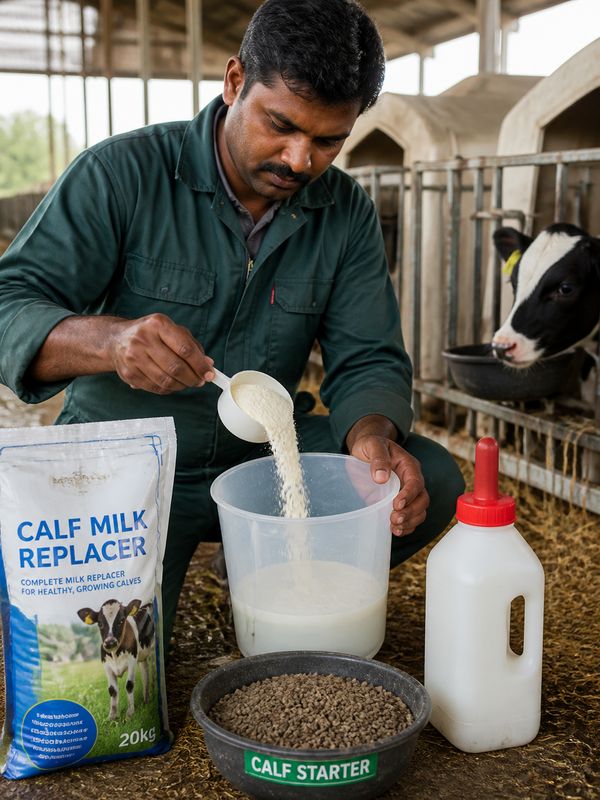
100 grams of milk replacer in one liter of lukewarm water at 37 degrees Celsius can be dissolved, and the resulting milk replacer solution can be given to calves instead of milk.
It should be provided based on the calf’s needs. Bottle feeders or nipple feeders are what are really needed to give the milk replacer solution.
🍼 Care must be taken to prepare a fresh solution for each feeding.
By separating the calf from the mother cow at birth and establishing weaning, the availability of milk can be ensured. This will cause the calf to stop suckling.
For the first week, the milk replacer solution can be given mixed with other things.
After this, the calf can be fed exclusively on the milk replacer solution twice a day.
Care must be taken to prepare a fresh solution for each feeding.
Feed according to the calf’s needs for steady growth and better management.
Besides milk replacers, it is also beneficial to train the calf to eat specially prepared calf starter feed, which is easily digestible and well-liked, as a light meal.
You can start by giving 100 grams per day and gradually increase the amount according to the calf’s preference.
🚰 By providing feed and fresh water in the right quantity and at the right time, the growth of the calf can be ensured.
By separating the calf from the mother cow, the farmer gets the entire milk. By providing feed and fresh water in the right quantity and at the right time, the growth of the calf can be ensured.
Can milk replacer be given to newborn calves instead of cow milk?
Milk replacer can be used as an alternative to milk after proper early feeding management. The article explains that separating the calf from the mother cow at birth and establishing weaning helps stop suckling and ensures milk availability. The replacer solution should be given based on the calf’s needs.
How much milk replacer powder should be mixed for calves?
The recommended mixing rate given here is 100 grams of milk replacer dissolved in one liter of lukewarm water at 37 degrees Celsius. This solution can then be given to calves instead of milk, preferably through bottle feeders or nipple feeders.
What nutrients are present in calf milk replacer?
Milk replacer contains about 22% protein and 18% fat. Skimmed milk powder is the main component, along with plant- and animal-based fats, starches, glucose, soybean and other grain powders, mineral salts, and vitamins such as A, E, and B12.
Why do farmers use milk replacer for calf rearing?
Using the mother’s milk for calf rearing can be expensive because more than 200 liters of milk may be needed until three months of age. Milk replacer, when used scientifically, helps support calf growth while allowing the farmer to retain the entire milk from the cow.
How often should calves be fed milk replacer?
After the first week, the calf can be fed exclusively on the milk replacer solution twice a day. The solution should be freshly prepared for each feeding and offered according to the calf’s needs through proper bottle or nipple feeding equipment.
When should calf starter feed be introduced?
Besides milk replacer, calves should be trained to eat specially prepared calf starter feed as a light meal. The article suggests starting with 100 grams per day and gradually increasing the quantity according to the calf’s preference and acceptance.