By George K. Mathai, Deputy Director (Rtd.), Department of Agriculture
E-mail: mathaigk@gmail.com
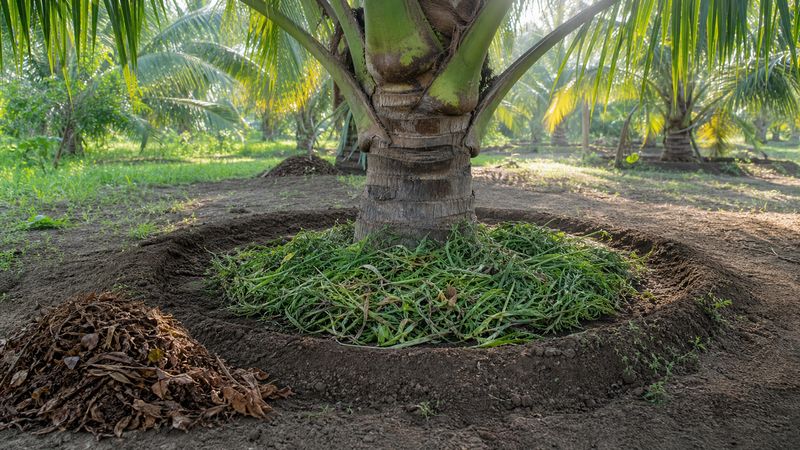
Coconut farming care first starts with opening the basins around the trees by the beginning of a month, followed by weeding, feeding at the base, and timely dolomite or lime application.
Quick answer: The basins around the trees should be opened by the beginning of this month, and after weeding, the weeds should be put in it. If river silt was not added, provide leaves and compost at the base of the trees.
Definition: Monthly coconut basin care means opening the basin, keeping it weeded, adding organic material such as leaves and compost when needed, and applying dolomite or lime from 30 cm away from the coconut tree’s base up to the edge of the basin.
The basins around the trees should be opened by the beginning of this month.
After weeding, the weeds should be put in it.
Sprinkle one kilogram of dolomite or 750 grams of lime from 30 cm away from the base.
For coconut trees less than 10 years old, EPN and a very clean base help prevent attacks.
The basins around the trees should be opened by the beginning of this month, and after weeding, the weeds should be put in it.
Steps block for coconut basin care:
- 1. Open the basins around the trees by the beginning of this month.
- 2. After weeding, put the weeds in it.
- 3. If you were unable to add silt from the river, provide leaves and compost at the base of the trees.
- 4. It should only be applied 30 cm (approximately one muzham/cubit) away from the coconut tree’s base.
- 5. As soon as the basin is opened, sprinkle one kilogram of dolomite or 750 grams of lime, starting from 30 cm away from the coconut tree’s base up to the edge of the basin.
Expert Tip: Keep the application zone clear: do not place leaves, compost, dolomite or lime right against the coconut tree’s base; begin from the recommended 30 cm distance.
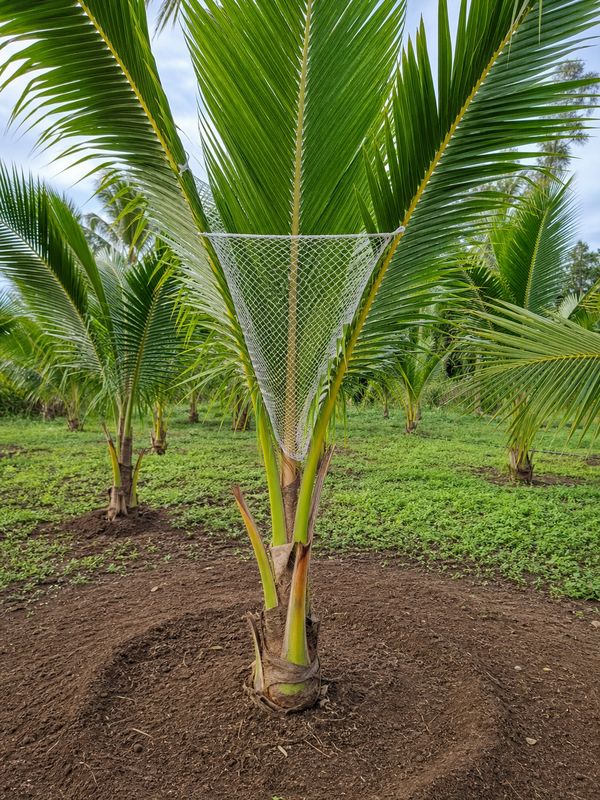
For coconut trees less than 10 years old, applying EPN (Entamo Pathogenic Nematode) at the base, while also keeping the base very clean without any weeds or leaves, will prevent stem bleeding and red palm weevil attacks.
Pest alert: By inserting nets with small mesh into the gaps of the top four fronds, rhinoceros beetles and red palm weevils can be reduced.
- ✅ Apply EPN at the base for coconut trees less than 10 years old.
- ✅ Keep the base very clean without any weeds or leaves.
- ✅ Insert nets with small mesh into the gaps of the top four fronds.
It has been experienced that the size of coconuts on the trees decreases as the summer heat increases and due to the lack of a continuous supply of calcium.
Did You Know? It was also observed that when these were supplied continuously for 2 years, the coconuts returned to their old size.
Boron deficiency is seen to affect plant density and maturation. This causes tender coconuts to fall and the quality of the coconut kernel to decrease.
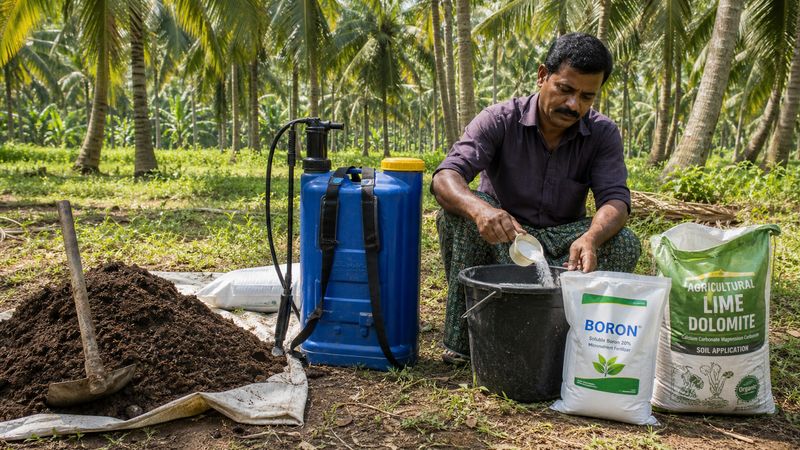
When you get mag mari sprinkled on cow dung, it can be given as is or by spraying. Boric acid, or boron fertilizer, should be sprayed by mixing it in the ratio of one gram per one liter of water, at a time when there is no rain.
If the number of coconut trees is few, it would be better to use the boric acid which is available in 20-gram packets in an orelikkavil poppar.
| Input Or Issue | Quantity / Method | Purpose Noted In The Article |
|---|---|---|
| Dolomite | One kilogram, starting from 30 cm away from the coconut tree’s base up to the edge of the basin | Applied as soon as the basin is opened |
| Lime | 750 grams, starting from 30 cm away from the base up to the edge of the basin | Alternative to dolomite in coconut basin care |
| Calcium supply | Continuous supply for 2 years was observed | Coconuts returned to their old size |
| Boric acid or boron fertilizer | One gram per one liter of water, sprayed when there is no rain | Helps address boron deficiency linked with tender coconut fall and lower kernel quality |
For effective coconut tree monthly care, open the basins early in the month, weed properly, add leaves and compost if river silt was missed, and apply dolomite or lime only from 30 cm away from the base. Clean bases, EPN, small-mesh nets, calcium supply and boron spray together support healthier coconut palms.
What should I do for coconut trees at the beginning of this month?
Open the basins around the coconut trees by the beginning of this month. After weeding, put the weeds in the basin. If silt from the river could not be added, provide leaves and compost at the base, but apply them only from 30 cm away from the coconut tree’s base.
How far from the coconut tree base should dolomite or lime be applied?
Dolomite or lime should start from 30 cm away from the coconut tree’s base and continue up to the edge of the basin. The article specifically notes this 30 cm distance, approximately one muzham or cubit, so the material is not placed directly against the base.
How much dolomite or lime is recommended for coconut basin care?
As soon as the basin is opened, sprinkle one kilogram of dolomite or 750 grams of lime. The application should begin 30 cm away from the coconut tree’s base and extend to the edge of the basin, making the placement as important as the quantity.
How can stem bleeding and red palm weevil attacks be prevented in young coconut trees?
For coconut trees less than 10 years old, apply EPN, described as Entamo Pathogenic Nematode, at the base. At the same time, keep the base very clean without weeds or leaves. This combination will prevent stem bleeding and red palm weevil attacks.
How do small mesh nets help in coconut pest control?
Small mesh nets can be inserted into the gaps of the top four fronds. According to the article, this helps reduce rhinoceros beetles and red palm weevils. It is a practical physical barrier method that supports coconut pest management along with keeping the palm base clean.
Why do coconuts become smaller during summer?
The article notes that coconut size decreases as summer heat increases and because of the lack of a continuous supply of calcium. It was also observed that when these were supplied continuously for two years, the coconuts returned to their old size.
How should boric acid or boron fertilizer be sprayed on coconut trees?
Boric acid, or boron fertilizer, should be sprayed by mixing it at the ratio of one gram per one liter of water. The spray should be done at a time when there is no rain. For a few coconut trees, 20-gram packets of boric acid are considered better.