🧑🔬 Information Courtesy: Dr. Santhosh J. Eapen, Principal Scientist, IISR, Kozhikode. For more information: 0495-2731410
A new variety of pepper that has captured the hearts of farmers with its high productivity.
In the context of the threat of global warming, pepper cultivation is facing a major crisis. The success of experiments conducted at the Nilambur estate, which is suitable for pepper cultivation, and at the Panniyur station of the Kerala Agricultural University is a relief.
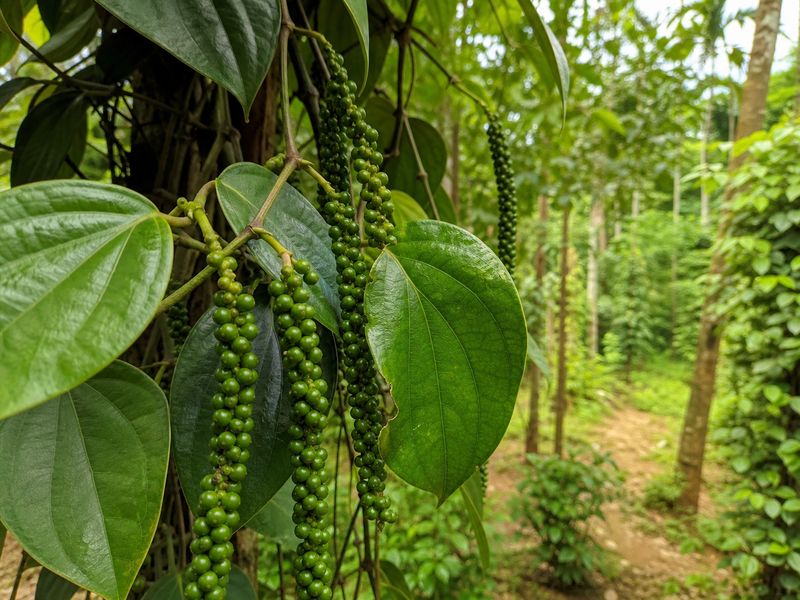
However, the reality that there has already been a massive drop in production cannot be forgotten. The low pollination capacity of varieties like Panniyur 1, 2, 5, and 8 developed by the Kerala Agricultural University is also a reason for this.
Moreover, in common pepper varieties, pollination occurs only up to about 15 percent. In adverse weather conditions, the pollination rate drops even further.
From 6-year-old vines, approximately 7.5 kg of green pepper is obtained.
Approximately 7.5 kg of green pepper gives about one and a half kg of dried pepper.
In experimental cultivation, it is said that a maximum of up to 21.5 kg of green pepper has been obtained from a single vine.
This is the minimum that can be expected.
Chandra has long spikes on its lateral branches, known as compact setting.
Another special feature is its plump berries, or bold berries.
A single spike yields about 90 berries.
It is resistant to pests.
| Dry weight recovery rate | 33.5 percent |
| Weight of 1000 peppercorns | 156 grams |
| Pungency and aroma | Equivalent to the world-famous Malabar pepper |
| Alpha-pinene in common pepper oil | 5.1 percent |
| Beta-pinene that causes aroma | 3.2 percent |
| Oleoresin | 8.7 percent |
💡 The fact that this variety has more oil content and the ability to resist other climatic changes is what attracts the attention of farmers.
- 🕘 To plant Chandra saplings, it is best to choose a time before 10 AM and after 4 PM.
- 🌿 Carefully dig out the four-month-old sapling with soil from 4 inches away from its base without cutting the taproot.
- 🕳️ Then, plant it in a pre-prepared pit.
- 🧫 Before planting, it is good to dip the roots in a Pseudomonas solution.
- 🛡️ This can protect the plants from wilt disease and quick wilt.
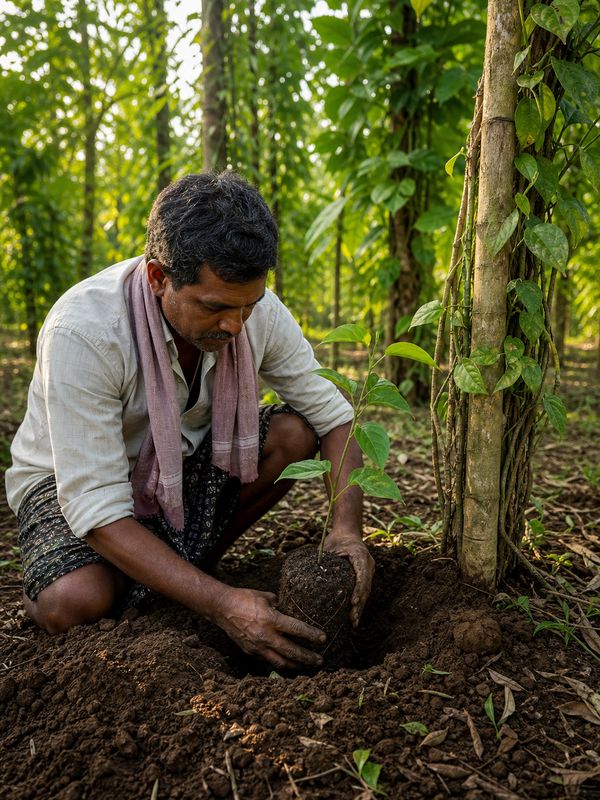
The saplings should be given enough shade.
They should be watered during summer.
Fertilizers can be applied after 6 months.
Also, applying fertilizer twice a year is good. However, it does not require extra fertilization. Extra care is also not required.