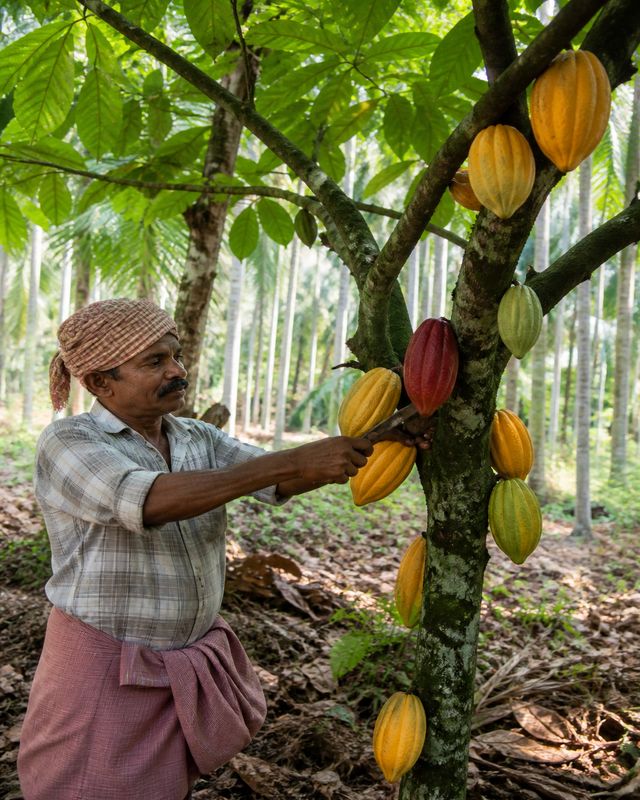
By Joby Joseph Thottungal
Ten years ago, the average international market price for one kilo of dried cocoa beans was 152 rupees. In the first week of March this year, it reached 525 rupees. That is, a 245% increase! By the last week of March, the price rose to 630 rupees – a 314% increase! Farmers are now in a situation where buyers are approaching them, offering ‘even more’. Demand is that high.
🍫 Key price signal: Even setting aside this year’s record price, cocoa prices have been stable for the past 10 years, which is one reason farmers are watching this crop closely.
The next question is whether this bumper gain will last. Market experts say that even the current record price will not fall for months. The reason is the production cost faced by major producing countries and the shortfall in supply during the off-season.
Ivory Coast and Ghana, which account for 60% of global cocoa production, are in the grip of the ‘El Niño’ weather phenomenon.
Due to increased humidity, diseases spread in the cocoa plantations of both countries, and severe drought followed.
Major processing-exporting companies in these countries have shut down many of their plants. There is also a lack of availability of beans.
The situation is the same in Nigeria’s cocoa plantations.
Even if the current super price comes down after the season, with disease and pest attacks being controlled, one should not think it will fall. Global conditions indicate that the upward trend will continue for now.
⚠️ Global rule change: Cocoa is accused of causing global warming. The European Union has already banned cocoa beans produced through deforestation. On the other hand, chocolate consumption is also increasing every year.
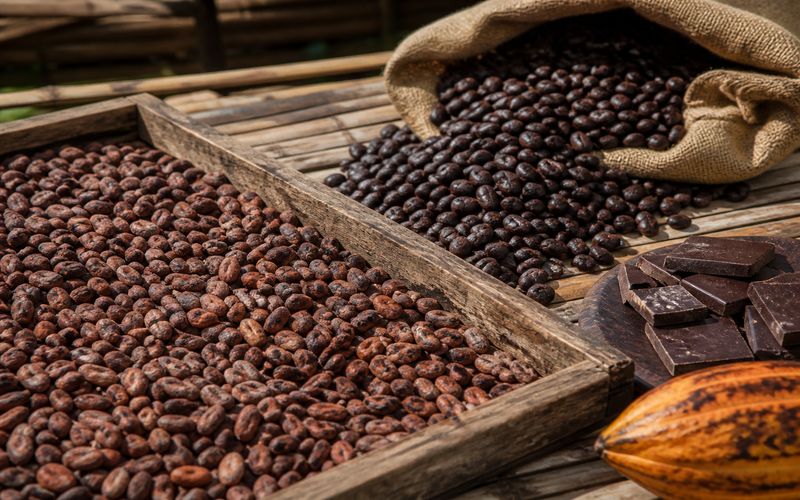
The only source of real chocolate is natural cocoa. This fact remains unchanged to this day. It is estimated that around 3600 chemical changes occur between the cocoa bean becoming chocolate.
These changes during fermentation, sun-drying, and roasting determine the unparalleled quality, taste, and flavor of chocolate. There is no substitute for this taste. That is why large companies, including Mondelez (Cadbury), are moving into cocoa cultivation.
Still, they are not getting enough beans. The supply-demand gap is likely to widen in the coming years. This is also the situation that is assessed to make the future of cocoa cultivation bright.
Even setting aside this year’s record price, cocoa prices have been stable for the past 10 years. During the season, the price for wet beans has been from 45 to 65 rupees and for dry beans from 165 to 185 rupees. This is what has attracted the farmers of the state in recent times.
Farmers will not abandon cocoa because it is an intercrop, has low maintenance costs, and provides a weekly income. For a common farmer, a weekly income is not a small thing. The low investment also encouraged them to start farming. Thus, it was when they started farming with the mindset ‘not great, but not that bad either’ that cocoa’s price became a ‘jackpot’.
🌱 Farmer expectation: Farmers did not expect this ‘lottery’ to last. They believe that the farming will be very profitable if they can get an average of 65 rupees per kilo for wet beans and 250 rupees for dry beans.
Considering the global cocoa production scenarios and the huge growth of the chocolate market, it can be expected that the state’s market will achieve a stable gain at the aforementioned price.
The sweetness of the current price hike. But for many farmers in the state, it is a statement of disappointment that they do not have the opportunity. A good percentage of the crops in the highlands were destroyed, turning farmers against cocoa. Those who continued farming did not give it much care.
The 2018 flood and the subsequent increase in the menace of monkeys and squirrels in the landslide-affected hilly areas also caused a decline in cocoa cultivation.
When cocoa cultivation decreased in Kerala, cultivation increased in Andhra Pradesh. Not only that, they also became number one in cultivation area. Cocoa has also started farming systematically in Tamil Nadu, Assam, and Meghalaya.
In the West Godavari region of Andhra Pradesh, cocoa is cultivated as a part of large-scale farming. It is cultivated very scientifically and profitably along with coconut. While our average production is two kilos of dry beans per tree per year, in Andhra it can be up to double that.
⭐ Quality advantage: However, due to adverse weather conditions, the cocoa butter content in the beans harvested in Andhra is low. In terms of quality, our cocoa beans are the best. The beans grown in our climate have a special quality and flavor. That is why big chocolate companies show a preference for our beans.
Although it starts bearing fruit in one and a half years, it takes 4-5 years for cocoa to reach its best yield. Therefore, cocoa is not a crop to be cultivated hastily seeing the price hike.
Although it can be a main crop, you get a steady production when you grow it as an intercrop. In our country, cocoa is grown as an intercrop with coconut and areca nut. In the current situation, it is worth thinking about giving cocoa a place in integrated farming systems.
👩🔬 Expert view: Dr. J.S. Minimol, a scientist at the Cocoa Research Centre of the Kerala Agricultural University, says that it is worth renovating the neglected plantations.
"Many plantations are not maintained, with the attitude of ‘whatever we get is enough’. If properly maintained, they can be elevated to excellent production in a short time. A mature tree yields an average of 150 pods per year. There are trees that yield more or even double that.
Although the main production season is April-July, well-maintained plantations will have a decent harvest throughout the year. The trees in the state’s plantations are ones that are adapted to the climate and have excellent genetic potential from hybrids. That is why our cocoa trees are able to resist diseases and pests."
Why are cocoa prices rising so sharply?
Cocoa prices are rising because global supply is under pressure while chocolate consumption continues to grow. Ivory Coast and Ghana, which together account for 60% of global cocoa production, have faced El Niño-related humidity, disease spread, and severe drought. Bean availability has reduced, and some processing-exporting companies have shut down plants.
Will the current cocoa price increase continue?
Market experts say even the current record price may not fall for months. Even if the super price comes down after the season, the article notes that global conditions indicate the upward trend will continue for now, especially because of production costs, off-season supply shortfalls, and disease and pest pressures in major producing countries.
Is cocoa farming profitable for small farmers?
Cocoa can be attractive for small farmers because it is an intercrop, has low maintenance costs, and can provide weekly income. Farmers believe cultivation can be very profitable if they receive around 65 rupees per kilo for wet beans and 250 rupees for dry beans, especially in a stable market.
How long does cocoa take to give good yield?
Cocoa may start bearing fruit in about one and a half years, but it takes 4-5 years to reach its best yield. Because of this, the crop should not be planted hastily only by looking at a temporary price hike. It suits long-term planning, especially as an intercrop with coconut or areca nut.
Why do chocolate companies prefer Kerala cocoa beans?
The article notes that beans grown in Kerala’s climate have special quality and flavor. Although Andhra Pradesh has expanded cocoa cultivation and may produce higher yields per tree, adverse weather conditions there can reduce cocoa butter content. This quality advantage is why big chocolate companies show a preference for Kerala beans.
Can neglected cocoa plantations be improved?
Yes. Dr. J.S. Minimol of the Cocoa Research Centre of Kerala Agricultural University says neglected plantations are worth renovating. Many plantations are maintained with the attitude that whatever is received is enough, but with proper care they can be elevated to excellent production in a short time.