The central government claims that the aim is to regulate and perfect the production, quality, distribution, and sale of pesticides. The Centre points out that the new pesticide law will equally protect the lives of farmers and cattle, and that the law provides for the maximum promotion of biopesticides among farmers and for the circulation of basic pesticides.
However, the new law also has many loopholes in the regulatory mechanism. There is criticism against the bill that the powers of the states are limited. There is also a complaint that the bill has no provision for price control or to take action for notification.

This is one of the main challenges faced by the primary agricultural sectors like pesticides and fertilizers. Some studies reveal that about 25 percent of the pesticide market is captured by fake products. The old saying ‘poison-free farming is alien to Malayalis’ should be changed.
The biggest problem with the draft bill presented in the Rajya Sabha by the Union Minister for Agriculture and Farmers’ Welfare, Shri Raj Singh Chauhan, is that unofficially, agriculture has been widely destroyed in all states by using fake seeds and pesticides. This has been the main problem for farmers to date. The draft bill was introduced giving priority to all security measures, including steps to destroy the fake market.
⚠️ Key concern: Deadly pesticides banned in developed countries including Canada are still widespread in India. For example, Endosulfan. 27 pesticides banned in Kerala are still abundant in neighboring states. The states are unable to control their cross-border flow.
A law is needed to put an end to this. A new law is essential to control the manufacture, storage, sale, use, and disposal of pesticides. However, efforts to make the law have been going on for decades without success. A year has passed since the draft of the new law was approved by the Union Cabinet on February 12, 2020.
According to the new law, a Central Pesticide Board will be established. Its members will be representatives of central government departments, 5 representatives from the states, and 2 representatives of farmers. A toll-free number will also be set up at the Centre as a government advisor.
Representatives of central government departments will be part of the board.
5 representatives from the states are included in the proposed structure.
2 representatives of farmers will be members of the board.
A toll-free number will also be set up at the Centre.
Bio-products, or biostimulants, that emerged under the scheme formulated to eradicate fakes were established. To counter this, farmers made a fertilizer control order. Subsequently, the Union Agriculture Minister also announced the consolidation of the outdated seed and pesticide laws.
Strict provision for labeling pesticides was made mandatory by the Centre. The draft of the new notification was presented in the current session of Parliament. Its further discussions have now been published by the Union Ministry of Agriculture and Farmers’ Welfare.
✅ Important change: The Pesticide Management Bill 2020 replaces the 1968 Pesticide Act, which is 57 years old and outdated.
It was a long-standing demand of farmers and voluntary organizations in the agricultural sector that it should be amended in accordance with the times. Draft laws were brought in 2008, 2017, 2019, and 2020 but did not bear fruit. It was not passed due to opposition. There is no significant change between the 2020 draft law and the previous draft.
The new law is to comprehensively create village public infrastructure, natural resource protection, waste management, and modern construction methods as new schemes. The Centre also says that it is farmer-centric.
The board will advise the central and state governments on criteria, scientific methods for identifying pesticides, pesticide neutralization, and training standards for workers. The new bill also has provisions to evaluate safe alternative pesticides, and the distribution, efficiency, and safety of registered pesticides. Pesticide residues in food items will be assessed.
The authority to grant registration for new pesticides rests with the Central Registration Committee. Online registration is mandatory for certificates for pesticides used in sectors such as agriculture, environment, and health. All applications must be submitted in digital form.
The manufacturer and importer of new pesticides must provide specified information to the registration committee in digital form. It will contain the name of the chemical substances in the pesticides, chemical structure, toxicity, specialty, and all other information required to assess the efficiency, safety, and lifespan of each pesticide for which the application is made.
Export can be done in case of emergencies. There will be simple procedures for approving biopesticides and pesticides based on farmers’ traditional knowledge, with the approval of the National Disaster Management Authority.
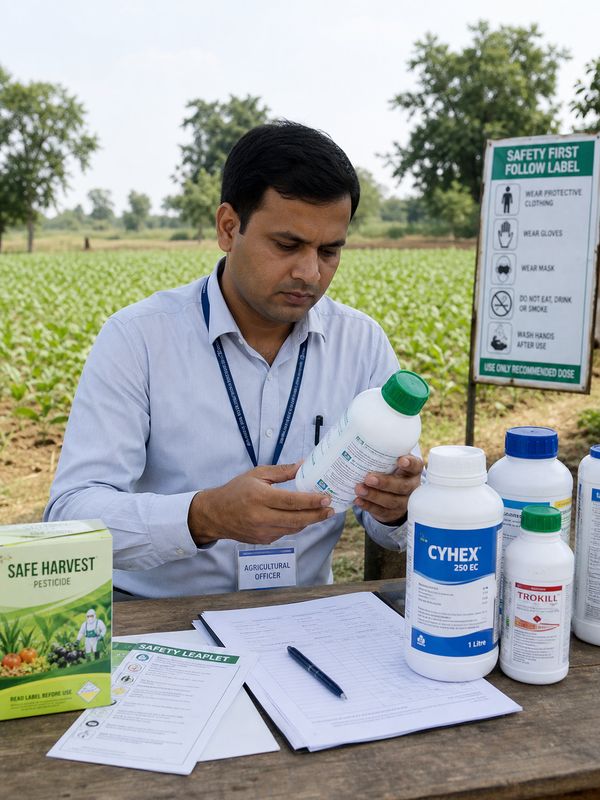
When an application for registration of a new pesticide is received, the registration committee must take a decision within one year.
If a decision cannot be taken within this time limit based on the available information, the time can be extended by another 6 months.
To extend the deadline again, permission from the central government must be obtained.
If a decision cannot be taken on applications for generic pesticides within 18 months, it will be considered registered and a certificate will be issued.
The central or state governments can grant temporary registration to new pesticides for 3 years.
If sales are to continue after 3 years, a permanent certificate is mandatory.
Within the temporary registration period, complete information regarding safety, efficiency, and environmental impact must be collected. If a registered pesticide is not produced within 3 years, the certificate will become invalid. If the certificate is for import and a license for production or sale is not obtained within one year, the registration will be cancelled.
If it becomes clear that a pesticide is harmful to humans, other living beings, and the environment, the registration will be cancelled at any stage. Registration will also be cancelled for violation of pesticide laws. The decision of the registration committee regarding a cancelled pesticide can be reviewed. The central government has the power to accept appeals on rejected registration applications.
💻 Digital record: It is the responsibility of the registration committee to maintain a National Register of Pesticides in a digital portal, including all registered pesticides.
If any pesticide in use is found to be dangerous to human health, other living beings, and the environment, and a basis for it is established, its distribution and sale can be banned by the central and state governments. The ban will be for one year. In the existing law, this is 6 months. If the registration committee finds that the banned pesticide is not dangerous…
Main crops related to milling.
While addressing issues related to the interests of multinational companies, the corruption and negligence of officials, and anti-environmental development perspectives, they have moved away from the real problems faced by farmers. There are big lobbies behind the easy availability in India of deadly pesticides that are banned even in the European Union.
There is no special system to address farmers’ complaints. Rights including the pricing of registered pesticides have been handed over to corporates. There is no system to stop the exorbitant pricing of fake pesticides that cause continuous crop loss and farmer suicides.
⚠️ Farmer cost pressure: Paddy farmers who cultivate for the first and second seasons in many parts of Kottayam district are hesitant to cultivate due to the financial burden caused by the annual increase in pesticide costs.
Meanwhile, pharmaceutical companies are reaping profits worth crores every year. If pesticides are applied in excess of the permissible limit, it will adversely affect both the crop and the soil. Chemicals are widely used to color crops and ripen them quickly. These are sold without registration.
The new pesticide is not being registered because its registration process is not complete. However, it is the multinational registration committees that have to prove that these pesticides are safe. It was farmers who were selling these products in foreign countries with high safety standards on applications. Chemicals are a result of the applicant’s ignorance, the elitist attitude of officials, and special interests.
The new law is also connected to the pesticide law. There is no special provision for education to prevent pesticide use. The compensation system for those who suffer from pesticide use is not effective. This is a matter for the states. But, states do not have a strong legal system to provide compensation.
A law is necessary. To implement the law, states need sufficient financial assistance. The central law does not give importance to the production and use of biopesticides. The 1968 pesticide law does not differentiate between chemical pesticides and biopesticides. However, the new law…
…countries that are members of our national treaty. Pesticide residues in food are a major health issue. It is a major cause of environmental problems. The bill provides…
For those who violate the provisions of the Pesticide Act, the fine ranges from ₹50,000 to ₹50 lakh. Imprisonment from 3 to 5 years will also be imposed. If the offense is repeated, the fine can be increased.
Violation of the provisions of the Pesticide Act can attract a fine from ₹50,000 to ₹50 lakh.
Imprisonment from 3 to 5 years will also be imposed for violations.
Selling unregistered, registration-cancelled, banned, or expired pesticides can lead to up to 2 years imprisonment and a fine from ₹10 lakh to ₹40 lakh.
For use and sale of a pesticide that causes death and serious health problems, the punishment is 5 years imprisonment and a fine of ₹10 lakh to ₹50 lakh.
Even if the chemical composition, tampering, or appearance of the pesticide is changed, or if anything is changed in the biopesticide, its label, or leaflet, a fine of ₹2 to ₹5 lakh can be imposed. If this is repeated, the registration certificate and license will be suspended or cancelled.
What is the main aim of the new pesticide law in India?
The central government claims that the aim is to regulate and perfect the production, quality, distribution, and sale of pesticides. It also says the law will protect farmers and cattle, promote biopesticides, circulate basic pesticides, and create stronger controls over manufacture, storage, sale, use, and disposal.
Why are farmers concerned about fake pesticides?
Some studies reveal that about 25 percent of the pesticide market is captured by fake products. The article notes that agriculture has been widely destroyed in many states by fake seeds and pesticides, making fake-market control one of the central reasons given for the draft bill.
How will pesticide registration work under the new law?
The Central Registration Committee will grant registration for new pesticides. Online registration is mandatory, and manufacturers or importers must submit digital information including chemical substances, chemical structure, toxicity, specialty, efficiency, safety, and lifespan details for each pesticide application.
Can harmful pesticides be banned under the proposed law?
Yes. If any pesticide in use is found dangerous to human health, other living beings, and the environment, and a basis for it is established, the central and state governments can ban its distribution and sale. The proposed ban period is one year, compared with 6 months in the existing law.
Does the bill solve pesticide price control issues?
The article states that there is criticism against the bill because it has no provision for price control. It also says farmers face rising pesticide costs, while there is no system to stop the exorbitant pricing of fake pesticides that cause continuous crop loss and severe financial stress.
What punishments are proposed for pesticide law violations?
For violations, fines range from ₹50,000 to ₹50 lakh, and imprisonment from 3 to 5 years can be imposed. Selling unregistered, banned, expired, or registration-cancelled pesticides can bring up to 2 years imprisonment and a fine from ₹10 lakh to ₹40 lakh.