Is it a duck? Weighing around two and a half, three, or three and a half kilos. Egg production even in adverse conditions. No fuss about cage or food. – Is there such a duck? Of course! That is Snow White.
The story of a rejected stone becoming the cornerstone is what this breed, which was developed 10 years ago but went largely unknown, is all about.
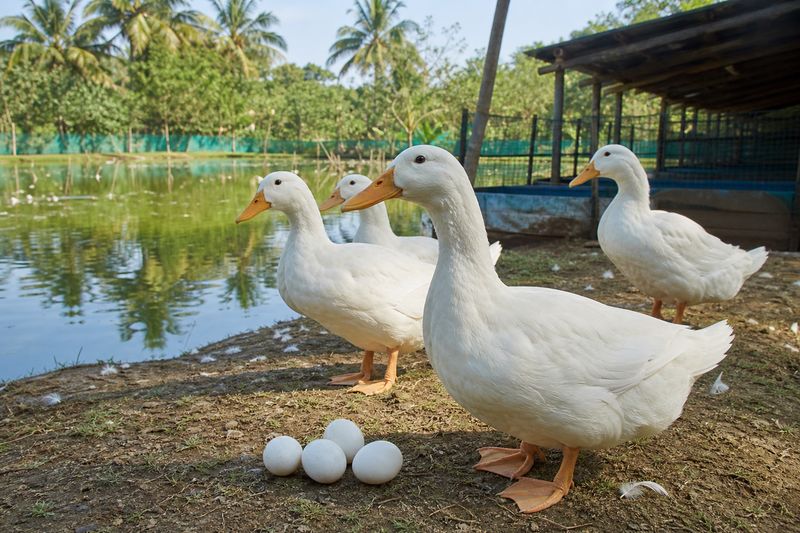
It has a pure white color. But the color is not the point. Snow White earned its name because of these superior qualities. It surpasses the Vigova breed in meat production and the Chara and Chembally breeds in egg production.
It was discovered by Dr. Thomas Jacob, who was the assistant director at the Niranam Duck Farm near Thiruvalla.
Meat weight
around two and a half, three, or three and a half kilos
Egg production
even in adverse conditions
Easy keeping
No fuss about cage or food
Pure white
A breed discovered under veterinary observation
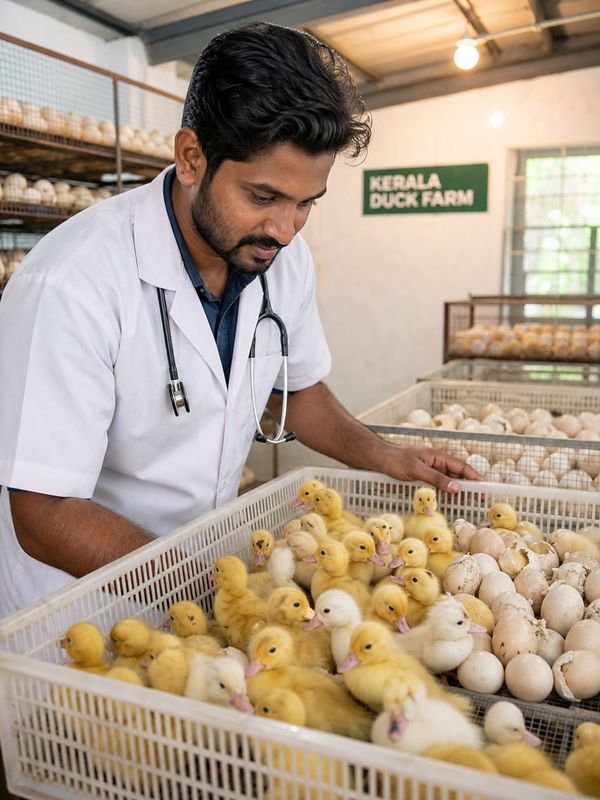
The newly hatched Chara and Chembally ducklings are dark yellow. Along with them, a few light-yellow ducklings would also be born. Although these were also given to the farmers, it was a common practice to abandon these weak ducklings.
Farmers said that these very unhealthy ducklings would die within a few days. At the same time, some farmers said that if given special care and helped through their early troubles, they would have higher productivity than other ducks.
Dr. Thomas Jacob became curious about this observation. He took some of the abandoned ducklings and raised them in a separate cage. He soon became convinced that what the farmers said was true. Although their growth was similar to Chara and Chembally and they looked like Vigova, they laid comparatively more eggs.
“We would get only one or two such ducklings,” says Dr. Jacob Thomas. He separated these ducklings and raised them. He was able to collect about fifty such ducks.
Then he thought about crossbreeding them with Vigova ducks. There was a good reason for this. It was a time when the production of Vigova ducklings had caused a huge loss for the duck farm. The reason was the low egg production of Vigova, despite their slow growth.
At the same time, the demand for Vigova was increasing day by day. After waiting for eight to ten months for breeding, only thirteen to fifteen Vigova ducklings would be obtained.
When the price of Vigova’s meat and the cost of production were taken into account, the farmer suffered a significant loss. On one hand, farmers couldn’t get Vigova ducklings even at a price that covered the production cost, and on the other hand, the farm was incurring losses due to the skyrocketing production costs.
As a solution to this, the idea of a meat duck with higher egg production lingered in the doctor’s mind, and the Kuttanadan Vella emerged as a possibility. Chara and Chembally, which are preserved as pure breeds, were not allowed to be used for crossbreeding. Kuttanadan Vella, however, had no such restrictions.
Thus, the ducklings obtained by crossing a Kuttanadan Vella female with a Vigova Super male showed growth equal to that of the Vigova, which excited the doctor. Not only their egg production but also their hatching percentage was relatively high. He saw the birth of a new breed emerge. He produced more of these hybrid ducklings and began marketing them. The goal was to tell the story of the discovery of this superior breed that had hatched.
Meanwhile, one day when the eggs were hatching, the farm workers saw an unbelievable sight and ran to the doctor, saying, “Sir, a miracle, come and see.”
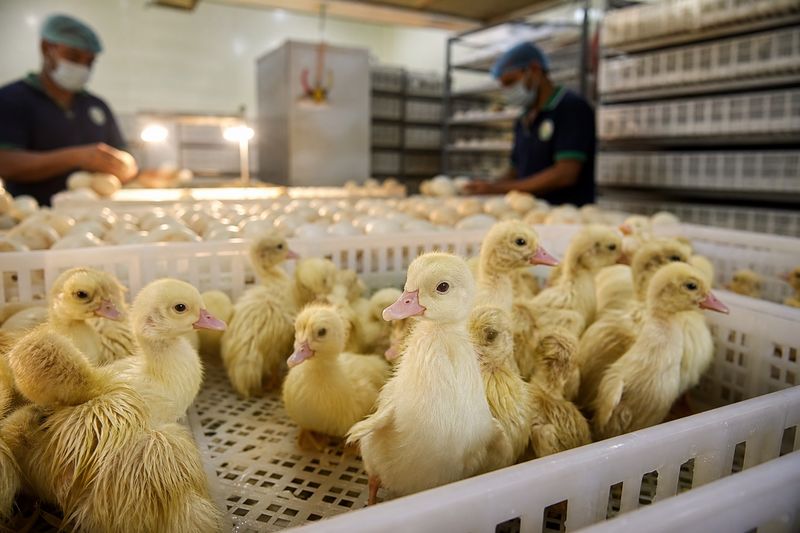
The doctor was also surprised to see the pure white ducklings that had hatched there. Since both Vigova and Kuttanadan Vella are brown/black colored, how could this be pure white! Ducklings usually turn white only after one or two months of growth.
The ducklings that were white when they hatched were named Snow White and raised.
The Snow White drakes, raised on broiler feed, reached an average weight of 2.4 kilos in 50 days.
Some even reached a weight of up to 3.1 kilos in sixty days.
The females, on the other hand, laid 220 eggs a year.
When farmers expressed their satisfaction, it was confirmed that Snow White is suitable for our agricultural sector.
The Snow White ducks were given on an experimental basis to farmers who were frustrated with raising Vigova. However, for a new breed to be officially recognized, it still has to cross many hurdles. Snow White has found a place on the list of the Department of Animal Husbandry.
The doctor wishes that more research should be conducted on this breed and that a more improved Snow White should be made available to farmers.
Since it’s a hybrid, the ducklings born after one or two generations may not have the same qualities. However, the doctor found a remedy for that. That is to improve them as a pure native breed with the Kuttanadan Vella.
When farmers selectively bred and developed Chara and Chembally, which have an average egg production of 180 eggs, over generations, early ailments and the white coating… The doctor said that we also had native duck breeds named Pandi and Kuruppu. They disappeared over time.
The genetic traits of the Kuttanadan Vella, which were hidden in duck flocks of mixed breeds, appeared in a modern form when this breed hatched. It is when thousands of eggs are hatched…
As the Department of Animal Husbandry has recognized Snow White, the Niranam Duck Farm has received permission to produce its ducklings. It may take a year for the ducklings to hatch after the parent stock is created.
However, ducklings from the limited Snow White stock at the Manjadi Duck Hatchery may be available within a few months. Phone: 0469-2963303
📞 9400701138
What is the Snow White duck breed known for?
Snow White is known for its pure white color, meat weight, and egg production even in adverse conditions. According to the article, it surpasses Vigova in meat production and Chara and Chembally in egg production, while also being less fussy about cage and food conditions.
Who discovered the Snow White duck breed?
The breed was discovered under the observation of Dr. Thomas Jacob, who was the assistant director at the Niranam Duck Farm near Thiruvalla. He became interested after hearing farmers say that some rejected light-yellow ducklings performed better when they survived early problems.
How much does a Snow White duck weigh?
The article describes Snow White ducks as weighing around two and a half, three, or three and a half kilos. Snow White drakes raised on broiler feed reached an average weight of 2.4 kilos in 50 days, and some reached up to 3.1 kilos in sixty days.
How many eggs does a Snow White duck lay in a year?
The female Snow White ducks mentioned in the article laid 220 eggs a year. This higher egg production was one reason the breed attracted attention, especially when compared with the lower egg production problem faced in Vigova duckling production.
Is Snow White a pure breed or a hybrid duck?
Snow White is described as a hybrid. Because of that, ducklings born after one or two generations may not have the same qualities. Dr. Thomas Jacob’s suggested remedy was to improve them as a pure native breed with Kuttanadan Vella traits.
Where can farmers get Snow White ducklings?
The article says the Department of Animal Husbandry has recognized Snow White, and Niranam Duck Farm has received permission to produce ducklings. It may take a year after parent stock is created, while limited stock at Manjadi Duck Hatchery may be available within a few months.
Why did farmers originally reject some ducklings linked to Snow White?
Newly hatched Chara and Chembally ducklings are dark yellow, but a few light-yellow ducklings also appeared. Farmers often abandoned these weak ducklings because they seemed unhealthy and were expected to die within a few days, though some later noticed better productivity with special care.