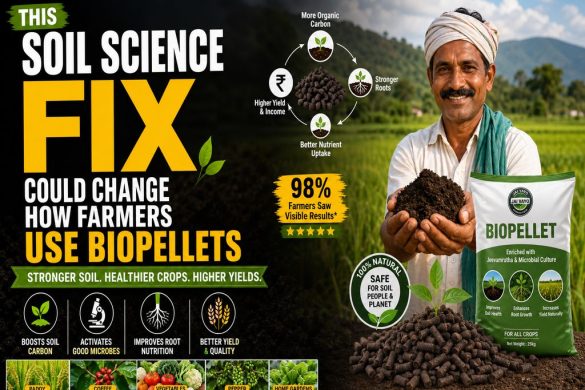
Major changes are happening to soil health all over India. Carbon is decreasing, nutrients are leaching away, and beneficial microorganisms are being destroyed. Although chemical fertilizers provide quick results, in the long run, they reduce the organic content of the soil. When the soil’s microbiome — its microorganism system — loses its balance, plants easily fall prey to diseases and stress.
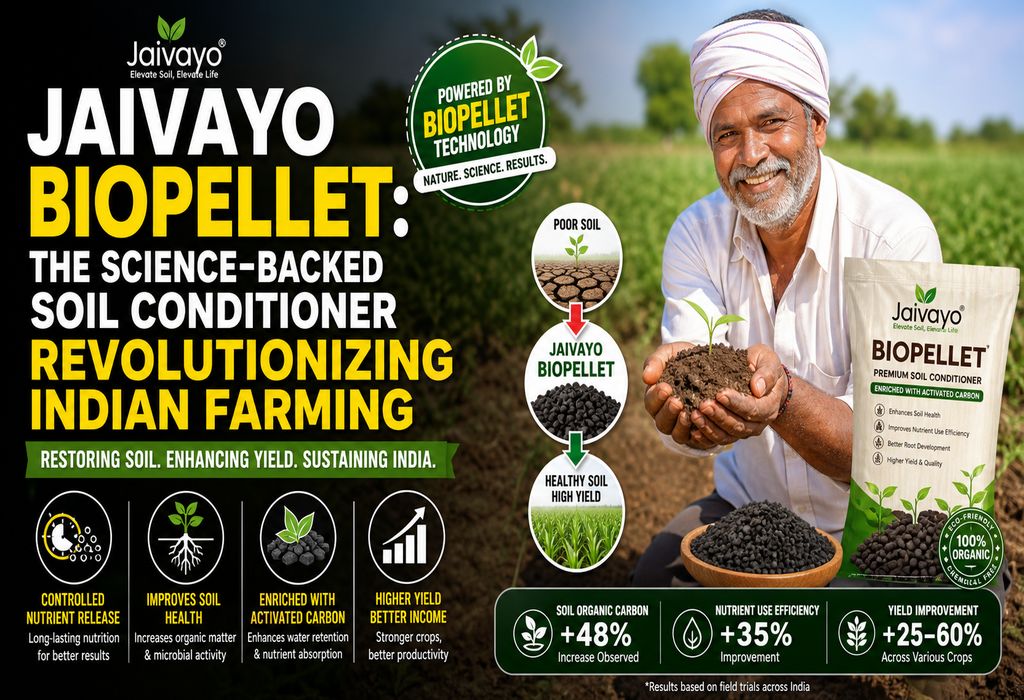
Jaivayo offers a scientific and simple solution to this growing crisis: the Biopellet — a soil preparation mixture, or soil conditioner, engineered to restore what modern agriculture has taken away.
🌱 What Is a Biopellet?
The Biopellet is made by combining various organic components in precise proportions. When placed in water, these pellets swell up and burst open. As the outer shell breaks, it releases cow dung, macro- and micro-nutrients, along with ingredients specifically suited for each crop.
A key distinction in the design of these pellets is that they do not dissolve partially in water. Instead, they release nutrients in a controlled manner, ensuring efficiency and precision. Based on its mode of action, the biopellet is also referred to as a bio-stimulant.
💡 What makes the Biopellet different? Unlike conventional fertilizers that can partially dissolve unevenly, Jaivayo’s Biopellet is engineered for controlled, timed nutrient release — functioning simultaneously as a soil conditioner and a bio-stimulant.
🔬 3 Types of Biopellets in Development
Jaivayo is currently developing three types of biopellets to cater to different farming needs and soil conditions:
Made entirely from organic components with no synthetic additions.
A blend with a partial addition of fertilizers for enhanced performance.
Specially designed for individual crops — currently formulated for black pepper, coconut, coffee, and vegetables.
🪴 Where and How Can Biopellets Be Used?
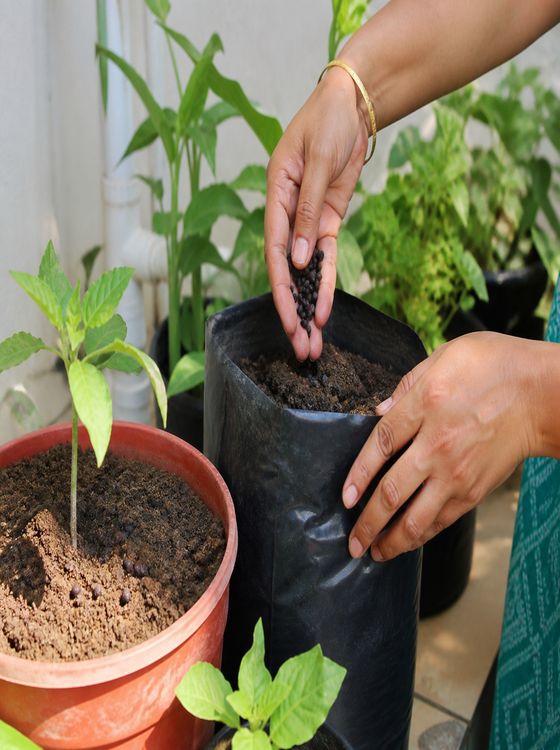
The biopellet can be applied directly to the soil or mixed with water, sand, or other media. According to P.G. Thomas, besides farmlands, it is also suitable for grow bags, terrace gardens, and homestead farming.
Research is currently underway to adapt this product for hydroponics — a soilless farming method — further expanding its range of application.
- ✅ Direct soil application
- ✅ Mixed with water or sand
- ✅ Grow bags & terrace gardens
- ✅ Homestead farming
- 🔬 Hydroponics (research ongoing)
🌍 Why the Biopellet Is a Game-Changer for Soil Health
The biggest advantage of the biopellet is that it increases the carbon percentage in the soil. When carbon increases, beneficial bacteria and humus in the soil also increase. This improves the overall productivity of the crop.
The presence of beneficial fungi like mycorrhiza helps the roots to absorb nutrients effectively. Additionally, the activated carbon contained in the biopellet acts as a mechanism that releases nutrients with precision — addressing one of the most persistent challenges in modern soil management.
Restores carbon levels that are depleted by conventional farming practices.
Encourages growth of beneficial bacteria and humus to revive soil microbiome balance.
Beneficial fungi help plant roots absorb nutrients more effectively and efficiently.
Activated carbon ensures nutrients are released with precision, not in random bursts.
🧪 Current Field Trials & Crops Under Focus
Currently, Jaivayo is in the phase of field trials focusing on the following crops:
🥥 Coconut
☕ Coffee
🥬 Vegetables
🌿 Spices
⚠️ Note: The crop-specific biopellet has currently been prepared for black pepper, coconut, coffee, and vegetables. Research for additional crops is ongoing as Jaivayo continues to expand its product range.
❓ FAQ
What is Jaivayo Biopellet and how does it work?
Jaivayo Biopellet is a soil conditioner made by combining organic components in precise proportions. When placed in water, these pellets swell and burst open, releasing cow dung, macro- and micro-nutrients in a controlled manner. Unlike conventional fertilizers, the biopellet does not partially dissolve — it delivers nutrients precisely, making it function as both a soil conditioner and a bio-stimulant.
What are the 3 types of biopellets from Jaivayo?
Jaivayo is developing three types of biopellets: a fully organic version containing only organic components, a semi-organic version with partial fertilizer additions, and a crop-specific biopellet tailored for individual crops. The crop-specific category is currently formulated for black pepper, coconut, coffee, and vegetables.
Is Jaivayo Biopellet suitable for home gardens and grow bags?
Yes, the Biopellet is highly versatile. Beyond traditional farmlands, it can be applied directly to the soil or mixed with water, sand, or other media. It is well suited for grow bags, terrace gardens, and homestead farming — making it a practical choice for both small-scale and commercial growers.
Can Biopellet be used in hydroponics?
Research is currently underway to adapt the Jaivayo Biopellet for hydroponics — a soilless farming method. While it is not yet commercially available for hydroponics, the ongoing research suggests the product may soon be compatible with this increasingly popular growing method.
How does Biopellet help improve soil health?
The biopellet increases the carbon percentage in the soil, which in turn promotes the growth of beneficial bacteria and humus. The presence of mycorrhiza fungi supports effective nutrient absorption by plant roots. Activated carbon in the pellet enables precision nutrient release, making it an effective tool to restore depleted and degraded soils across India.
Which crops is Jaivayo Biopellet currently being tested on?
Jaivayo is currently conducting field trials with its biopellets on black pepper, coconut, coffee, vegetables, and spices. These crops represent some of India’s most commercially important agricultural products, particularly in states like Kerala where these crops are widely cultivated.
Why are chemical fertilizers considered harmful to soil microbiome?
While chemical fertilizers deliver quick results, prolonged use reduces the organic content of the soil. This disrupts the soil’s microbiome — the complex system of beneficial microorganisms that maintains soil balance. When this balance is lost, plants become more vulnerable to diseases and environmental stress, leading to declining long-term crop productivity.