Research article: “Advanced packaging innovations for extending the shelf life and nutritional value of capsicum (Capsicum annuum L)” by Anand Yadav, Pushpendra Kumar, Virendra Bansal and Sonal Shukla, Department of Horticulture (Vegetable Science), ITM University, Gwalior, Madhya Pradesh, India. Published in International Journal of Advanced Biochemistry Research, 2025; 9(1): 171-177. DOI: https://doi.org/10.33545/26174693.2025.v9.i1c.3434
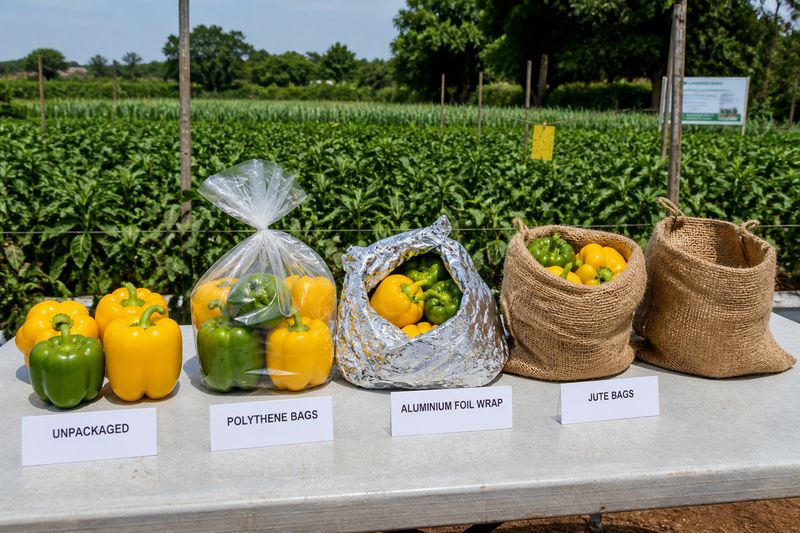
Bell pepper, also called capsicum, shimla mirch or green pepper, is popular because of its delicate taste, pleasant flavour, vitamins and minerals. But after harvest, it can lose moisture, shrink, soften and lose market value quickly if it is not packed well.
This ITM University, Gwalior study tested 14 packaging treatments on fully matured, disease-free and pest-free bell pepper fruits. The biggest practical takeaway is simple: polythene packaging performed best overall for maintaining fruit size, firmness and ascorbic acid, while aluminium foil helped Total Soluble Solids and jute bags helped titratable acidity.
Bell peppers belong to the Solanaceae family and are different from chilli pepper, even though both are Capsicum annuum. They are cultivated widely in temperate regions of Central and South America and Europe, as well as tropical and subtropical areas of Asia, including India and China.
The crop is harvested at different maturity stages and sold in green, yellow, orange and red colours. These colour variations are linked to cultivars developed from the original plant. Because coloured capsicums are highly demanded in urban markets, hotels, catering, fresh consumption, stuffing, baking, pizza toppings and burgers, maintaining quality after harvest is important for growers, traders and consumers.
⚠️ Bell pepper is described as a non-climacteric fruit, producing minimal ethylene. Even so, storage conditions and packaging strongly influence moisture loss, shrinkage, firmness, ripening behaviour and nutritional quality.
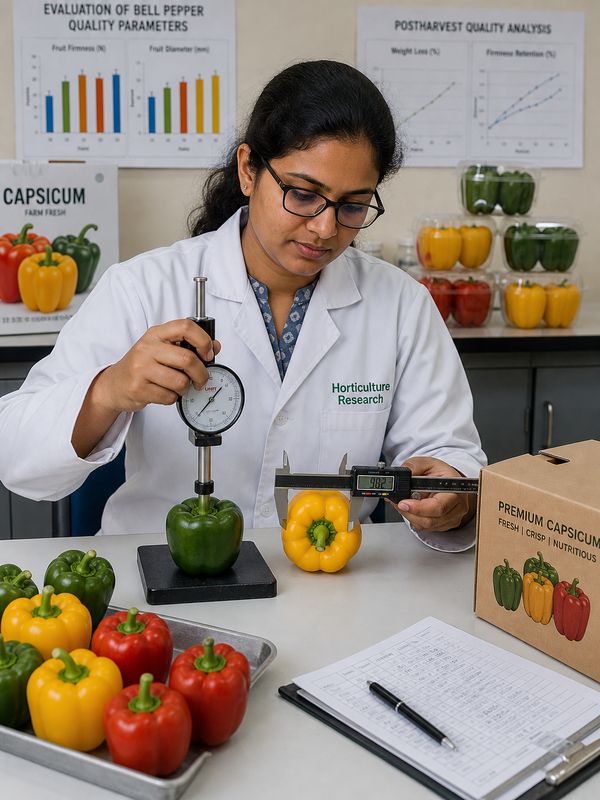
The experiment was carried out during 2023-24 at the Department of Horticulture, ITM University, Gwalior. Fully matured, high-quality bell peppers free from disease and pest damage were collected from the School of Agriculture, ITM University Gwalior.
The investigation used 14 treatments with 3 replications. Observations were recorded on the 0th, 4th, 8th, 12th, 16th and 20th days. The study measured both physical quality and biochemical quality so that shelf life could be judged in a complete way.
Fruit diameter: Polar and equatorial diameter were measured with a Vernier calliper and expressed in millimetres.
Fruit firmness: Firmness was recorded as kg/cm² across the storage period.
Fruit pH and TSS: pH was measured with a pH meter, while TSS was measured using a refractometer and expressed as °Brix.
Acidity and vitamin C: Titratable acidity was determined by titration, and ascorbic acid was measured using 2,6-dichlorophenol indophenol dye.
The study compared common, low-cost and practical packaging options that farmers and traders may encounter in the vegetable supply chain. The treatment list in the paper includes control along with cotton, polyethylene, paper cutting, dona, aluminium foil, tissue paper, fruit net, jute bag, fiber box, thermocol, wooden box, banana leaf and bamboo leaf.
On the 0th day, fruits stored in cotton showed the highest initial fruit polar diameter at 67.45 mm and highest equator diameter at 66.31 mm. But from the 4th day onward, polythene became the strongest performer.
By the 4th day, fruits stored in polythene had the highest polar diameter of 61.147 mm and equator diameter of 60.026 mm. The same trend continued through the 8th, 12th, 16th and 20th day. On the 20th day, polythene-packed fruits still recorded 45.42 mm polar diameter and 44.396 mm equator diameter, showing better retention of fruit size.
✅ In layman terms, polythene helped capsicum lose less water. Less moisture loss means less shrinkage, better cell turgor pressure, improved shape and more attractive fruits in the market.
| Storage day | Best treatment for fruit diameter | Key recorded value | Practical meaning |
|---|---|---|---|
| 0th day | Cotton | 67.45 mm polar and 66.31 mm equatorial diameter | Highest initial diameter at start of observation |
| 4th day | Polythene | 61.147 mm polar and 60.026 mm equatorial diameter | Polythene started showing stronger size retention |
| 8th day | Polythene | 57.63 mm polar and 56.506 mm equatorial diameter | Less shrinkage than other treatments |
| 12th day | Polythene | 54.383 mm polar and 53.269 mm equatorial diameter | Better preservation of structural integrity |
| 16th day | Polythene | 49.43 mm polar and 48.306 mm equatorial diameter | Maintained marketable appearance longer |
| 20th day | Polythene | 45.42 mm polar and 44.396 mm equatorial diameter | Best late-storage size retention |
Firmness is one of the first things buyers notice. Soft capsicum is harder to transport, less attractive to retailers and often sells at a lower price. On the 0th day, banana leaf had the highest firmness at 21.84 kg/cm². However, by the 4th day, polythene-packed fruits recorded the highest firmness at 17.77 kg/cm².
The polythene treatment continued to maintain the highest firmness values: 13.66 kg/cm² on day 8, 10.32 kg/cm² on day 12, 8.05 kg/cm² on day 16 and 6.55 kg/cm² on day 20. The control fruits consistently displayed the lowest firmness throughout the observation period.
| Treatment | 0th day | 4th day | 8th day | 12th day | 16th day | 20th day |
|---|---|---|---|---|---|---|
| Control | 17.71 | 12.59 | 9.48 | 6.14 | 3.87 | 2.37 |
| Polythene | 18.79 | 17.77 | 13.66 | 10.32 | 8.05 | 6.55 |
| Banana leaf | 21.84 | 17.72 | 13.61 | 10.17 | 7.90 | 6.40 |
| Thermocol | 21.26 | 17.14 | 13.03 | 9.69 | 7.42 | 5.92 |
| Jute bag | 20.99 | 16.87 | 12.76 | 9.42 | 7.15 | 5.65 |
The researchers linked polythene’s firmness advantage to reduced ethylene production and delayed ripening, which helped retain the structural integrity of fruit tissues.
The biochemical results show that no single package led every quality trait. Polythene was the best overall for physical quality and ascorbic acid, but aluminium foil and jute bags were stronger for some specific biochemical parameters.
Total Soluble Solids: Aluminium foil recorded the highest TSS: 4.06 °Brix on day 0, 5.03 on day 4, 6.54 on day 8, 5.95 on day 12, 5.44 on day 16 and 4.13 on day 20.
Titratable acidity: Jute bags recorded the highest acidity: 0.17% on day 0, 0.39% on day 4, 0.48% on day 8, 0.69% on day 12, 0.95% on day 16 and 1.06% on day 20.
Ascorbic acid: Polythene recorded the highest vitamin C values: 106.86 mg/100g on day 0, 129.33 on day 4, 138.81 on day 8, 136.68 on day 12, 126.47 on day 16 and 123.37 on day 20.
Control result: The control group showed the lowest values across measured parameters, proving that unpacked or poorly protected capsicum loses quality faster.
These findings align with earlier work cited in the article, including Martínez-Romero et al. (2003), Nelson et al. (1970), Xu et al. (2013), Cejudo-Bastante et al. (2021), Secer et al. (2020), Li et al. (2023), Dewi et al. (2020), Saeed et al. (2010), Saito et al. (2020), Huwei et al. (2021) and Nabiyev et al. (2024).
- ✅ For longer marketable life: Polythene packaging was the most useful option in this study because it reduced moisture loss and maintained firmness.
- ✅ For sweetness-related quality: Aluminium foil gave the highest Total Soluble Solids values across the storage period.
- ✅ For acidity retention: Jute bags performed best for titratable acidity, reaching 1.06% on the 20th day.
- ✅ For nutritional value: Polythene maintained the highest ascorbic acid content, including 123.37 mg/100g on the 20th day.
⚠️ Practical note: While polythene performed best in this experiment, farmers should also consider local market rules, ventilation needs, temperature, humidity, food safety and responsible plastic disposal before adopting any packaging method at scale.
Read the full research paper here: Advanced packaging innovations for extending the shelf life and nutritional value of capsicum (Capsicum annuum L).
The study concluded that polythene packaging was the most effective treatment for preserving the structural integrity and overall quality of bell pepper fruits. It maintained better polar diameter, equator diameter, fruit firmness and ascorbic acid across the storage period.
Aluminium foil was the best option for maintaining high TSS, while jute bags performed best for titratable acidity. The control group consistently showed the lowest values, confirming that suitable packaging is essential for extending shelf life and protecting capsicum quality after harvest.
Which packaging material is best for increasing capsicum shelf life?
In this 2025 ITM University study, polythene packaging performed best overall for extending capsicum shelf life. It maintained the highest fruit diameter after day 4, preserved firmness up to the 20th day and also retained the highest ascorbic acid content compared with other treatments.
Why did polythene packaging work better for bell pepper storage?
Polythene likely worked better because it reduced moisture loss and helped maintain cell turgor pressure. This slowed shrinkage, protected fruit shape and helped preserve firmness. The study also noted reduced ethylene production and delayed ripening in polythene-packed fruits.
Is aluminium foil better than polythene for capsicum?
Aluminium foil was not better overall, but it was the best treatment for maintaining Total Soluble Solids. It recorded the highest TSS values from day 0 to day 20. For firmness, fruit size and ascorbic acid, polythene performed better in this experiment.
Can jute bags be used for storing capsicum after harvest?
Yes, jute bags can be used, and in this study they performed best for titratable acidity. Jute bags recorded the highest acidity values throughout storage, reaching 1.06% on the 20th day. However, they were not the best for firmness, fruit diameter or vitamin C retention.
How long were capsicum fruits stored in the study?
The bell pepper fruits were observed for a 20-day storage period. Measurements were taken on the 0th, 4th, 8th, 12th, 16th and 20th days. This helped researchers compare how different packaging materials affected quality changes over time.
What quality parameters were measured in the capsicum packaging study?
The researchers measured physiological and biochemical parameters. These included fruit polar diameter, equatorial diameter, fruit firmness, pH, Total Soluble Solids, titratable acidity and ascorbic acid. This combination gave a clearer picture of shelf life, marketability and nutritional quality.
Does packaging really affect the market value of capsicum?
Yes. Packaging affects moisture loss, firmness, shrinkage, appearance and nutritional quality. Since buyers prefer firm, fresh-looking capsicum with good size and colour, the right packaging can help farmers and traders maintain marketability for a longer period after harvest.