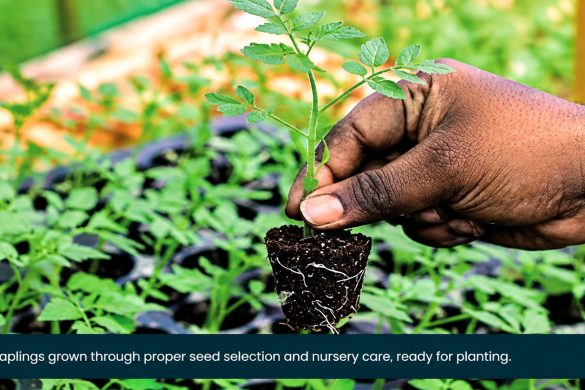
Germinating seeds often requires extra care. This is essential for resisting diseases and producing healthy seedlings. Soaking seeds in hot water, also known as hot water treatment, is beneficial. This helps to soften the hard outer shell of the seed and increases its germination capacity.
It also helps to prevent seed-borne diseases, like in bitter gourd, snake gourd, ridge gourd, etc. This also helps prevent ants from carrying away the seeds during germination.
Seeds for germination can be sprouted by tying them in a moist cotton cloth. To treat the seeds, take boiled water in one container. Keep cold water in another container. Add cold water to the hot water to make it lukewarm.
When small bubbles start to rise in the water, add the seeds. Do not add the seeds directly into boiling water. Stir the seeds once after putting them in the water. Half a container of water will be sufficient.
20 grams of Pseudomonas can be added to the water with the seeds. Bacillus subtilis can be used as a substitute for Pseudomonas.
To prevent diseases in germinated seedlings, once the seeds start to sprout, you can spray a solution of 20 grams of Pseudomonas in one liter of water.
Similarly, when preparing the potting mix for sowing seeds, mix 20 grams of Pseudomonas with one kilogram of dried and powdered cow dung or vermicompost and keep it in the shade.
Then, mix it with the potting mix and sow the seeds. The seeds can be sown after 12 hours.
The seeds can be planted after soaking them in a Pseudomonas solution.
They should be kept in the shade for 4-6 days.
Sow the seeds only after the potting mix is well moistened. This helps to retain moisture until the seeds sprout. It is also good for preventing termite attacks.
- ✅ Seeds like spinach, okra, and brinjal can be sown directly.
- 📏 Seeds should be planted at a depth twice their size.
- ⚠️ If the seeds are planted too deep, they will have difficulty sprouting.
- 🌱 Moisture in the potting mix supports sprouting and helps reduce termite problems.
To prevent termites, you can sprinkle a cup of fine ash. Sprinkling powdered neem cake is also good for repelling termites. Additionally, preparing the soil with Trichoderma before planting seeds helps to keep diseases at bay to a large extent.
When planting seedlings from pro-trays, it is best to plant good quality local seedlings. They will quickly adapt to the local climate.
It is best to plant seedlings in the afternoon after the sun’s intensity has reduced. The seedlings are likely to wilt in the strong sun. Therefore, planting in the evening is better for the seedlings.
When removing seedlings from the pro-tray, be careful not to break the roots. Watering the pro-tray before removing the seedlings helps to lift them out with the roots intact. Also, dipping them in a Pseudomonas solution before planting helps to increase disease resistance and enhance root growth. The same method applies to planting in grow bags.
Dig a pit, pour water, and plant the seedlings after the soil is soaked. After planting the seedling, firm the soil around it well. It is better to wet the pit first than to dig a small pit, place the seedling, cover it with soil, and then water it.
When done this way, the roots can bond well with the soil, take root quickly, and grow lushly.
This helps prevent the seedlings from drying out quickly. It is good to provide shade for two to three days after planting. Mulching with dry or green leaves also helps to retain moisture. A branch with its leaves can be staked into the soil to provide support for the plant.




You may also like