Reference: Mohammed Riyas, farm owner, Tanur.
Source context: Attracting visitor attention at the agricultural fair in Malappuram — The Earth’s great birds, like ducks — Online Curiosity.
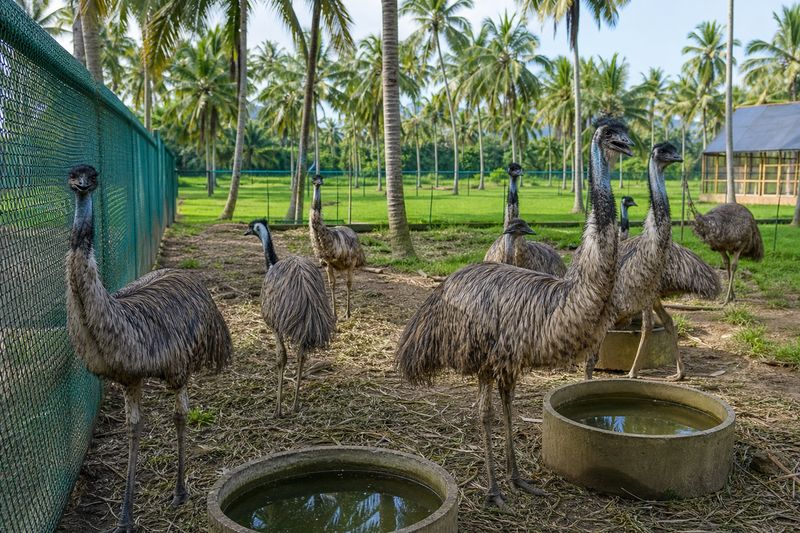
Emu birds need open space to run, fencing, fresh water, and balanced feed.
The exhibition features around 63 breeds of chickens under one roof. At this venue, to the right of the pen for the emu, the world’s second-largest bird, is the place for the number one, the ostrich.
Although it is a commercial farm named Ostrich Farm, Mohammed Riyas and his team from Tanur are becoming the stars among birds by setting up such a farm for the first time in Kerala.
In the farm-tourism sector, which is limited even in Kerala, there are many possibilities for products from various parts of the ostrich, says farm owner Mohammed Riyas.
Scan QR code to watch the video. The fair display helped visitors compare the emu and ostrich side by side, making these large birds a major attraction.
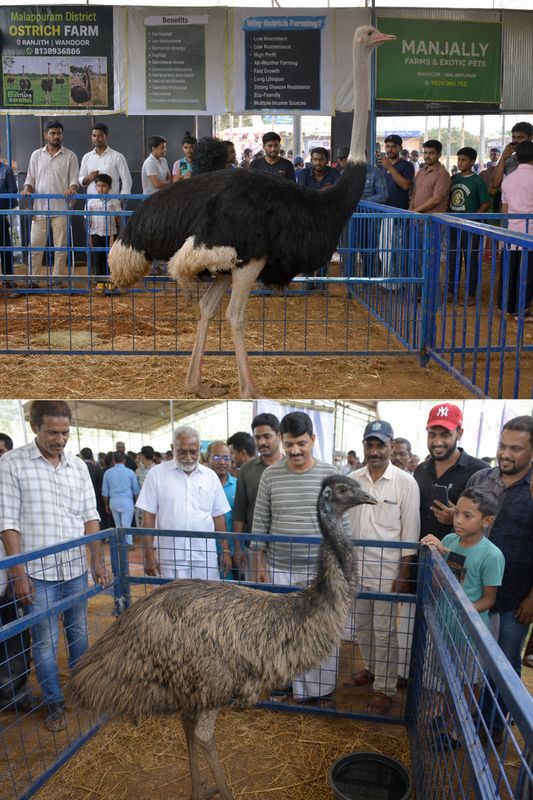
The ostrich, the world’s largest bird, will be over 9 feet tall. Half of its height is the length of its neck. Its native land is the African grasslands. They can also grow in Kerala’s conditions.
- ✅ They should be raised inside a fence that is over 4-5 feet high.
- ✅ There should be space to run.
- ✅ Male birds will be larger. They will be black in color.
- ✅ There will also be white feathers on the wings and tail.
- ✅ Meanwhile, female birds will be brown. The female bird is more beautiful than the male bird. In the case of the emu, the situation is reversed.
Running Space: Large birds need space to run and must be raised within proper fencing.
Daily Feed: A pair will need about 5 kilograms of feed daily. Cattle feed is the main thing.
Two chicken coops, and finely chopped green grass are included for food. Various tubers and leafy greens should be included in their food.
Fresh Water: Plenty of fresh water should also be given. They reach maturity after two and a half years.
Emu birds are to be raised in a 1:2 ratio. That is, one female bird needs 2 male birds. Both mature in the same habitat.
December-January are the breeding months. When raising in a 1:2 ratio, one female bird is removed from the flock.
- ✅ The eggs will have an average weight of 900 grams.
- ✅ They are dark green in color.
- ✅ They lay eggs at intervals of about 6 days.
- ✅ It is the male bird that incubates.
- ✅ It takes an average of 58-62 days for the eggs to hatch.
- ✅ They lay an average of 12 eggs during a breeding season.
If immersed in boiling water, it can be hard-boiled in 10 minutes. Dishes like omelets and bull’s-eye can also be prepared.
It will be 24 times the size of a normal chicken egg. Besides these, grains and cattle feed can also be added to their food.
💡 Farmer takeaway: Emu farming in Kerala needs planned housing, feed management, breeding-season attention, and enough open area, while the fair also showed how farm-tourism can create visitor curiosity around large birds.