In many places, the initial symptoms of Gummosis are seen on mangosteen trees that have borne fruit. To prevent this from worsening, spray Calcium Nitrate, follow with Sulphate of Potash after one week, and use Verticillium for issues linked with leaf spot and thrips around the fruit stalk.
🌿 Quick crop-care note: Both nutrient sprays should be applied by drenching the entire tree, after adding an adjuvant.
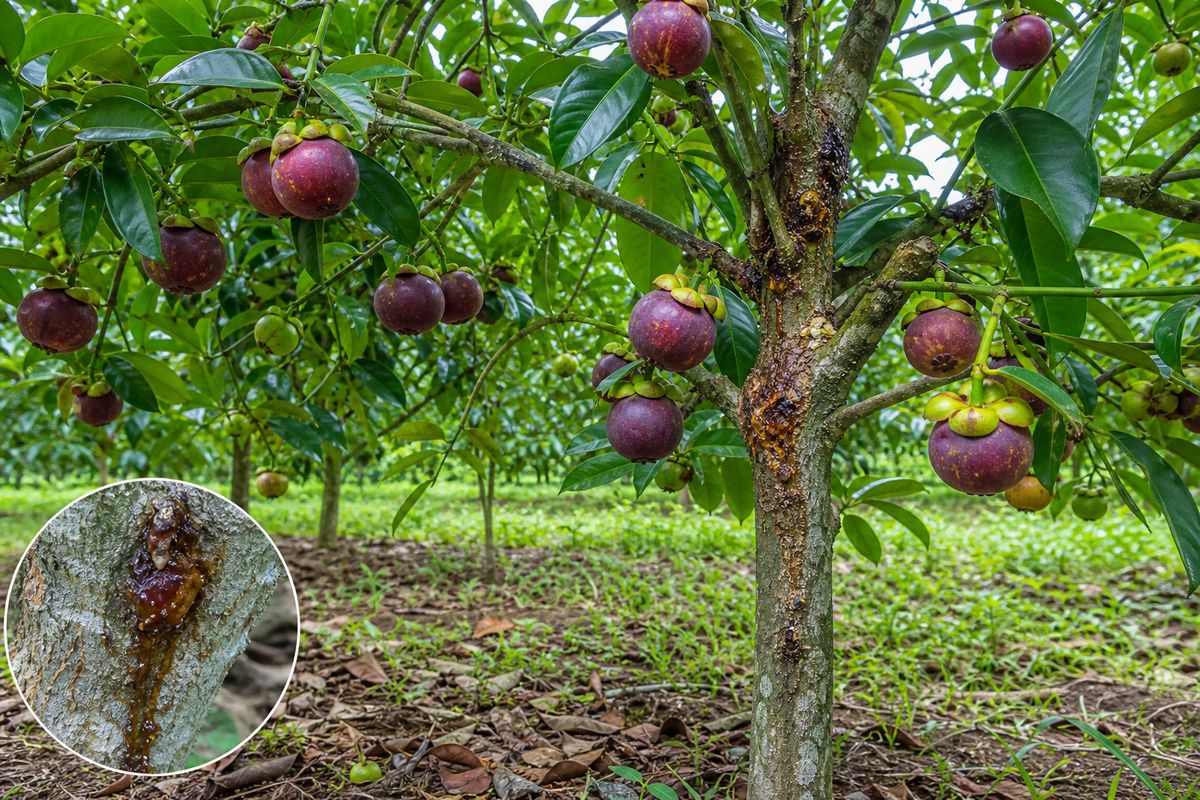
Initial symptoms of Gummosis are seen on mangosteen trees that have borne fruit.
Mix 3 g of Calcium Nitrate in one liter of water and spray.
After one week, spray 4 g of Sulphate of Potash in one liter of water.
For leaf spot and thrips, spray 30 g of Verticillium in one liter of water with an adjuvant.
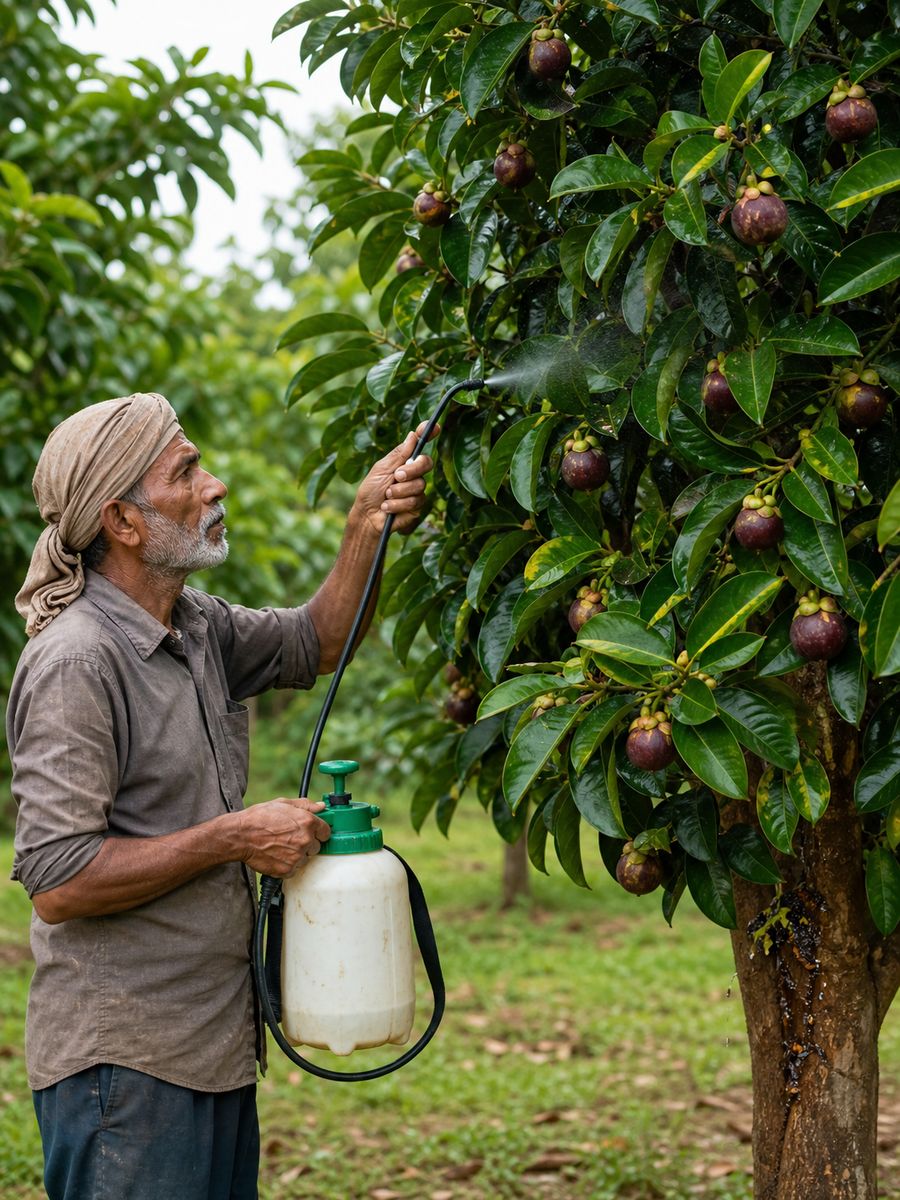
To prevent this from worsening, mix 3 g of Calcium Nitrate in one liter of water and spray.
After one week, spray a solution of 4 g of Sulphate of Potash in one liter of water.
Both of these should be sprayed by drenching the entire tree, after adding an adjuvant.
⚠️ Important: The instruction is to spray by drenching the entire tree, not just lightly wetting a few visible branches.
During the time of ripening, due to attacks from leaf spot and thrips, the area around the stalk of the fruit develops a scab-like appearance and dries up.
🌱 To avoid this: Mix 30 g of Verticillium in one liter of water with an adjuvant and spray.
| Problem / Stage | Spray Material | Quantity | Water | Application Note |
|---|---|---|---|---|
| Initial symptoms of Gummosis on fruit-bearing mangosteen trees | Calcium Nitrate | 3 g | One liter | Spray by drenching the entire tree after adding an adjuvant. |
| Follow-up spray after one week | Sulphate of Potash | 4 g | One liter | Spray by drenching the entire tree after adding an adjuvant. |
| Ripening stage fruit stalk scab due to leaf spot and thrips | Verticillium | 30 g | One liter | Mix with an adjuvant and spray. |
The Sulphate of Potash spray is advised one week after the Calcium Nitrate spray.
An adjuvant is mentioned in both the nutrient spray and Verticillium spray instructions.
The symptom near ripening is focused around the stalk of the fruit, where a scab-like appearance develops and dries up.
The recommended spray method for the first two sprays is drenching the entire tree.
For mangosteen gummosis treatment, early action matters when the initial symptoms of Gummosis are seen on fruit-bearing trees. The advised sequence is 3 g of Calcium Nitrate in one liter of water, followed after one week by 4 g of Sulphate of Potash in one liter of water, with both sprays applied by drenching the entire tree after adding an adjuvant.
During ripening, when leaf spot and thrips cause the area around the fruit stalk to develop a scab-like appearance and dry up, use 30 g of Verticillium in one liter of water with an adjuvant and spray.
What is the first spray for mangosteen gummosis symptoms?
The first spray for the initial symptoms of Gummosis on fruit-bearing mangosteen trees is 3 g of Calcium Nitrate mixed in one liter of water. It should be sprayed by drenching the entire tree after adding an adjuvant.
When should Sulphate of Potash be sprayed on mangosteen trees?
Sulphate of Potash should be sprayed one week after the Calcium Nitrate spray. The recommended mixture is 4 g of Sulphate of Potash in one liter of water, applied by drenching the entire tree with an adjuvant.
How do leaf spot and thrips affect mangosteen fruits during ripening?
During ripening, attacks from leaf spot and thrips can cause the area around the stalk of the fruit to develop a scab-like appearance and dry up, reducing fruit quality near the stalk region.
What is the Verticillium spray recommendation for mangosteen fruit stalk scab?
To avoid the scab-like drying around the fruit stalk during ripening, mix 30 g of Verticillium in one liter of water with an adjuvant and spray. This addresses problems caused by leaf spot and thrips.
Should the entire mangosteen tree be sprayed or only the affected part?
For the Calcium Nitrate and Sulphate of Potash sprays, the instruction is clear: both should be applied by drenching the entire tree after adding an adjuvant. This ensures coverage beyond only the visibly affected area.
Why is an adjuvant used in mangosteen spray mixtures?
The article specifies adding an adjuvant with the Calcium Nitrate, Sulphate of Potash, and Verticillium spray applications. The key instruction is to include it before spraying, especially when drenching the entire tree or treating ripening-stage fruit stalk issues.