🧠 The Problem: Why Do We Lose So Much Fruit?
More than 40% of harvested fruits are lost before they reach consumers—mainly due to rotting, weight loss, and rapid ripening. Guava, the fourth most important fruit crop in India, is especially vulnerable. It ripens within 3–4 days after harvest and suffers post-harvest losses as high as 15.88% during farm operations and storage.
❗ Key Issue: Chemical fungicides are being restricted due to health and environmental concerns. Farmers and researchers urgently need eco-friendly, low-cost alternatives.
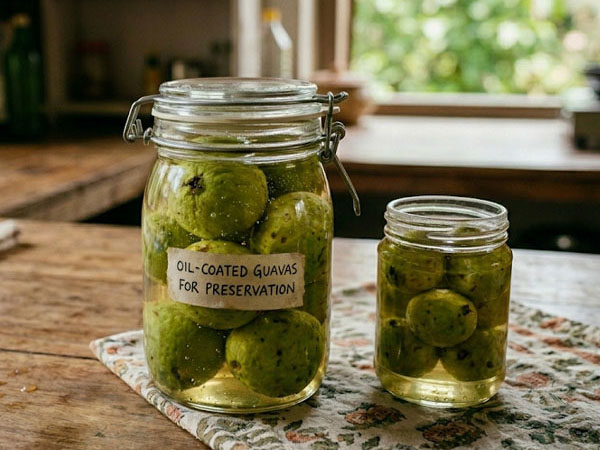
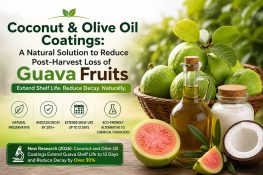
💡 The Solution: Edible Oil Coatings
This study tested seven different edible oils as natural coatings for guava fruits (variety: Gwalior-27). The goal was to see if these oils could:
✅ Reduce decay (spoilage)
✅ Slow down weight loss
✅ Preserve taste, texture, and color
✅ Extend shelf life at room temperature
The oils tested were:
- Coconut oil
- Olive oil
- Linseed oil
- Sesame oil
- Almond oil
- Mustard oil
- Castor oil
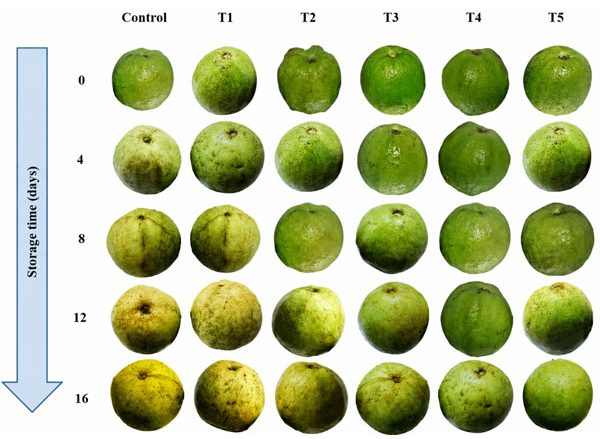
🔬 How the Experiment Was Done
- Fruit variety: Gwalior-27 guava
- Treatments: 7 different oils + a control group (no coating)
- Method: Fruits were dipped in oil for 5 minutes, then air-dried for 1 hour.
- Storage: 12 days at room temperature
- Observations taken at: Days 0, 3, 6, 9, and 12
- Weight loss (%)
- Decay/spoilage (%)
- Specific gravity (density)
- Acidity (titratable acidity)
- Total sugars & reducing sugars
- Phenol content (antioxidants)
- Sensory qualities (taste, flavor, color, overall acceptability)
📊 Key Results at a Glance
Best Overall: Coconut Oil (T1)
Coconut oil-coated fruits performed best in most categories, including taste, flavor, and overall acceptability. It also maintained high sugar levels and phenol (antioxidant) content.
Runner-Up: Olive Oil (T2)
Olive oil scored second-highest in sensory qualities and also helped preserve fruit quality well.
Best for Preventing Decay & Weight Loss: Castor Oil (T7)
Castor oil was the champion at reducing weight loss (only 7.44% after 12 days) and decay (only 20.1%) . However, it scored poorly on taste and texture.
Worst: Control (No Coating)
Uncoated fruits had the highest weight loss (27.87%), highest decay (33.24%), and lowest sensory scores.
📈 Detailed Findings (Simplified)
Physiological Loss in Weight (PLW%)
- Control: Lost 27.87% weight by day 12
- Castor oil: Lost only 7.44% (best)
- Coconut & Olive oils: Lost ~12.89% each
✅ Why it matters: Less weight loss means juicier, fresher – looking fruits that sell better.
Decay or Spoilage (%)
- Control: 33.24% decay by day 12
- Castor oil: 20.1% decay (lowest)
- Coconut oil: 20.46% decay (second lowest)
🔬 The science: Castor oil contains ricinoleic acid (>80%) , which has strong antifungal properties. This explains why it was so effective against rotting.
Specific Gravity (Density)
- Control: Dropped to 0.70 by day 12
- Coconut oil: Maintained 0.98 (closest to fresh fruit)
💡 What this means: Specific gravity decreases as fruits lose weight and increase in volume. Coconut oil helped maintain fruit structure longer.
Titratable Acidity (Natural Acidity)
- Coconut oil: Highest acidity (0.20%) at day 12
- Control: Lowest acidity (0.17%)
🍏 Why it matters: Acidity gives fruits their tangy flavor. Better retention = better taste.
Total Sugars (%)
- Coconut oil: 10.1% at day 12 (higher than day 3!)
- Control: Dropped to 7.42% at day 12
🍬 Takeaway: Coconut oil slowed down sugar breakdown, keeping fruits sweeter longer.
Reducing Sugars (%)
- Coconut oil: 7.54% at day 12
- Control: Only 4.98% at day 12
Phenol Content (Antioxidants)
- Coconut oil: 42.6 mg/100g at day 12
- Control: Only 27.4 mg/100g
🧪Health angle: Higher phenol content means more antioxidants, which are good for human health.
Sensory Scores (0–10 Scale at Day 12)
| Parameter | Coconut Oil | Olive Oil | Control |
|---|---|---|---|
| Flavor | 7.72 | 7.09 | 3.52 |
| Taste | 7.56 | 7.01 | 3.57 |
| Overall Acceptability | 7.58 | 7.27 | 3.58 |
Verdict
✅ Coconut oil slowed down sugar breakdown, keeping fruits sweeter longer.
🌟 Top Takeaways for Farmers & Home Users
Best for overall quality & taste: Coconut oil (T1)
Best for preventing rot & weight loss: Castor oil (T7)
Best eco-friendly alternative to chemicals: Coconut or olive oil
Shelf life extended to: 12 days at room temperature (vs 3–4 days normally)
Cost-effective? Yes – coconut oil is widely available and inexpensive in tropical region
📚 Conclusion from the Research Team
“Coconut oil coating greatly extends the shelf life of guava and lowers post-harvest losses. It maintained optimum levels of sugars, phenol, and titratable acidity. After coconut oil, olive oil also maintained good flavor, taste, and overall acceptability. Coconut oil is cost-effective, eco-friendly, and easily available in the market.