Credibility note: This article is based on details shared in the magazine report featuring Dr. A.V. Mathew, former Associate Director at Kerala Agricultural University, Dr. B. Meera, Assistant Professor at the College of Agriculture, Vellayani, and Saji, owner of Omana Mushrooms in Ranni.
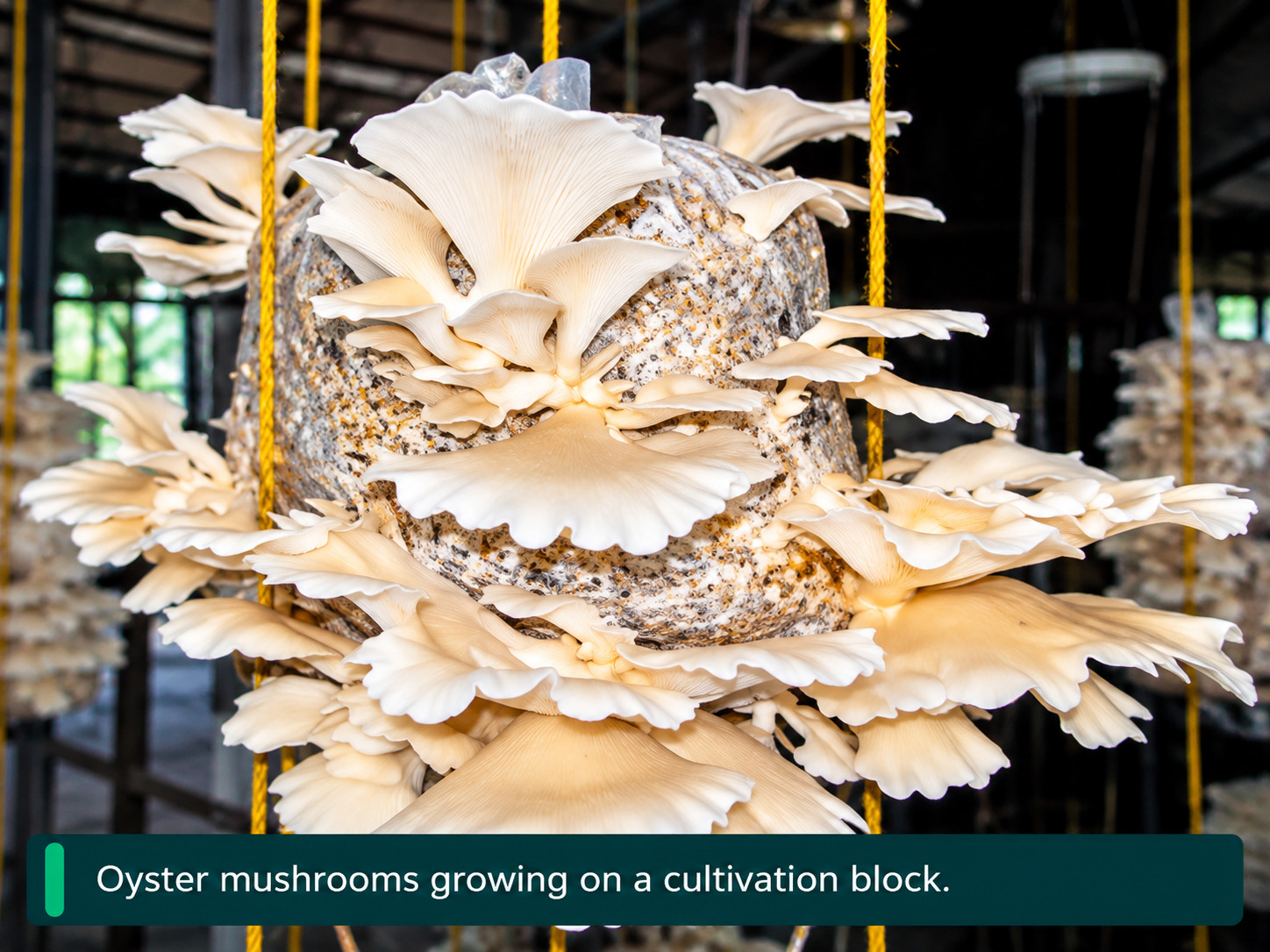
What is the biggest limitation of oyster mushroom cultivation? The fact that production doesn’t happen year-round. Without setting up a high-tech shed with an investment of around 5 lakh rupees, production has to be halted during the rainless months.
However, with the discovery of a new variety of oyster mushroom that yields even in summer at normal atmospheric temperatures, a solution to this problem has been found. This brings great hope to small-scale farmers as it allows for year-round cultivation with low investment.
The favorable climate for oyster mushrooms is a temperature of 25-28 degrees Celsius and atmospheric humidity of over 80 percent. In Kerala, this climate is available only during the monsoon season.
To cultivate oyster mushrooms year-round, this atmospheric condition must be created inside the mushroom shed even during the summer. Only by building a high-tech shed with a fan & pad system, which requires a high investment, can this be made possible. Many people limit their mushroom cultivation to the monsoon season due to this difficulty.
High-tech summer cultivation can require around 5 lakh rupees, making it difficult for ordinary farmers.
However, if a variety of mushroom that can be cultivated naturally even in summer is found, it would be a great blessing for ordinary farmers.
The oyster mushroom named Pleurotus Saffius is becoming a solution for many farmers who suffer losses in oyster mushroom cultivation due to low yield and the spread of diseases during summer. It was to solve this financial loss occurring in mushroom cultivation during summer that Dr. A.V. Mathew, a former Associate Director at the Kerala Agricultural University, identified this promising variety.
He says that a new variety was discovered from mushrooms that grew on the partially decomposed trunk and leaves of a coconut tree and the trunk of a mango tree. Later, it was identified that this variety belongs to the Saffius category of mushrooms.
Spawn is produced and provided using tissue culture technology. It can be produced using rubber sawdust, mushroom, and corn flour as a medium. He said that there is more demand for the spawn of the new variety at this time when the demand increases during the summer.
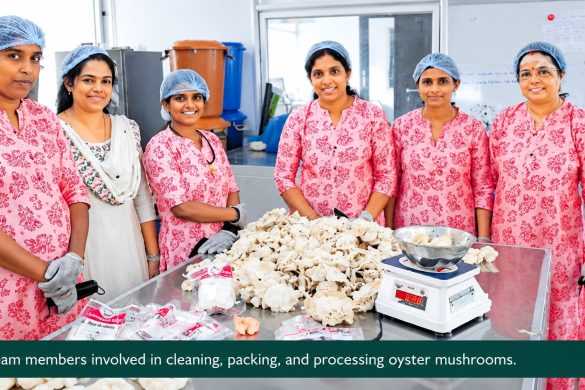
Saji, the owner of Omana Mushrooms in Ranni, said that since the spawn of the Saffius mushroom is available, it is possible to produce and market it even in summer. This is generally the time when everyone in regular mushroom sheds stops oyster mushroom cultivation.
However, Saji is now waiting for production after preparing the beds for a new batch. It is expected that this batch will yield until March-April. Last summer too, Saffius was produced in Saji’s mushroom shed. While other oyster mushrooms take more than 20 days for the first harvest, Saffius yields within 10-12 days, Saji says. Therefore, more batches can be cultivated.
On the 12th day.
On the 14th day.
On the 18th day.
About one and a half kilos of mushrooms from one bed.
A price of 250-300 rupees per kilo can be obtained. Dr. Mathew said that more yield can be obtained from this compared to the production of other oyster mushrooms.
Saji has been cultivating and marketing Saffius for 2 years. The technical assistance for producing Saffius spawn is provided by Dr. B. Meera, an Assistant Professor at the College of Agriculture, Vellayani.
The spawn produced in the laboratory, known as Mother Spawn, is given to farmers, and Saji produces the spawn used for cultivation in beds from it. Saji cultivates using second-generation spawn, or F2 Generation.
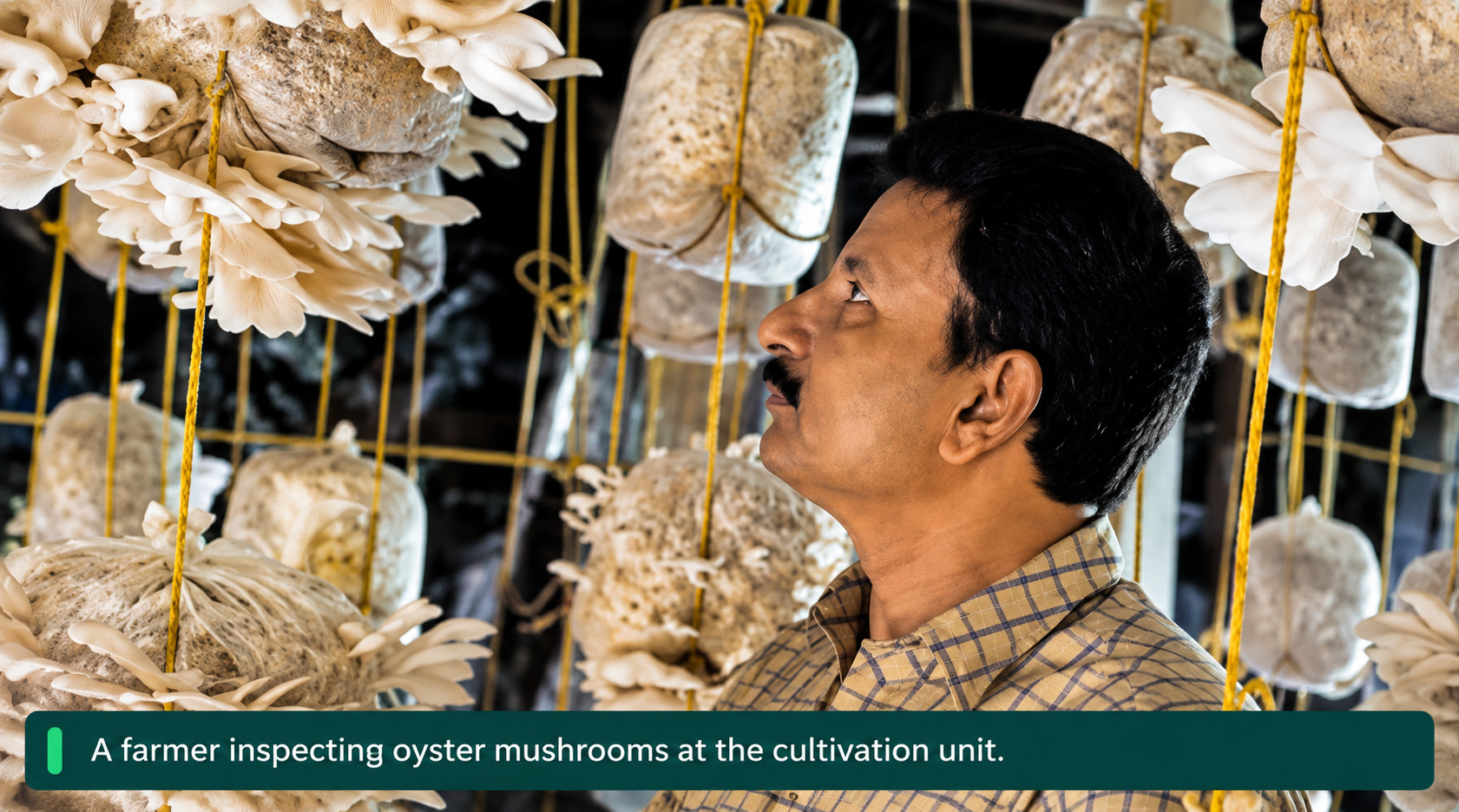 It is believed that Saffius belongs to the edible Pleurotus ostreatus category. It has been sent for DNA testing for precise identification of the species. The biggest specialty of this edible, pure white variety of mushroom is that it can be cultivated even in summer.
- ✅ There is high demand for this colored mushroom in the market.
- ✅ Saji’s customers pre-order the product.
- ✅ He sells up to 5 kg of mushrooms a day.
- ✅ A 100-gram packet costs 40 rupees.
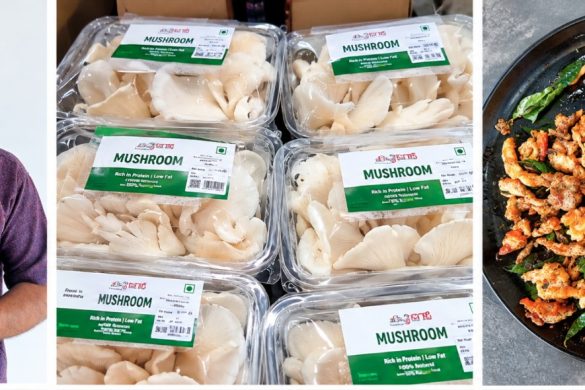
The product is delivered directly to shops and homes in Ranni, Kozhencherry, Chengannur, and Thiruvalla. It is sold in attractive covers.
The advantages of the Saffius mushroom found by Dr. A.V. Mathew and Saji include a short-duration crop, first harvest within 14 days, good white color, and a taste and smell that everyone likes.
It is suitable for commercial cultivation in homes and flats. Spawn can be made easily, and the spawn will be ready in just 10 days.
The mycelium of the Saffius mushroom has the ability to lyse nematodes and absorb nutrients from them. This may be the reason why the growth of hyphae is completed very quickly in the beds during spawn running, without any spoilage.
The green fungus, Trichoderma, a nightmare for mushroom farmers, is not seen in Saffius beds. It has 0.1% more fiber than the HPC C-Census Athamariyas (Hu) mushroom cultivated in Kerala.
Therefore, Saffius can be stored for up to 48 hours at normal atmospheric temperature, 28-32°C, without spoiling. It has higher pest and disease resistance. No worm infestation has been observed at all.
After mushroom cultivation, the remaining medium, or spent media, if added to the potting mixture or used in the soil, can protect other crops from the attack of nematodes to a certain extent. The point is that it is useful as both compost and a bio-nematicide.
Pleurotus oyster mushrooms are known in English as oyster mushrooms. Although there are 203 varieties of these, 40 species have been scientifically identified. It has been understood that two of them are poisonous and 25 are edible.
This variety, which is part of the edible Pleurotus ostreatus, is the most cultivated oyster mushroom in the world. Besides this, edible varieties in white, black, blue, pink, and yellow/golden colors are also cultivated.
 There is also a perception in society that only white-colored mushrooms are edible and that other colors are poisonous. Dr. Mathew said that the common perception has no scientific basis. There is no connection between edibility and color.
However, he pointed out that no matter how much scientific evidence is presented, Malayalis will only eat white mushrooms. Therefore, Dr. Mathew opined that white mushrooms have more commercial potential here.
For the contact number included in the original magazine article: 9447067354.
Can Pleurotus Saffius oyster mushroom grow in summer?
Yes. The key feature of Pleurotus Saffius is that it can be cultivated in summer heat of 32-35 degrees Celsius and in lower atmospheric humidity of 50-70% R.H. This is why it is being discussed as a hopeful option for small-scale farmers who usually stop oyster mushroom cultivation outside the monsoon season.
Does Saffius need a high-tech fan and pad mushroom shed?
No. According to the report, a normal mushroom shed is sufficient for Saffius cultivation. Farmers do not need an expensive fan & pad shed, which can otherwise require around 5 lakh rupees. This low-investment advantage makes the variety especially useful for home growers, beginners, and small commercial units.
How fast is the first harvest of Saffius oyster mushroom?
Saffius is described as a short-duration crop. While other oyster mushrooms may take more than 20 days for the first harvest, Saffius can yield within 10-12 days. The report also notes a first harvest on the 12th day, followed by harvests on the 14th and 18th days.
What yield can farmers expect from one Saffius mushroom bed?
The article states that about one and a half kilos of mushrooms can be obtained from one bed. A price of 250-300 rupees per kilo can be obtained. Dr. Mathew said that more yield can be obtained from this variety compared to the production of other oyster mushrooms.
Is white oyster mushroom the only edible oyster mushroom?
No. Dr. Mathew said that the belief that only white mushrooms are edible has no scientific basis. There is no connection between edibility and color. However, the report notes that white mushrooms have stronger commercial potential in Kerala because consumers there generally prefer white mushrooms.
Is Saffius resistant to common mushroom diseases?
The report notes that Saffius has higher pest and disease resistance. Green fungus, Trichoderma, which is a major problem for mushroom farmers, is not seen in Saffius beds. No worm infestation has been observed at all, and its mycelium may help lyse nematodes and absorb nutrients from them.