Staff Reporter
Mohandas of Puvattuparambu, Kozhikode, runs 5 ventures on 4 cents of land. Mohandas, who was a construction worker, was unable to go to work due to a fall. However, by cultivating mushrooms at home and adding value to them, Mohandas and his wife Lasitha are earning a good income.
They have a total of four cents of land. After building a house there, there isn’t even a yard left. But, adjacent to this house, they run ventures like mushroom cultivation, mushroom spawn production, mushroom value addition, a water lily-lotus nursery, and ornamental fish farming.
🌱 Land: Four cents after building a house
🍄 Weekly oyster mushroom output: 28-30 kg
🥫 About half becomes value-added products
🐠 Ornamental fish turnover: about ₹70,000
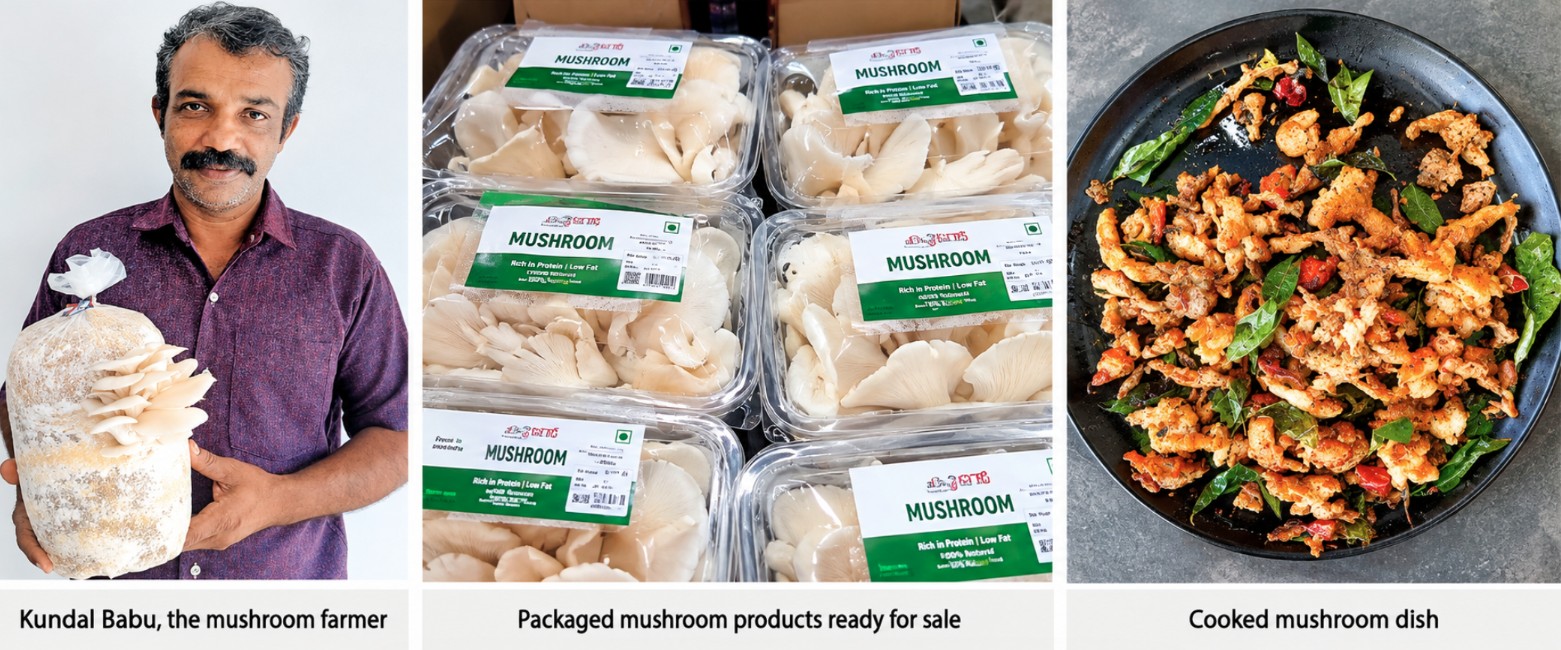
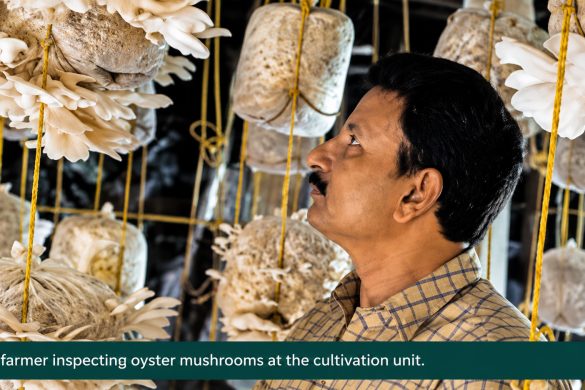
Mushroom packets ready for marketing. Mohandas with a mushroom bed.
Mushroom Cultivation
Grown at home as the main income source.
Mushroom Spawn
Quality spawns are developed and supplied.
Value Addition
Products include pickle, cutlet, pakoda and powder.
Water Lily-Lotus Nursery
Hybrid water lilies and lotuses are sold as saplings.
Ornamental Fish
Aquarium fish, plants, feed and services are provided.
About 20 years ago, Mohandas had cultivated mushrooms on a small scale. But he couldn’t find a sufficient market for it then. Later, when he was at home, he developed it.
The income from mushrooms is approximately 7,500 rupees. They are able to earn an income by selling mushroom fry (200 grams) through a scheme.
They are active in developing quality mushroom spawns themselves and providing all the necessary materials for new entrepreneurs for mushroom cultivation.
📈 An income of 12,000 to 15,000 rupees can be obtained per bed.
⚖️ On average, up to 2 kg can be harvested from one bed in five to six months.
They also prepare value-added products like pickled mushroom, mushroom pickle, mushroom cutlet, mushroom pakoda, and mushroom powder. They prepare and give 150 packets of mushroom spawn, made at home, to farmers.
Lasitha near the autoclave. She owns an autoclave, laminar airflow, etc., for mushroom spawn production. Through the agricultural department’s ‘Samagra’ scheme, she has received assistance worth 2 lakh rupees, including an autoclave, laminar airflow, culture tubes, spirit lamp, and an incubation room.
🎯 The aim is to make mushrooms available to the poor and common people at a low price. Mushroom pickles, mushroom cutlets, and mushroom pakoda are in high demand. Although they don’t have their own shops, customers come to their home to buy them.
💧 70% humidity is required to produce mushroom spawn. The mushroom spawn is produced in a completely natural way without using a fan, cooler, or AC. The mushroom spawn, prepared by drying boiled paddy, is delivered to hotels and homes.
⚠️ Machine assistance is needed for spawn production. Since these facilities are not available, large-scale production is not possible.
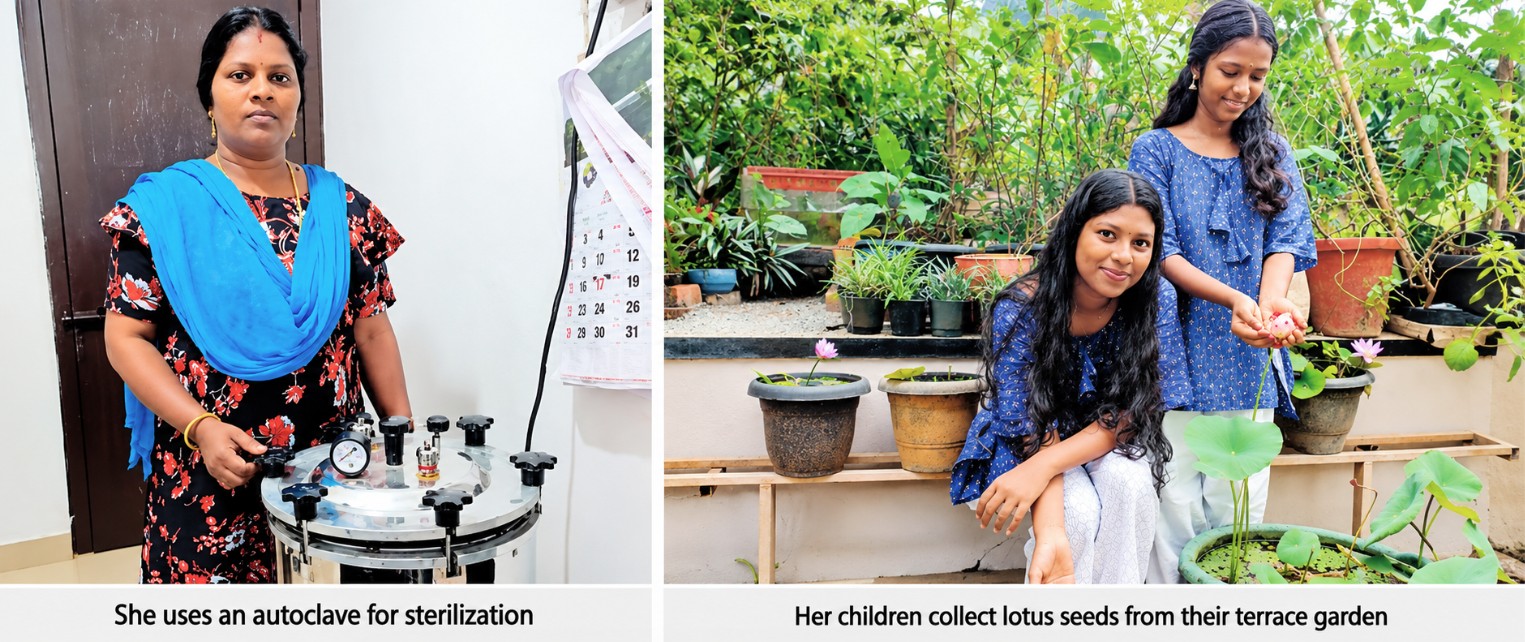
In addition to mushroom value-added products, there are also water lily and lotus plants. Her daughter and daughter-in-law help with all this. Daughter Prajitha and daughter-in-law Kavya are part of the family effort.
Different from the traditional farming method, hybrid varieties of water lilies and lotuses are arranged in the front yard. These, which bloom in 28-30 days, are in high demand. Saplings are given to those who need them.
So there is no tension about selling fresh mushrooms. Along with this, there is also a collection of small fish, quail, chicken, aloe vera, betel leaf, hibiscus, basil, marigold, and orchids. All of these are for sale. But the main income is from mushroom cultivation and value-added products.
Good support is received from the agriculture department and the panchayat. Besides, there is support from their children and brother. As the number of customers has increased, they are preparing to expand further.
🍄 Currently, 28-30 kg of oyster mushrooms are produced weekly.
🥫 About half of this is made into value-added products.
Various types of lotus and water lily plants that grow only in botanical gardens and such places are in their front yard. There are also varieties like ‘Prabhutva’ and ‘Milky Pond’.
The nursery and ornamental fish venture is run by their daughter Prajitha (a Plus Two student). In his youth, Mohandas used to make and supply plastic flowers for aquariums.
He learned about the nursery and ornamental fish farming with the help of YouTube and other resources. They also provide stones, soil, plants, and feed for aquariums. They also do aquarium cleaning and setting.
🐟 They have been in this field for a year. Mohandas pointed out that there has been a turnover of about 70,000 rupees.
📞 Contact: 7403337568, 9745167371