Home » Cocoa Wilting Diseases: How to Identify and Control VSD & Lasiodiplodia Dieback

Cocoa Wilting Diseases: How to Identify and Control VSD & Lasiodiplodia Dieback

by Sama Sadhik
6 minutes read

By: Dr. Lija James, Dr. J.S. Minikol, Dr. Najitha Ummer, Dr. A. Aswini, Dr. Dhanya Unnikrishnan
Scientists at the Cocoa Research Centre, Kerala Agricultural University | 📞 0487-2438451
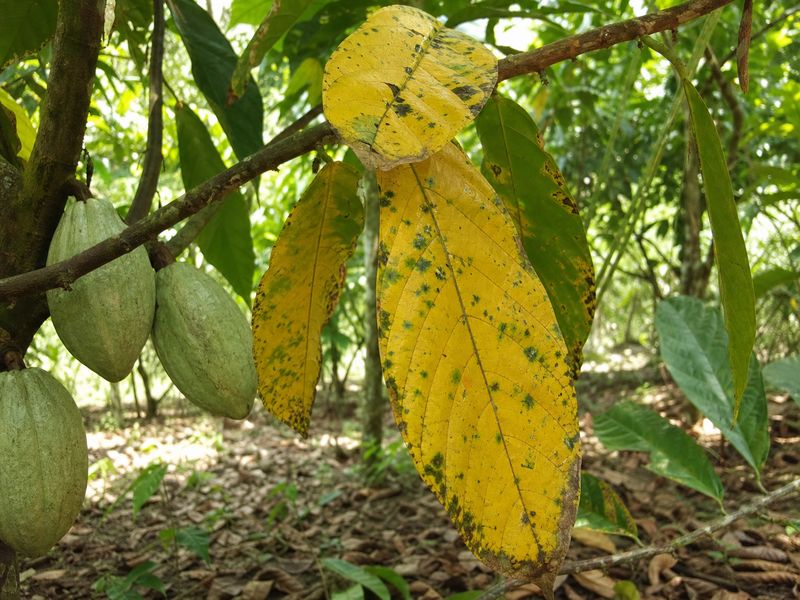
Discoloration and withering of cocoa tree leaves due to wilt disease

Constant care for cocoa trees is very important. This is one of the main cash crops. But, diseases in cocoa trees and low yields are a matter of concern. The climate and soil are also very different.

Two major wilt diseases — Vascular Streak Dieback (VSD) and Lasiodiplodia Dieback — pose serious threats to cocoa plantations. Early identification and timely management are key to protecting your crop.


🍄 Vascular Streak Dieback (VSD)

Causal Organism: Oncobasidium theobromae — a fungus that causes disease in cocoa trees. Spores are the primary source of infection.

🔍 Symptoms

  • ✅ Discoloration and withering of leaves and branches are the main symptoms.
  • ✅ Leaves fall off starting from the stem; swelling can be seen.
  • ✅ After leaf fall, new buds sprout but new leaves wither again.
  • ✅ Before withering, leaves turn yellow with green spots — a primary symptom.
  • ✅ Swelling of leaf veins (vascular tissue) is also observed.
  • ✅ When branches are split, a brown color is visible inside.
  • ✅ Tiny mushroom-like growths appear on affected branches.

Because the disease spreads internally through the vascular streak, it is called Vascular Streak Dieback.
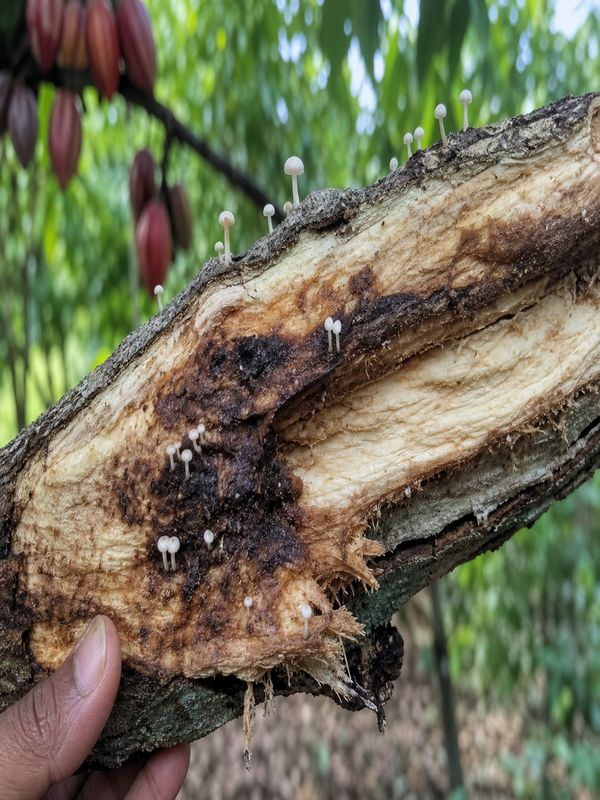
Brown discoloration inside cocoa branch caused by Vascular Streak Dieback fungus

⚠️ Changes in branches and side shoots — including brown internal coloration and mushroom-like growths — are key diagnostic signs of VSD and must not be ignored.

🛡️ Control Measures for VSD

  • 🌱 Cultivate disease-resistant varieties — available at the Cocoa Research Centre of the Kerala Agricultural University.
  • ✂️ When symptoms appear, prune the affected branch 30 cm below the infection and apply Bordeaux paste on the cut surface.
  • 💧 Spray 1% Bordeaux mixture for disease resistance.
  • 🧪 For disease control, apply any of the following fungicides:

Fungicide Trade Name Dosage
Hexaconazole Contaf 2 ml/liter
Propiconazole Tilt 1 ml/liter
Tebuconazole Folicur 1.5 ml/liter

🌿 Lasiodiplodia Dieback

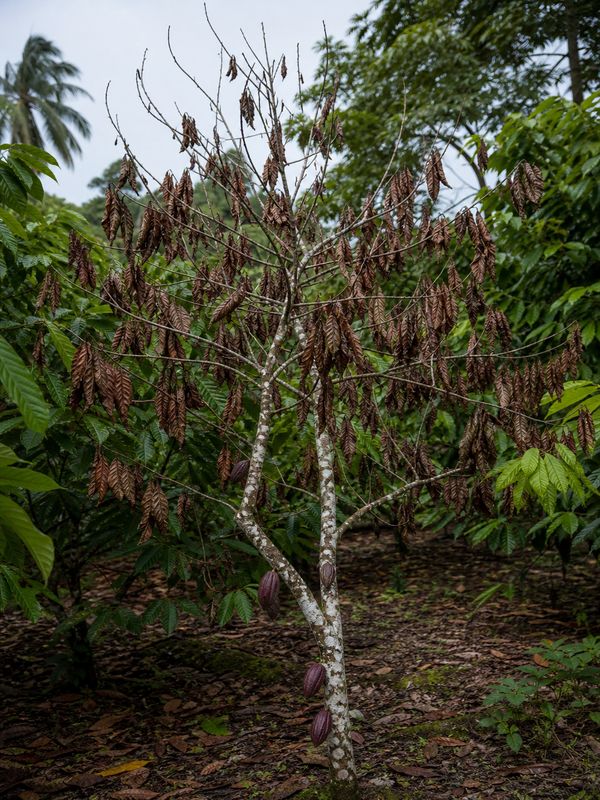
Cocoa tree drying up and dying due to Lasiodiplodia theobromae branch dieback infection

Causal Organism: Lasiodiplodia theobromae — a fungus and mainly a wound pathogen. It enters through cuts made during budding or through other wounds on the tree.

🔍 Symptoms

  • ✅ Drying of leaves and branches starting from the top — not caused by vascular streak.
  • ✅ Leaves wilt and the entire tree might die within 2 to 3 months.
  • ✅ Leaves turn dry but remain attached to the tree for a long time.
  • ✅ Can also cause pod rot.
  • ✅ This disease is more severe in older trees.

🛡️ Control Measures for Lasiodiplodia Dieback

  • 🔥 Cut and burn the affected branches to prevent the disease from spreading.
  • 🖌️ Apply Bordeaux paste on all cut surfaces.
  • 💧 Spray 1% Bordeaux mixture.
  • 🧪 Apply 0.25–0.3% Copper Oxychloride (2.5–3 g/liter).

The following can also be sprayed alternately for effective management:

Fungicide Concentration Dosage
Copper Oxychloride 0.2% 2 g/liter
Mancozeb 0.3% 3 g/liter

To control severe branch dieback, apply any of the following:

Fungicide Dosage
Carbendazim 12% + Mancozeb 63% WP (Mould) 2 g/liter
Carbendazim 0.1% (1 g/liter)
Tebuconazole (Contaf) 2 ml/liter

📌 Key Takeaways

🌱
Always plant disease-resistant cocoa varieties to reduce VSD risk.

✂️
Prune VSD-infected branches 30 cm below the infection point and seal cuts with Bordeaux paste.

🔥
Cut and burn Lasiodiplodia-affected branches to stop disease spread.

🧪
Use recommended fungicides such as Hexaconazole, Propiconazole, Tebuconazole, and Mancozeb at the correct dosage.


❓ FAQ

➕ What causes Vascular Streak Dieback (VSD) in cocoa trees?

VSD is caused by the fungus Oncobasidium theobromae. Spores are the primary source of infection. The disease spreads internally through vascular tissue, causing leaf discoloration, yellowing with green spots, branch swelling, and tiny mushroom-like growths on infected branches.

➕ How can I identify Lasiodiplodia Dieback in cocoa?

Key signs include drying of leaves and branches starting from the top, wilting, and dry leaves that remain attached to the tree. The entire tree can die within 2 to 3 months. It can also cause pod rot and is more severe in older trees. The cause is the wound pathogen Lasiodiplodia theobromae.

➕ How do I differentiate VSD from Lasiodiplodia Dieback?

In VSD, brown discoloration is visible inside split branches along with tiny mushroom-like growths, and yellowing with green spots occurs before leaf fall. In Lasiodiplodia Dieback, drying starts from the top without vascular streak involvement, and dry leaves remain attached. Lasiodiplodia is also linked to wounds from budding cuts.

➕ What fungicide is best for controlling cocoa dieback diseases?

For VSD, Hexaconazole (2 ml/liter), Propiconazole (1 ml/liter), or Tebuconazole (1.5 ml/liter) are recommended. For Lasiodiplodia Dieback, Copper Oxychloride, Mancozeb, or a combination of Carbendazim 12% + Mancozeb 63% WP at 2 g/liter are effective. Bordeaux mixture (1%) is also widely recommended for both.

➕ How should cut branches be treated to prevent disease spread in cocoa?

After pruning affected branches, always apply Bordeaux paste on all cut surfaces. This helps seal the wound and prevents re-entry of fungal pathogens. For VSD, prune at least 30 cm below the visible infection site. For Lasiodiplodia, cut and burn the removed branches to eliminate the source of infection.

➕ Are disease-resistant cocoa varieties available in Kerala?

Yes. Disease-resistant cocoa varieties are available at the Cocoa Research Centre of the Kerala Agricultural University. Cultivating these resistant varieties is one of the most effective long-term strategies for preventing Vascular Streak Dieback (VSD) and reducing overall crop losses due to fungal diseases.

➕ Why is Lasiodiplodia Dieback more severe in older cocoa trees?

Older cocoa trees are more susceptible because they tend to have more wounds from pruning, budding operations, and physical damage over time. Since Lasiodiplodia theobromae is a wound pathogen, it exploits these entry points more readily in older trees with reduced natural defence and healing capacity.


You may also like