Research source: Marwa Hassan Mayoof, Department of Horticulture and Landscape, Faculty of Agriculture and Marshes, University of Thi-Qar, Iraq. Published in International Journal of Advanced Biochemistry Research, 2026; 10(1): 55-58. DOI: https://www.doi.org/10.33545/26174693.2026.v10.i1a.6866
Sweet pepper (Capsicum annuum L.) is a valuable vegetable crop from the nightshade family, and this greenhouse study looked at a practical question many growers care about: can organic nutrient sprays and biofertilizer improve the nutrient status of pepper leaves?
The experiment compared three organic nutrient spray levels, 0, 2, and 4 g/L, with three biofertilizer levels, 0, 2, and 4 mL/L. The strongest results came from the highest rates. Organic nutrient spraying at 4 g/L gave leaf nitrogen of 2.643%, phosphorus of 0.5900%, and potassium of 2.0067%. Biofertilizer at 4 mL/L also significantly improved the same nutrients, giving nitrogen of 2.113%, phosphorus of 0.5133%, and potassium of 1.8478% compared with the control.
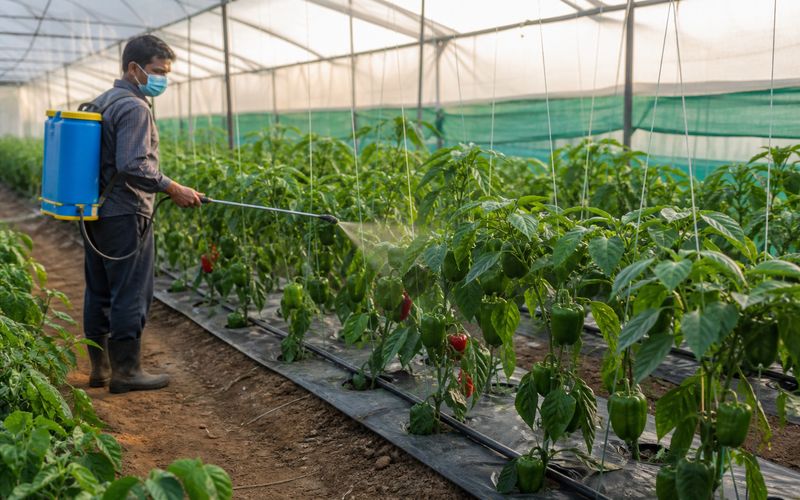
Sweet pepper is important because it is widely grown, highly consumed, and nutritionally rich. According to the article, every 100 grams of fresh pepper fruit contains about 1.2 g protein, 4.8 g carbohydrates, 2.6 g fiber, 0.8 g fat, 29 mg calcium, 2.6 mg iron, and 61 mg phosphorus. The fruit is also an important source of vitamin C, which supports bone formation, protein metabolism, appetite, and resistance to inflammation. It also contains vitamins B1, B2, and A, which are known antioxidants.
Sweet pepper grows best in a moderate climate that leans warm, with an optimal growth temperature of about 21-27 ºC. The study notes that peppers can grow successfully under unheated protected cultivation in some regions when early varieties are used.
The research also highlights a wider farming concern: pressure to increase vegetable production can lead to heavier chemical fertilizer and pesticide use, especially in short-season vegetable crops. This may increase health and environmental risks through nitrate, oxalate, and pesticide residues.
Crop:
Sweet pepper, Capsicum annuum L.
Location:
Protected plastic greenhouse in Dhi Qar Governorate, Iraq.
Soil:
Clayey loam soil sampled from 0-30 cm depth.
Organic nutrient spray:
0, 2, and 4 g/L.
Biofertilizer:
0, 2, and 4 mL/L.
Design:
Randomized Complete Block Design with three replications and 27 experimental units.
Seeds were sown in plastic trays with one seed per cell, then kept in a shaded area covered with green saran cloth. Seedlings received uniform agricultural care before being transplanted into the greenhouse field. The first nutrient and biofertilizer application was carried out six weeks after planting, and the second was applied 15 days later.
Five homogeneous plants were randomly selected from each experimental unit in all replications. The researchers focused on the percentage of nitrogen, phosphorus, and potassium in the leaves. A dry, ground leaf sample of 0.2 g was digested using sulfuric acid and perchloric acid before nutrient measurement.
Nitrogen
Estimated by the Micro Kjeldahl distillation method described by Page et al. (1982).
Phosphorus
Measured colorimetrically using the Ascorbic Acid method of Murphy and Riley (1962), with a UV-700 spectrophotometer at 700 nm.
Potassium
Estimated using a flame photometer and a standard curve prepared with potassium chloride.
Statistics
Data were analyzed with GenStat, and means were compared using LSD at the 0.05 significance level.
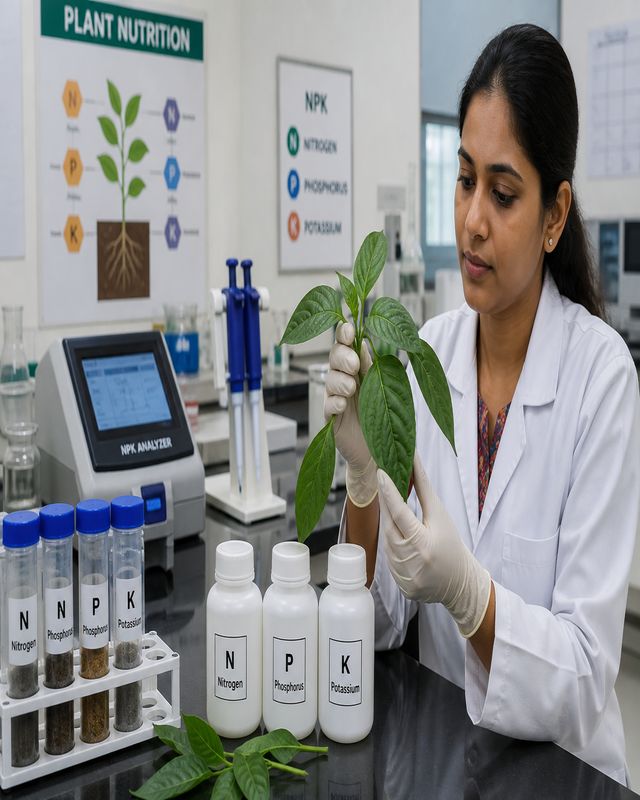
The study found that both the organic nutrient spray and the biofertilizer had a significant effect on leaf nutrient content. The most effective single rate of organic nutrient was 4 g/L, while the most effective single biofertilizer rate was 4 mL/L.
The best interaction was also clear. When 4 g/L organic nutrient was combined with 4 mL/L biofertilizer, the leaf nutrient levels reached the highest recorded values for the combined treatment: 2.910% nitrogen, 0.6833% phosphorus, and 2.7967% potassium.
In simple terms, the plants receiving both inputs at the highest tested levels showed much better nutrient concentration in their leaves than plants that received neither input.
The organic nutrient treatment at 4 g/L produced the highest average nitrogen percentage in leaves, reaching 2.643%. The control treatment had the lowest nitrogen percentage at 0.599%. Biofertilizer also had a significant effect: 4 mL/L gave the highest nitrogen percentage of 2.113%, compared with 1.263% in the control.
| Treatment focus | Highest value | Lowest or control value | Meaning for growers |
|---|---|---|---|
| Organic nutrient spray | 4 g/L gave 2.643% nitrogen | Control gave 0.599% nitrogen | Foliar organic feeding improved leaf nitrogen status. |
| Biofertilizer | 4 mL/L gave 2.113% nitrogen | Control gave 1.263% nitrogen | Biofertilizer supported better nitrogen availability and uptake. |
| Interaction | 4 g/L organic nutrient plus 4 mL/L biofertilizer gave 2.910% nitrogen | No organic nutrient plus no biofertilizer gave 0.213% nitrogen | The combined treatment was the strongest nitrogen response. |
The organic nutrient treatment at 4 g/L gave the highest phosphorus percentage in leaves at 0.5900%, while the control recorded the lowest value of 0.2900%. Biofertilizer at 4 mL/L also significantly increased phosphorus to 0.5133%, compared with 0.3700% in the control.
| Treatment focus | Highest value | Lowest or control value | Meaning for growers |
|---|---|---|---|
| Organic nutrient spray | 4 g/L gave 0.5900% phosphorus | Control gave 0.2900% phosphorus | Organic nutrient spraying improved phosphorus concentration in leaves. |
| Biofertilizer | 4 mL/L gave 0.5133% phosphorus | Control gave 0.3700% phosphorus | Biofertilizer likely helped phosphorus availability. |
| Interaction | 4 g/L organic nutrient plus 4 mL/L biofertilizer gave 0.6833% phosphorus | No organic nutrient plus no biofertilizer gave 0.2400% phosphorus | The combined treatment gave the best phosphorus response. |
The organic nutrient treatment at 4 g/L significantly outperformed the control and gave the highest average potassium percentage in leaves at 2.0067%. The control gave 1.4249%. Biofertilizer at 4 mL/L also recorded the highest potassium percentage at 1.8478%, compared with 1.5797% in the control.
| Treatment focus | Highest value | Lowest or control value | Meaning for growers |
|---|---|---|---|
| Organic nutrient spray | 4 g/L gave 2.0067% potassium | Control gave 1.4249% potassium | Organic nutrient spraying supported better potassium nutrition. |
| Biofertilizer | 4 mL/L gave 1.8478% potassium | Control gave 1.5797% potassium | Biofertilizer improved potassium availability and uptake. |
| Interaction | 4 g/L organic nutrient plus 4 mL/L biofertilizer gave 2.7967% potassium | No organic nutrient plus no biofertilizer gave 1.2657% potassium | The combined treatment produced the strongest potassium result. |
The article explains that organic nutrients can help provide essential elements such as N, P, and K and reduce visible deficiency symptoms. Organic materials may improve the availability of both macronutrients and micronutrients in leaves. Humic acid, according to Mikkelsen (2005), can affect carbon assimilation efficiency, increase cell membrane permeability, and enhance phosphorus absorption. Singer et al. (1998) also noted that humic acid can make nutrients more available and encourage uptake of potassium, phosphorus, and calcium.
Biofertilizer performance is linked to microorganisms that help plants access nutrients. These organisms can fix nitrogen and solubilize phosphorus and potassium. They may also secrete growth regulators, organic acids, and chelating compounds, which can increase nutrient availability around plant roots and improve absorption.
The practical message from this study is not that chemical fertilizers disappear overnight, but that organic nutrient spraying and biofertilizer can play a useful role in improving sweet pepper leaf nutrition and supporting cleaner production systems.
- ✅ Organic nutrient spray at 4 g/L significantly improved nitrogen, phosphorus, and potassium percentages in sweet pepper leaves.
- ✅ Biofertilizer at 4 mL/L also significantly increased N, P, and K compared with the control.
- ✅ The strongest combined treatment was 4 g/L organic nutrient plus 4 mL/L biofertilizer.
- ✅ The experiment used a reliable RCBD factorial design, three replications, GenStat analysis, and LSD testing at the 0.05 level.
- ✅ For growers, the results support using biological and organic inputs as part of a balanced sweet pepper nutrition plan.
The study cited works by Abu Rayan (2010), Al-Rawi and Khalaf Allah (2000), Al-Marjani (2011), Al-Naemi (1999), Hassan (2001), Zidan and Hamad (2016), Othman (2007), Asli and Neumann (2010), Mawgoud et al. (2010), Cresser and Parsons (1979), Denis (1979), Grubben and Mohamed (2004), Magdoff and Weil (2005), Mikkelsen (2005), Page et al. (1982), and Singer (1998). These references covered organic agriculture, agricultural experiment design, pepper production, organic fertilizers, humic substances, plant digestion methods, soil organic matter, and nutrient analysis.
What was the best organic nutrient spray rate for sweet pepper in this study?
The best organic nutrient spray rate tested was 4 g/L. It produced the highest average leaf nitrogen at 2.643%, phosphorus at 0.5900%, and potassium at 2.0067%. These values were significantly higher than the control treatment in the greenhouse experiment.
What biofertilizer rate gave the strongest result in sweet pepper leaves?
The strongest biofertilizer rate was 4 mL/L. It significantly increased leaf nitrogen to 2.113%, phosphorus to 0.5133%, and potassium to 1.8478% compared with the control. The response suggests that biofertilizer helped improve nutrient availability and plant uptake.
Did combining organic nutrient spray and biofertilizer work better?
Yes. The combination of 4 g/L organic nutrient spray and 4 mL/L biofertilizer produced the highest interaction values: 2.910% nitrogen, 0.6833% phosphorus, and 2.7967% potassium in leaves. This was better than applying neither input.
Why do biofertilizers improve pepper plant nutrition?
Biofertilizers contain beneficial microorganisms that can fix nitrogen and help solubilize phosphorus and potassium. They may also release organic acids, chelating compounds, and growth-regulating substances. These actions can make nutrients more available to plants and improve root absorption.
Is foliar organic nutrient spraying useful for pepper farming?
The study supports foliar organic nutrient spraying as a useful method for improving sweet pepper leaf nutrition. The article also notes that foliar feeding can meet a large portion of plant nutrient needs and may help reduce deficiency symptoms when used correctly.
Can this study help reduce chemical fertilizer use in peppers?
The results suggest that organic nutrient sprays and biofertilizers can support cleaner pepper production by improving NPK content in leaves. However, fertilizer decisions should still be based on soil testing, crop stage, local climate, and agronomist recommendations rather than replacing all fertilizers at once.